
A claim shared to social media purported to tell the tale of a heroic carrier pigeon named Cher Ami, a member of the U.S. Army Pigeon Service who served in World War I. According to the claim, the bird saved the lives of 194 soldiers by delivering a crucial message despite being severely injured.
The claim was shared in a post to Facebook (archived) in August 2024, along with a graphic describing the story in brief. One commenter replied, "Read the story, saved a lot of lives, and he was only a pigeon. Sorta gives me hope that we may evolve to this level." Another added, "I saw Cher Ami displayed in the Smithsonian Museum."
The claim has also circulated (archived) on TikTok (archived) for a number of years (archived), with users sharing their enthusiasm for the feel-good story of the heroic bird.

(AmazingFeed Facebook page)
A longer comment on the Facebook post — which describes Cher Ami as female though the Smithsonian Institution confirmed through DNA testing in 2021 that the bird was male — elaborated on the claim, saying:
Cher Ami was severely injured — shot, blinded in one eye, and lost a leg — but she still managed to deliver her message, which was crucial in saving nearly 200 soldiers of the "Lost Battalion" in the Argonne Forest. For her bravery, Cher Ami was awarded the French Croix de Guerre, and she became a symbol of heroism. Her preserved body is displayed at the Smithsonian Institution in Washington, D.C.
This story highlights the vital role carrier pigeons played in warfare, particularly before the widespread use of radio communication.
The claim is a simplification of the circumstances surrounding Cher Ami's famous flight, with some facets patriotically mythologized in its retellings over the years.
It is true that Cher Ami made a courageous mid-battle flight and suffered injuries that would ultimately lead to his death. But official reports suggest that the delivered message didn't definitively aid in the rescue of the survivors.
'The Lost Battalion'
First, some clarification around the term "Lost Battalion." Under the command of Maj. Charles W. Whittlesey, "the so-called 'Lost Battalion,' in the strict sense of the word, was not a battalion," according to a 1928 report compiled by the Historical Section of the Army War College, titled "The Operation of the So-called Lost Battalion,' Oct. 2nd to Oct. 8th, 1918."
The report continued, "The units usually known by this name were Companies A, B, C, E, G, and H of the 306th Infantry, Company K, 307th Infantry, and two platoons of Companies C and D 306th Machine Gun Battalion, all of the 77th Division. Their strength was that of about two battalions."
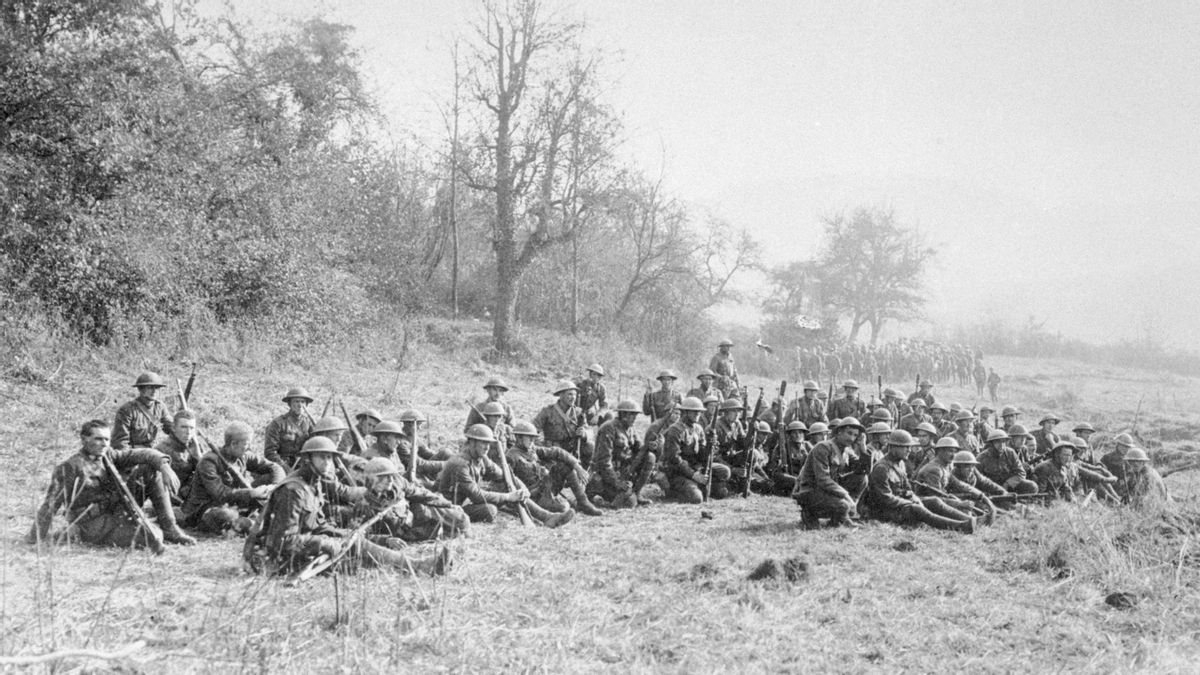
In early October 1918, during the Meuse-Argonne Offensive — which would come to be known as the deadliest campaign in U.S. history — the "Lost Battalion" became surrounded by the enemy.
According to an account of the operation published on the Army Reserve website:
The American First Army had kicked off its offensive in France's Meuse-Argonne region with a goal of reaching the city of Sedan and cutting the railroad, which supplied German armies in France.
The American offensive — the largest battle in American history — involved 1.2 million Soldiers and kicked off Sept. 26, 1918.
On Oct. 2, 1918, Whittlesey and his battalion were to attack north into the dense Argonne Forest with the 2nd Battalion of the 308th in support. Both units should have had about 800 men each at full strength, but now they barely had 800 men together.
The name "Lost Battalion," as they would come to be known in nationwide headlines of the time, was a misnomer in other ways. According to The Washington Post, "The troops' location was always known. They weren't 'lost' — they were neglected, first by their commanders and then by history."
Indeed, this is supported by the aforementioned 1928 report. One line in the report reads, "The troops under Major Whittlesey were never in any sense lost."
According to the report's account of Oct. 4, 1918, the day Cher Ami undertook his mission was filled with danger:
At 2:45 p.m., fire from friendly artillery from the southeast was put down on the slopes of hill 198. It crept up to the position, onto it, and clung there. The enemy trench mortars and his machine guns gleefully joined in. This fire lasted about one and half hours and wrought havoc in the position, causing about thirty casualties. During the confusion, some men wandered away and were captured by the enemy. Major Whittlesey released his last pigeon with a message asking that the American fire be stopped.
The "last pigeon"

(National Archives)
"We are along the road parallel 276.4. Our own artillery is dropping a barrage directly on us. For heaven's sake stop it."
However, the 1928 report about the events surrounding Cher Ami's flight concluded that the bird's arrival did not have an impact on friendly fire. The report read, "This message was received by the commander of the 154th Brigade, at 4:38 p.m., but the firing had already ceased."
Regardless, when Whittlesey's men were finally rescued — in legend, but not verified, attributed to Cher Ami's delivery of the coordinates — the scene was bleak. The 1928 report said:
There was no demonstration or cheering. The relieving companies turned over every scrap of food they had to the starving men, who devoured it ravenously. Immediate attention was given to the wounded and the exhausted men threw themselves on the ground to rest … Out of the 463 men and officers who were cut off by the enemy on October 3rd, 69 had been killed or were missing, and 156 wounded were evacuated. The total casualties were 225 or 48.6%.

(The Morning News)
One other key discrepancy stems from a later report by The Morning News (Wilmington, Delaware) on May 1, 1919, suggesting that Cher Ami's delivery of the Lost Battalion's coordinates resulted in the delivery of critical supplies. The newspaper wrote:
Cher Ami carried a message from the "Lost Battalion" in the Argonne, which enabled aviators to locate the men and drop them food and water and led to their rescue. When Cher Ami delivered the message, his left leg was gone just above the second joint and he bears a deep crease scar across his breast, made by a German bullet.
However, the 1928 report would later contradict this, saying those supplies never arrived because the enemy intercepted them.
From about noon until dark the planes of this squadron made a continuous succession of flights over the position, dropping food, medical supplies, ammunition, and pigeons. Although the pilots showed great courage and contempt for the enemy's fire, not one package fell within reach of Whittlesey's men. The enemy seized upon the packages of food and called out in English the articles which they contained.
Cher Ami Returns Home
In the months after the battle, Cher Ami returned to the United States with trainer Capt. John Carney, and many newspapers celebrated the pigeon's reported accomplishments. Cher Ami was given the

(The Chicago Tribune)
On April 17, 1919, The Chicago Tribune, reporting on Cher Ami's nomination for the Distinguished Service Cross by Gen. John J. Pershing, the commander of the American Expeditionary Forces (AEF) during WWI, quoted a sergeant as saying, "General Pershing, he came on inspection, and he asked to see this bird ... and he says to the captain: 'there isn't anything the United States can do too much for this bird.'"
Cher Ami ultimately died from his injuries, and his remains were donated to the Smithsonian, where they were stuffed by a taxidermist and remain in the collection to this day.
Whittlesey, the commander who sent the message attached to Cher Ami, died by suicide in 1921 when rumors of his perceived failures during the ordeal were said to "darken his last days." However, it is likely he was suffering from then-undiagnosed post-traumatic stress disorder. The 1928 report on the operation ultimately concluded:
... orders were carried out in every detail by Major Whittlesey … During this time Major Whittlesey's command, though suffering terribly from lack of food and medical attention, held its position against repeated attacks of the enemy; refused honorable terms of surrender; and, by its heroic conduct, upheld the finest traditions of American Arms.
Snopes has covered claims relating to the pigeon before, including the assertion that pigeons were domesticated and abandoned by humans, leaving them with no survival instincts, and that a photo authentically depicts a Nazi soldier wearing a cage of carrier pigeons on his back.