
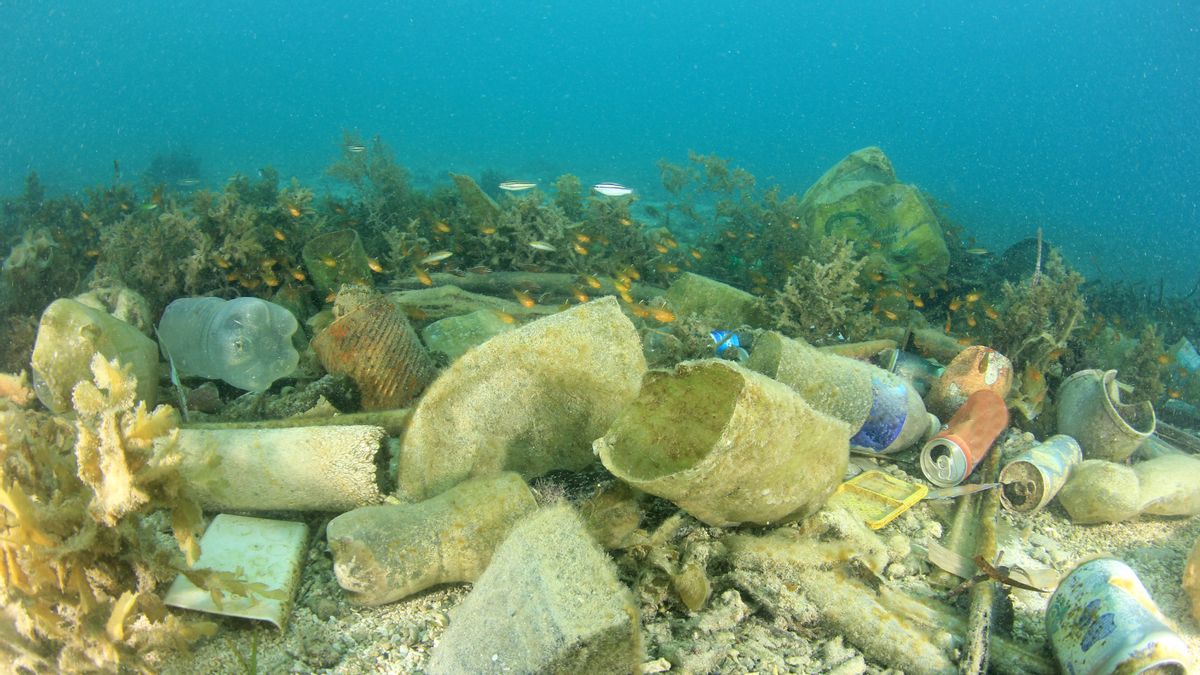
A persistent claim shared by high-profile sources such as the United Nations, (archived) (archived) World Wide Fund for Nature (WWF) and the International Atomic Energy Agency (IAEA) (archived) says that, by 2050, the world's oceans will contain more plastic than fish.
The claim came from a 2016 report titled, "The New Plastics Economy," by the Ellen MacArthur Foundation (EMF), a nonprofit organization that advocates for issues including eliminating waste and pollution. The foundation published a second version of the report in 2017.
The report claimed that by 2050 the oceans would contain 850 million tons of plastic versus 812 million tons of fish.
However, while the numbers cited in the EMF report were likely used in good faith, the authors of the studies used to make the claim in the report have since rowed back on their original findings.
According to background material from the EMF, the foundation extrapolated figures from a 2015 study into ocean plastics to arrive at the 850 million tons figure. The foundation used an estimate of fish stocks from a study from 2008 to arrive at the 812 tons figure.
The author of the plastics study, Jenna Jambeck, told the BBC in 2016 that she was not confident in the numbers in her study being projected forward the way the EMF had done so. Simon Jennings, the lead author of the 2008 fish study, conducted another study in 2015 that estimated fish biomass in the billions of tons rather than the millions used in the EMF report. Jennings' name did not feature in the 2017 edition of the EMF report.
Report's plastics figure came from extrapolation of 2008 estimates
In February 2016, the EMF released a document, titled, "Background to key statistics from the report" relating to "The New Plastics Economy: Rethinking the future of plastics." The stats document gave background to several figures from the 2016 report, including in a section, titled, "Plastics vs fish in the ocean explained."
According to the document, plastics numbers in the report were calculated from two sources: "Plastic waste inputs from land into the ocean," a peer-reviewed study by Jenna Jambeck published in 2008, and, "Stemming the Tide," a 2015 report by the Ocean Conservancy.
Jambeck's study created a model to estimate "mismanaged plastic waste" flow into the ocean from populations living within 50 km of a coast worldwide in 192 coastal countries. Using this model, Jambeck's study created three projections for plastic released into the ocean by 2025 (Figure 2).

(Jambeck, Jenna R., et al. "Plastic Waste Inputs from Land into the Ocean." Science, vol. 347, no. 6223, Feb. 2015, pp. 768–71. DOI.org (Crossref), https://doi.org/10.1126/science.1260352.)
The study's supplementary material provided additional details about the projections (Table S1). According to Table S1, in a scenario where 25% of mismanaged plastic waste ended up in the ocean, that would equal 8 million metric tons in 2010 and 9.1 million metric tons in 2015.

(Jambeck, Jenna R., et al. "Plastic Waste Inputs from Land into the Ocean." Science, vol. 347, no. 6223, Feb. 2015, pp. 768–71. DOI.org (Crossref), https://doi.org/10.1126/science.1260352.)
The EMF projected a range for the weight of plastic in the ocean by applying first
According to the stats backgrounder, the 5% was rounded down from estimates for plastic growth in Jambeck's report. The 3.5% was the expected global GDP growth rate, according to the International Energy Agency's World Energy Outlook 2015.
The EMF also used the Ocean Conservancy's "Stemming the Tide" report from 2015 to estimate ocean plastic numbers. That report said: "We estimate that the ocean may already contain upward of 150 million metric tons of plastic, based on global plastic production since 1950." This figure appeared three times in the 2017 EMF report to describe the current state of plastics in the ocean. "Stemming the Tide" did not project this figure forward to 2050.
However, the Ocean Conservancy removed "Stemming the Tide" from its website in 2022. In a statement explaining the removal, the organization said that its 150 million metric ton estimate also came from Jambeck's study.
Jambeck told the BBC in 2016 that she "would not feel confident projecting her work forward beyond 2025 to 2050." We have contacted Jambeck to ask if this is still the case and await her reply.
Further study found fish biomass could be billions of tons, rather than millions
Unlike the plastics number, the EMF report's fish estimate was not projected forward but rather based on figures from the 2015 Ocean Conservancy report and 2008 fish study unmodified.
The 2008 study, titled, "Global-scale predictions of community and ecosystem properties from simple ecological theory," by Jennings et al., looked at the amount of phytoplankton in the ocean on satellite images, using it to estimate the tonnage of fish. Phytoplankton is at the base of the food chain, so the amount of phytoplankton dictates the number of animals further up the chain.
Jennings' 2008 calculations found that there were 899 million tons of "fish biomass" in the ocean. However, another study by Jennings in 2015 that also based its fish biomass estimates on the amount of phytoplankton in the ocean found estimates of fish biomass to be in the billions, rather than the millions.
The EMF credited the lower number of 812 million tons to the "Stemming the Tide" report
Regardless of numbers, ocean plastics and protecting fish remain front-line issues
So, what do we know about fish and plastics in the ocean? At the time of this writing, the research EMF used to make its claim was more than 10 years old.
Since then, numerous studies have estimated ocean plastic and fish stocks.
Research from 2023 found a dramatically lower weight of plastic in the world's oceans, at 1.1–4.9 million tons, compared to the EMF's estimate of 850 million tons in 2050.
The research, "A growing plastic smog, now estimated to be over 170 trillion plastic particles afloat in the world's oceans—Urgent solutions required," used data on floating plastics from 11,777 ocean stations worldwide from 1979 to 2019 to reach its estimate.
By comparison, Jambeck's model from 2008 predicted around 100 million tons of plastic in the ocean by 2020 in its middle scenario.
Meanwhile, a study from 2024 found that fish stocks had been overestimated in the past, based on data from fisheries around the world. The study did not give an estimate for current fish stocks.
In conclusion, deciding whether there is more plastic or fish in the sea isn't as simple as the EMF report made it seem. That, however, doesn't blunt ongoing initiatives both to preserve fish stocks and prevent harmful plastics from reaching the sea.