
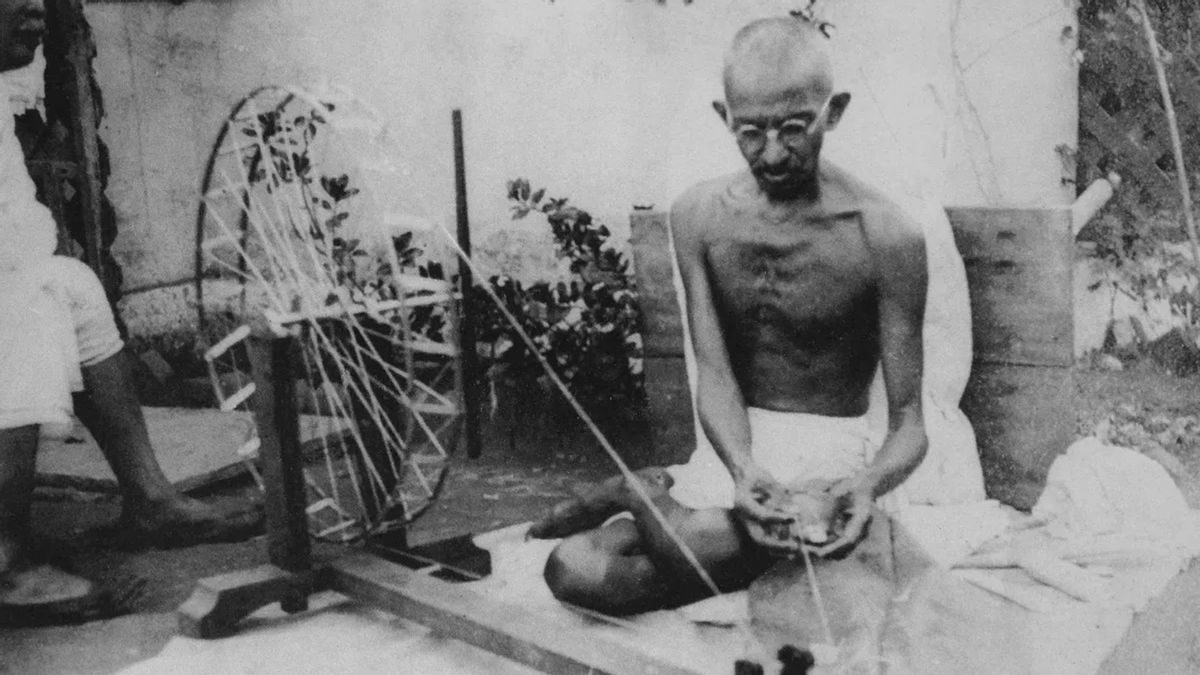
For several years, a quote allegedly from Mahatma Gandhi spread widely across the internet in which he purportedly shared his views on humans' misuse of Earth's resources. Gandhi allegedly said, "Earth provides enough to satisfy every man's need, but not every man's greed."
A number of organizations have shared the quote over several years. In April 2024, the United Nations official X account shared the quote on Earth Day. That same day, the Indian Ministry of Statistics and Programme Implementation Facebook account shared the quote.
We have been unable to find evidence of Gandhi using the exact quote, although he has often spoken about humans' exploitation of Earth in other words. We also reached out to historians and experts on Gandhi and will update this story if we get more information.
We searched through roughly a hundred volumes of "The Collected Works of Mahatma Gandhi" as stored on the official website of the Bharatiya Janata Party (BJP), the current ruling political party in India. We looked for examples of how Gandhi spoke about "Earth" and whether he used it with a similar meaning to the above quote.
In a 1903 article in the Indian Opinion, a newspaper Gandhi established in South Africa, he criticized the British leadership for calling for a day of prayer and thanksgiving, saying they had turned Earth into their colony. The quote appears in Volume 3 of the collection:
"The Earth is the Lord's", says the Bible. The Colonists have revised the text and say, "The Earth is ours". The appointment, therefore, of a day of humiliation is a mere hollow pretension, so long as God's commands are trampled under foot. And yet, we are free to confess that the proclamation is not a deliberate mockery of the Godhead.
In Volume 12 of the collection, in an essay titled, "General Knowledge About Health: Our Body," he wrote about the importance of a clean Earth in order to maintain one's health:
If we remember this clue [to the mystery of the Universe] we shall certainly see that clean earth, pure water, fresh air and open space and bright sunshine are essential for the preservation of the body, and that we need not fear any of these elements. In fact, illness follows when the body becomes comparatively deficient even in one of these.
However, in the following quotations we found in numerous volumes from his collected works, Gandhi also wrote about "man's" ego, pride and greed and connected it to the destruction of Earth (emphasis, ours):
The earth, though we ever trample her under our feet, is all forgiveness, and that is why we call her mother and sing to her every morning as we wake up. (Vol. 33)
In my opinion we sinned against God and man when we did not take care to keep mother earth and our river water clean. We have poetry enough in ourselves to call earth "mother earth" and deify all rivers of India. What a sacrilege it is to dirty "mother earth" in the manner we are doing and to make the waters of all rivers, which we deify, filthy! (Vol. 40)
Bowing to the earth, we learn to be humble as the earth which supports the beings that tread upon it. Earth therefore is rightly the consort of the Preserver. (Vol. 50)
Nature's creatures do not worry or fret about tomorrow but simply wait on tomorrow for the daily sustenance. Only man in his overweening pride and egotism imagines himself to be the lord and master of the earth and goes on piling up for himself goods that perish. Nature tries every day by its rude shocks to wean him from his pride but he refuses to shed it. Satyagraha [nonviolent resistance] is a specific for bringing home to one the lesson of humility. (Vol. 52)
The Earth bears our burden but does not hurt us; she bears the burden uncomplainingly. According to modern discoveries, she is hanging in space without support. If she were to get angry with us and stray ever so slightly from her path, we would instantly perish. For crores of years, however, the Earth has been rotating in her orbit and has sustained our life. This is the utmost limit of humility. We have sprung from this earth and to that shall we return. After knowing this, what pride can we feel? We are but a particle of dust and should remain so. (Vol. 53)
"All land belongs to God" has a deeper meaning. Like the earth we, of it, also belong to God, and hence we must all feel like one and not erect boundary walls and issue prohibition decrees against one another. (Vol. 70)
He who restrains himself physically and sins with his thoughts will fare worse than he who, without professing to observe brahmacharya [the path of Brahman or Truth], lives the life of a restrained householder. For he who lusts with the thought will ever remain unsated and will end his life a moral wreck and burden on the earth. Such a one can never be a full satyagrahi. Nor can one who hankers after wealth and fame. (Vol. 79)
Just contemplate the rot that has set in in beloved India and you will rejoice to think that there is [a] humble son of hers who is strong enough and possibly pure enough to take the happy step. If he is neither, he is a burden on earth. The sooner he disappears and clears the Indian atmosphere of the burden, the better for him and all concerned. (Vol. 98)
The Gandhi Book Centre in Mumbai, which has a number of resources about the leader on their website, responded to our questions via email. They directed us to other quotes from Gandhi that highlighted the same sentiment, but did not use the exact words. Per the collection "Speeches and Writings of Mahatma Gandhi" Gandhi stated:
It is not enough not to steal what is commonly considered as other men's property. It is theft if we use articles which we do not really need. Nature provides from day to day just enough and no more for our daily needs.
In the book "Trusteeship" Gandhi also wrote (emphasis, ours):
I suggest that we are thieves in a way. If I take anything that I do not need for my own immediate use and keep it I thieve it from somebody else. I venture to suggest that it is the fundamental law of Nature, without exception, that Nature produces enough for our wants from day to day, and if only everybody took enough for himself and nothing more, there would be no pauperism in this world, there would be no more dying of starvation in this world. But so long as we have got this inequality, so long we are thieving.
It is clear from the highlighted quotes that Gandhi contemplated the role of humans as a burden on the world, whose greed often took over, and Earth (or "Nature") as a generous, selfless and humble entity. That same idea is conveyed succinctly in the viral post above, but Gandhi did not use those exact words based on the available evidence.