
When the Christmas music begins in earnest in late November, it's easy for it to go in one ear and out the other.
After all, we've heard these songs hundreds, if not thousands, of times over the course of our lives and will continue to hear them in perpetuity. We're so intimately familiar with the melodies, we often don't consider the origin or historical evolution of a particular tune from the time before recording artists released what are now considered definitive versions.
But some social media users have suggested a noticeable difference in one popular song in particular — "The Twelve Days of Christmas."
A Facebook post (archived) from December 2023, which resurfaced at the onset of the 2025 holiday season, suggested that one of the lyrics, "On the fourth day of Christmas, my true love gave to me, four calling birds," actually started out as, "four colly birds."
Snopes previously dug into a claim that "The Twelve Days of Christmas" was originally created as a coded reference to important articles of the Christian faith, which we found to be false.
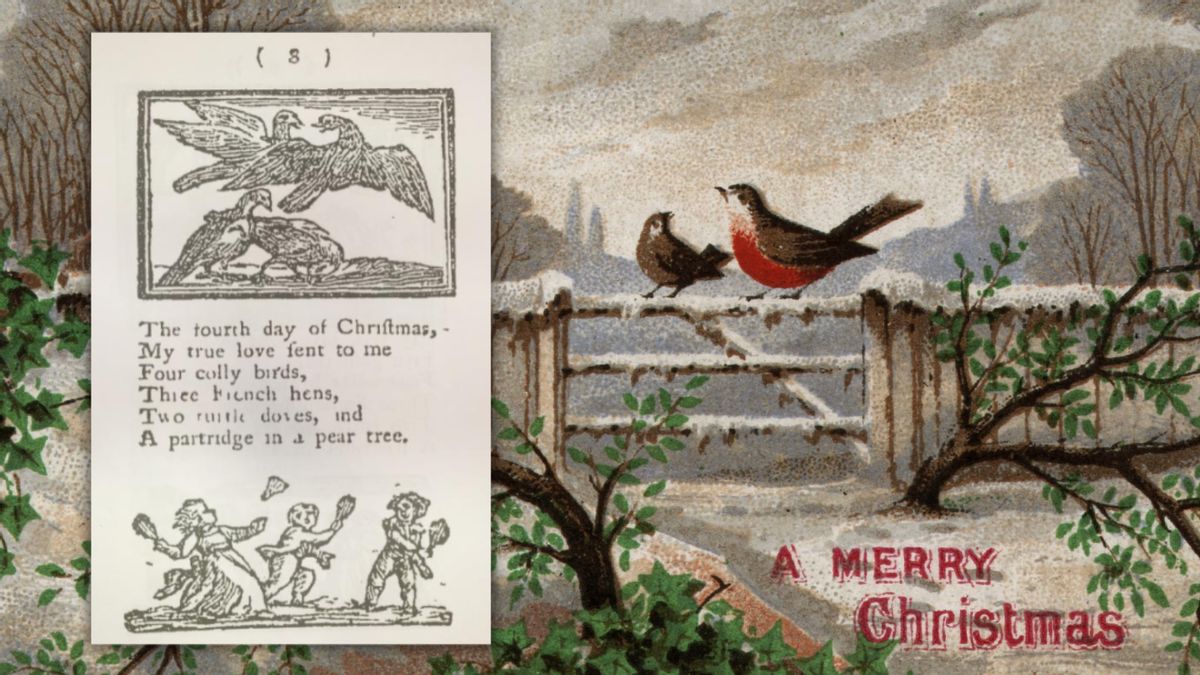
However, the assertion that the lyrics about four "calling birds" began as "colly birds," sometimes spelled "collie" or "colley," was true.
The available evidence suggested the lyrics were written as "four colly birds" in some older published versions of the Christmas staple.
"Mirth Without Mischief," a children's book

("Journal of the Folk-Song Society, Vol. 5, Issue 20" )

("The Cliftonian, Vol. 1, Issue 1")
According to Merriam-Webster, "colly" was a "chiefly British" dialect with origins in Old English that meant "to blacken with or as if with soot."
In William Shakespeare's "A Midsummer Night's Dream," a play written in the late 16th century, the character Lysander recites (emphasis ours):
Or, if there were a sympathy in choice,
War, death, or sickness did lay siege to it,
Making it momentary as a sound,
Swift as a shadow, short as any dream,
Brief as the lightning in the collied night;
That, in a spleen, unfolds both heaven and Earth,
And ere a man hath power to say "Behold!"
The jaws of darkness do devour it up.
So quick bright things come to confusion.
The context from Shakespeare also showed "colly" to mean black in color. Therefore, "colly birds" is likely a reference to blackbirds in the parlance of the time.
It was in the 1909 version of the song, arranged by composer Frederic Austin — the version we are most familiar with today — that "calling birds"
The reason for the change was unknown, but one likely possibility is that the evolution was an instance of a mondegreen, which Merriam-Webster defined as "a word or phrase that results from a mishearing especially of something recited or sung," that later became accepted as the true lyrics.
In sum, as the tradition of singing the song spread in the days before audio and video recordings, so too did altered versions of its lyrics until they became so pervasive that they became "official" in published texts.
"Colly birds" was not the only lyrical evolution within "The Twelve Days of Christmas." A summary on
Check out Snopes' previous reporting for further reading on the complete origin of "The Twelve Days of Christmas."