
Fact Check

Beware AI-generated audio claiming Qatari leader said he regrets inviting Trump to Middle East

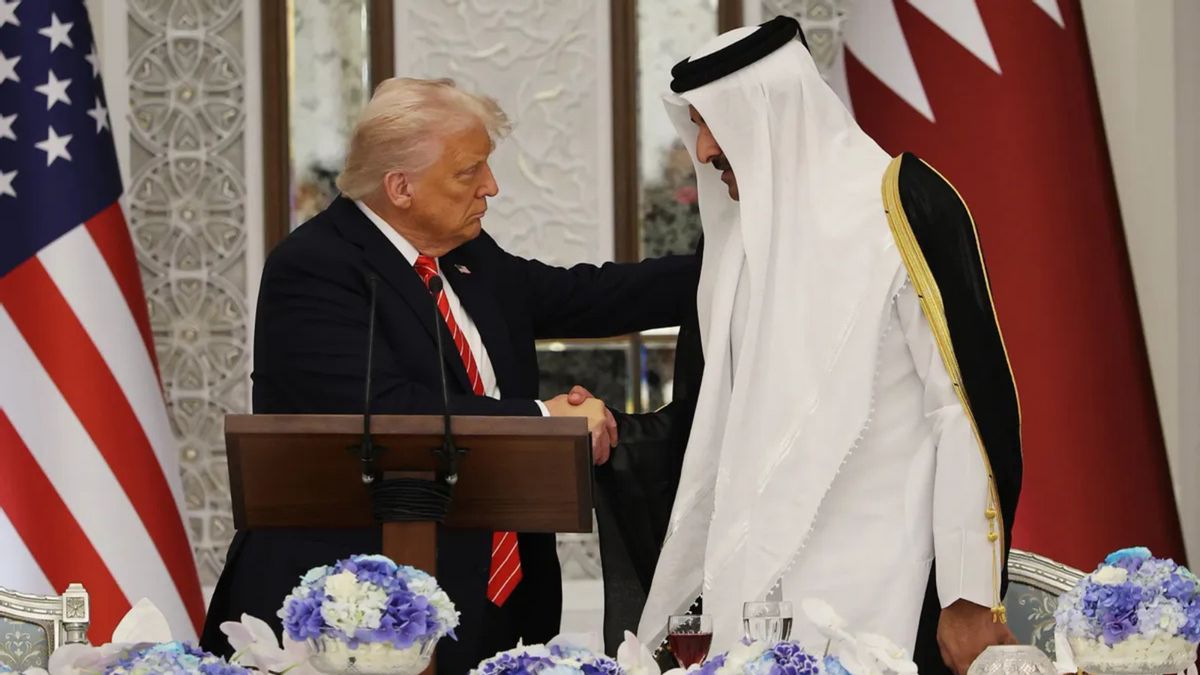
Qatar's emir, Sheikh Tamim bin Hamad Al Thani, met with U.S. President Donald Trump in May 2025.

by Rae Deng, Published May 19, 2025


A white man wearing a dark suit stands at a podium. His arm rests on the back of a veiled man standing to his right, who he is looking at.

Image courtesy of Getty Images


Claim:
A video authentically shows the emir of Qatar, Sheikh Tamim bin Hamad Al Thani, saying he regrets inviting U.S. President Donald Trump to the Middle East.
Rating:
Fake

About this rating


Shortly after U.S. President Donald Trump's visit to Qatar in May 2025, a rumor circulated online that the country's ruling emir said he regretted inviting the American commander-in-chief "to the Middle East." 

"He didn't come to discuss cooperation, he came to collect tributes," Qatar's leader, Sheikh Tamim bin Hamad Al Thani, allegedly said, per the clip. "Fountains, palaces, golden welcoming ceremonies, light shows, private flights. In his eyes, these grand gestures are not courtesies, but spoils of war." 

The video spread across social media platforms, including X, Facebook, Threads, Substack and TikTok.

Snopes readers also wrote in to ask whether a Qatari or Saudi official said he regretted inviting Trump to visit; the president went to Qatar, Saudi Arabia and the United Arab Emirates during his trip across the Middle East. 

This clip's audio appears to be generated by artificial intelligence, according to several tools that detect AI usage. Furthermore, the video of the sheikh is either AI-generated or an edited version of a 2017 interview with CBS' "60 Minutes." Thus, we rate this claim fake.

An AI detector available through "DeepFake-O-Meter," a project developed by the University of Buffalo Forensic Laboratory, rated the likelihood the audio was AI-generated as 100%. Another tool — "Deepfake Total," developed by the Fraunhofer Institute for Applied and Integrated Security — gave the audio clip a 75.6% chance of being AI-generated. 

Several eagle-eyed internet users noted that the clip appeared to match a 2017 interview with CBS' "60 Minutes," as seen in this YouTube video of the exchange from news outlet Al Jazeera, suggesting the clip is not AI-generated but outdated. However, when shown side-by-side, it's clear whoever made the clip either edited the CBS interview using video editing software or generated a clip through AI using the "60 Minutes" video as source material. See, for example, the smoothing of Al Thani's face in the faked clip (left) and the differing structure of his face in the legitimate interview (right) for comparison: 

Two very similar images of a man in white traditional Qatari clothing. On the left his face is slightly narrower and smoothed out, compared to the right, where his face has more texture and is rounder.

(Substack user NEW YORK MINUTE and Al Jazeera English/CBS 60 Minutes)

In the "60 Minutes" interview, the emir discusses a 2017 trip during Trump's first term, but nothing he says in the clip posted by Al Jazeera or the transcript published by CBS aligns with the AI-generated audio from May 2025. Thus, the video accompanying the AI-generated voice purporting to be the Qatari leader is either AI-generated or unrelated to Trump's 2025 visit. 

The clip and its claims seemed to originate with a TikTok video from user @tian128560m, per the username included in the videos circulating. That user no longer has the clip in question available on their profile, but several of their videos appear to also be misinformation, including one which falsely claims Barron Trump, son of U.S. President Donald Trump, dropped out of New York University, despite numerous reports that he finished his first year at NYU in May. We have reached out to the TikTok user and will update this story if we receive more information.

Snopes has previously fact-checked many claims about Qatar and its leaders; see our collection of fact-checks on the country here.


By Rae Deng

Grace "Rae" Deng specializes in government/politics and is based in Tacoma, Wash.


Source code