
During Academy Awards season in mid-March 2026, a longstanding rumor about Hollywood directors using a pseudonym in the credits of films they wanted to distance themselves from made the rounds online.
Users on social media platforms such as Instagram (archived) shared the rumor and stated, "For over 30 years, Hollywood directors used the fake name 'Alan Smithee' to disown films they had no control over."
The post further alleged "Alan Smithee" — also written "Allen Smithee" — was primarily used by directors who felt their vision had been compromised by studio or producer interference.
The claim that Hollywood directors once used the pseudonym Allen Smithee on films they didn't want their names attached to is true.
The 2001 book "Directed by Allen Smithee," edited by Jeremy Braddock and Stephen Hock, described the practice: "'Allen Smithee' (often 'misspelled' 'Alan Smithee') became the pseudonym set aside by the Directors Guild of America for those directors who feel — and, more importantly, can prove to the Guild's satisfaction — that their films have been taken out of their control."
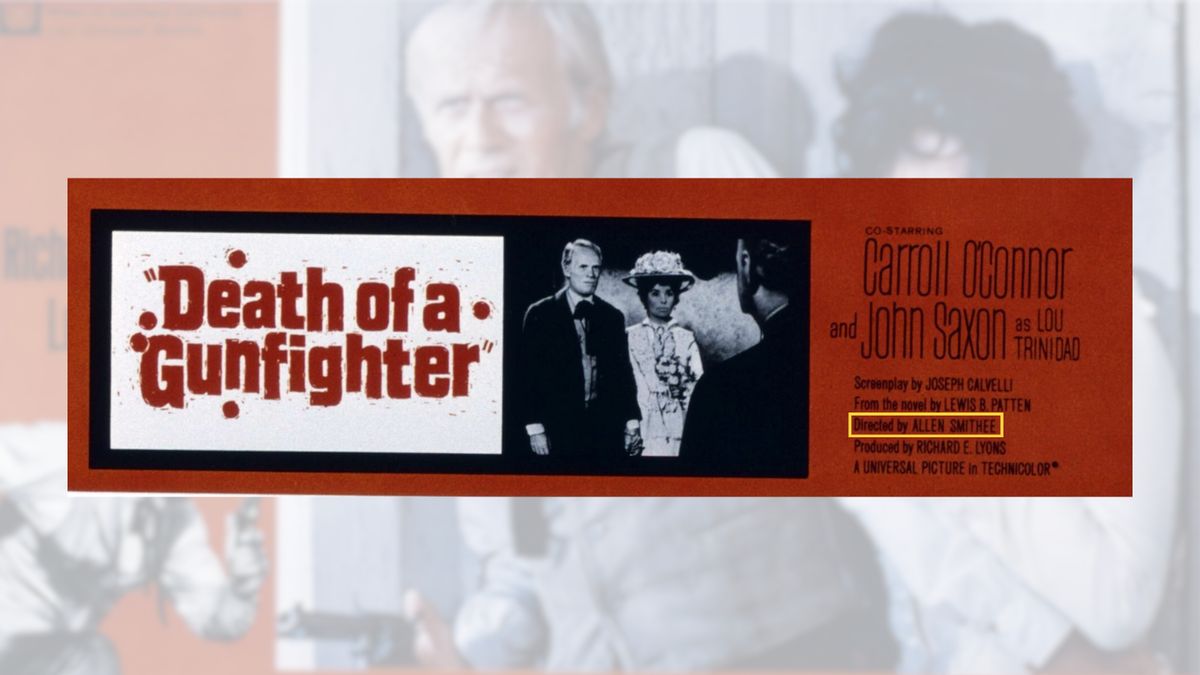
A representative for the Directors Guild of America confirmed to Snopes that the first use of the Smithee pseudonym occurred in 1969 with the film "Death of a Gunfighter." Robert Totten originally directed the Western but was replaced midproduction by Don Siegel at the insistence of the film's star, Richard Widmark.
Siegel wrote in his autobiography:
When I refused to take directing credit for the film, as did Bob Totten, the Directors' Guild made up a pseudonym for Totten and myself: "Allen Smithee." As the picture was well received, I told all my young friends who wanted to become directors to change their name to Smithee and take credit for the direction of the picture.

(Getty Images)
Though the Smithee pseudonym would eventually become synonymous with troubled productions and poorly received films, its original usage was, ironically, the opposite.
Famed film critic Roger Ebert called "Death of a Gunfighter" an "extraordinary Western" and wrote, "Director Allen Smithee, a name I'm not familiar with, allows his story to unfold naturally." Ebert's website later added an editor's note that read, in part, "It was not until years after this review was written that 'Allen Smithee' became publicly known as a pseudonym used by directors who wanted their name removed from a film's credits."
The DGA did not directly confirm to Snopes when the pseudonym ceased to be used. However, its usage in productions that fall within the oversight of the DGA has been minimal since 2000. A piece published in the Los Angeles Times on Jan. 15, 2000, cited the release of a 1998 film satirizing Hollywood's use of the pseudonym, "An Alan Smithee Film: Burn Hollywood Burn," as the nail in Smithee's coffin.
The article read, in part:
Ever since Disney released the film, in 1998, Smithee's reputation has suffered, with movie studios worrying that crediting him is tantamount to labeling a movie damaged goods. But this week came the first hard evidence that Smithee's days are numbered.
MGM's "Supernova," which opened Friday, was directed by Walter Hill, who subsequently petitioned the DGA to have his name removed. Normally, this would be Smithee's moment to shine. Instead, Hill, the production company and the DGA agreed to a different pseudonym: Thomas Lee. And that raised the question: Where was Smithee?
The answer, according to one DGA board member: Smithee has taken sick and is unlikely to recover.
Some famous film disasters credited to Smithee include 1994's "The Birds II: Land's End" and 1996's "Hellraiser IV: Bloodline."
The pseudonym was also used for alternate versions of films that otherwise did not feature it, such as the edited-for-TV versions of David Lynch's "Dune," Michael Mann's "Heat" and "The Insider," as well as versions of Martin Brest's "Scent of a Woman" and "Meet Joe Black" edited for in-flight viewing on commercial airlines.