
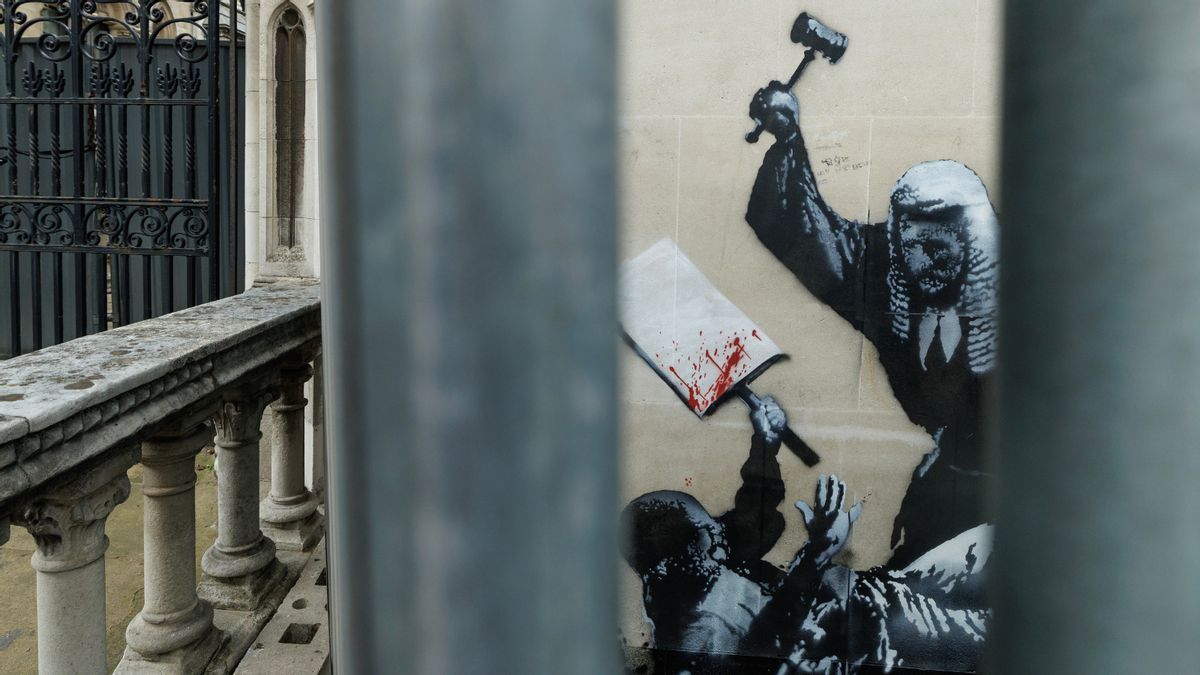
In September 2025, a claim (archived) circulated online that British authorities removed a mural by the street artist Banksy shortly after it appeared.
The mural,
Two days later, on Sept. 10, the Good Law Project, a
The group wrote, "BREAKING: They're scrubbing @banksy The court is erasing Banksy's mural just like it's erasing our right to protest."
The claim also circulated on Facebook, Threads (archived) and Instagram (archived). One version of the claim, which appeared on Reddit (archived), said authorities removed Banksy's mural after just one day.
According to an emailed
A spokesperson said, "The Royal Courts of Justice is a listed building and HMCTS are obliged to maintain its original character." The Press Association, a trusted newswire service in the U.K., posted images of the removal on Sept. 10, the same date as the Good Law Project's video.
Therefore, we rate this claim true — although the mural stood for more than one day, contrary to one version of the claim. It was unclear at the time of this writing exactly when Banksy painted the work, but British media first reported on it on Sept. 8, the same day as Banksy's Instagram post.
The Royal Courts of Justice are Grade I listed buildings, according to Historic England. According to British law, no alterations may be made to the courts without written permission from the local planning authority or the secretary of state.
Before the mural's removal, Press Association images showed the artwork covered by temporary walls and security guards standing by.
A spokesperson for the Metropolitan Police, regarding Banksy's mural, said officers "received a report of criminal damage to the side of the Royal Courts of Justice" on Sept. 8, 2025.
Banksy's work has often been political in nature. Though the artist had not, as of this writing, made a public statement about the message behind his work at the Royal Courts of Justice, the mural appeared shortly after the Metropolitan Police arrested 857 people under the U.K.'s Terrorism Act during a protest supporting Palestine Action on Sept. 6.
The U.K. government proscribed Palestine Action, a pro-Palestinian action network, as a terrorist group in July 2025.
The Metropolitan Police carried out the 857 arrests under Section 13 of the Terrorism Act, which made it a criminal offense to "wear clothing or carry or display articles in public" that caused "reasonable suspicion" that a person was a member or supporter of a proscribed terrorist group.