
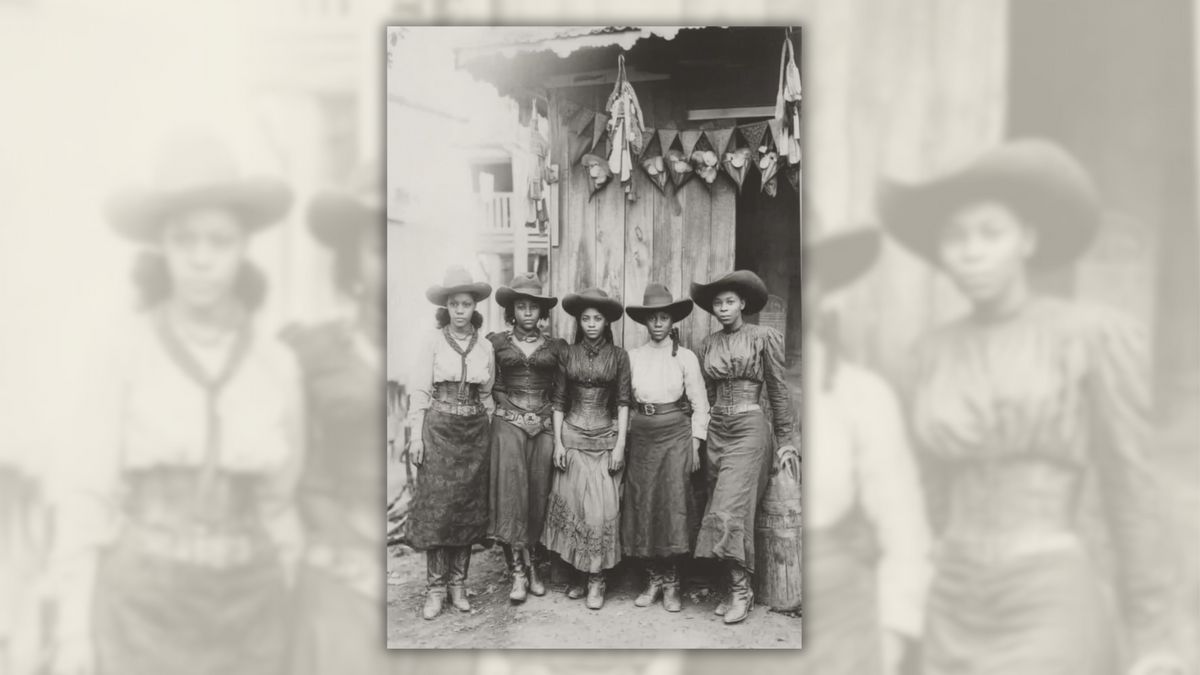
In summer 2025, an apparently vintage image supposedly showing five Black cowgirls in the Wild West circulated online.
Posts of the image appeared on Facebook, Instagram, X and Threads. While some commenters said the picture appeared to be generated by artificial intelligence, others seemed to believe it legitimately showed Black cowgirls in a bygone era.
In this case, the skeptics were right: Someone generated this image using artificial intelligence (AI). It did not legitimately show Black cowgirls from the American West in the 19th century. Thus, we've rated this image as fake.
The picture appeared to originate from a July 20 post by Facebook user Cepéda Brunson, who appears to largely post artificially generated content. We reached out to the Facebook user in charge of the account to confirm that they generated the image and await a response.
Hive Moderation, an artificial intelligence detection tool, determined that the image had an 86.3% likelihood of containing AI-generated or deepfake content. While these tools are not foolproof, other red flags include the fact that the clothes the fake women wore in the image did not look accurate to the period.
While the people in the picture did not exist, real Black cowgirls did exist in the Old West. Historians have found more records of Black cowboys than cowgirls; in fact, one in four cowboys was African American, according to a National Park Service article on the subject. However, historical documents like property deeds prove "a small number of Black and Latina women owned and managed their own ranches," according to the National Park Service. Many of these women were formerly enslaved.
Examples of notable Black cowgirls include Henrietta Williams Foster or "Aunt Rittie," a legend in her Texas cowhand community who worked alongside men while riding her horse without a saddle, Johanna "Chona" July, a member of the Black Seminole community and a skilled horse breaker, and Jane Warren, the first Black woman in her county to register her own cattle brand.
One of the women most often cited as a significant Black cowgirl, Mary Fields, was not a rancher, but she worked for the U.S. Postal Service on the American frontier and earned the moniker "Stagecoach Mary" due to her use of the horse-drawn vehicle to deliver mail amid harsh conditions.

Horse breaker Johanna July in 1937 (left) and mail carrier Mary Fields in an undated photo (right). (Library of Congress/National Postal Museum)
This was not the first dubious historical image we've investigated. For example, we previously looked into whether an image of a masked man was an authentic 1890s photo that inspired the character design for Batman.