
Snopes readers ask us to check claims of all types. Sometimes, those claims are serious topics with global implications. Other times, they are wholesome social media posts about animals. This claim is the latter.
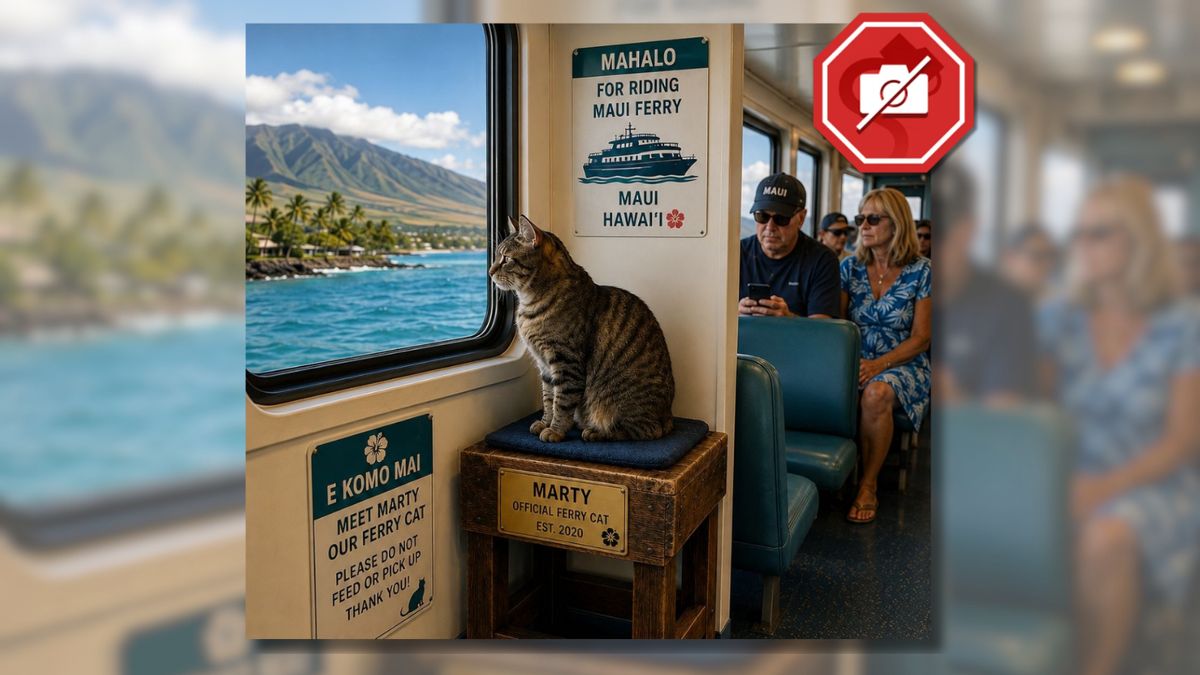
In June 2026, readers searched the Snopes website looking for information about images posted to Facebook claiming that the crew of a ferry had built a special seat for a cat named Marty, who was a regular "commuter" on the ship every day for about four years.
After investigating, we regret to inform readers that the image is fake. It was generated using artificial intelligence tools.
We first uploaded the image into Google Lens to perform a reverse image search. Next, we used search engines such as DuckDuckGo, Google and Yahoo to search for information on Marty the cat. The cute story would likely have been irresistible to local media outlets if it were real. Those searches revealed only social media posts spreading the rumor.
More telling, we found posts claiming that Marty had been riding ferries in Maui, Hawaii; Galveston, Texas; Savannah, Georgia; Mobile, Alabama; Mackinac Island, Michigan; Boston; and Apache Junction, Arizona. (That last one was particularly egregious: There is no river in Apache Junction.)
The pattern of nearly identical claims was a massive indication the story was fictional and the image was fake.
Snopes has debunked similar trends before. For example, we recently investigated a similar pattern of AI-generated images claiming to show water towers across the U.S. reading "You can't drink data." In that case, many of the images were shared to Facebook pages filled with AI-generated content titled "Life in [State]" or "[State] Life."
Some of the pages that shared the water tower claim, such as Massachusetts Life, also posted about Marty the cat. Other pages sharing the claim about Marty the cat used slightly different naming conventions, such as "[State] History" or "I Grew Up in [State]."
The strategy at play here is pretty common: People post a variety of AI slop in an attempt to make money from advertising revenue or from the social media platforms. The more posts, the better, and introducing slight differences between them allows the poster to target specific demographics of people.
The original source of the claim about Marty the cat was unknown. The rest of our conclusion came from visual signs and AI detection software.
For example, there were discrepancies in the landscape that appeared out the window: the focus was off in the Maui image, and the skylines of Galveston and Savannah were inaccurate in the Texas and Georgia images.
Additionally, while the text of the posts suggested Marty had been a daily commuter on the ferry for "nearly four years," the sign on his supposed stool read "Est. 2020" (in the Galveston image, it read "Est. 2021"). Four years ago would have been 2022.
We chose one image, the Maui image, and uploaded it into software that screens visual media for signs of AI, such as Sightengine and Hive Moderation. According to those tools, there was a 99% chance the image was generated using AI software.
Let us note here: These types of AI detection tools are fallible, and sometimes suggest that AI-generated images are real. Snopes cautions people against using them for definitive answers on media's authenticity without supporting evidence.
We also checked that image for SynthIDs, invisible watermarks hidden in AI-generated images, through Google Gemini and OpenAI. OpenAI detected a SynthID, confirming that the Maui image was generated using OpenAI tools. These tools are also fallible, for the opposite reason — in some cases they may find SynthIDs in real images that have been passed through but not altered by AI tools.