
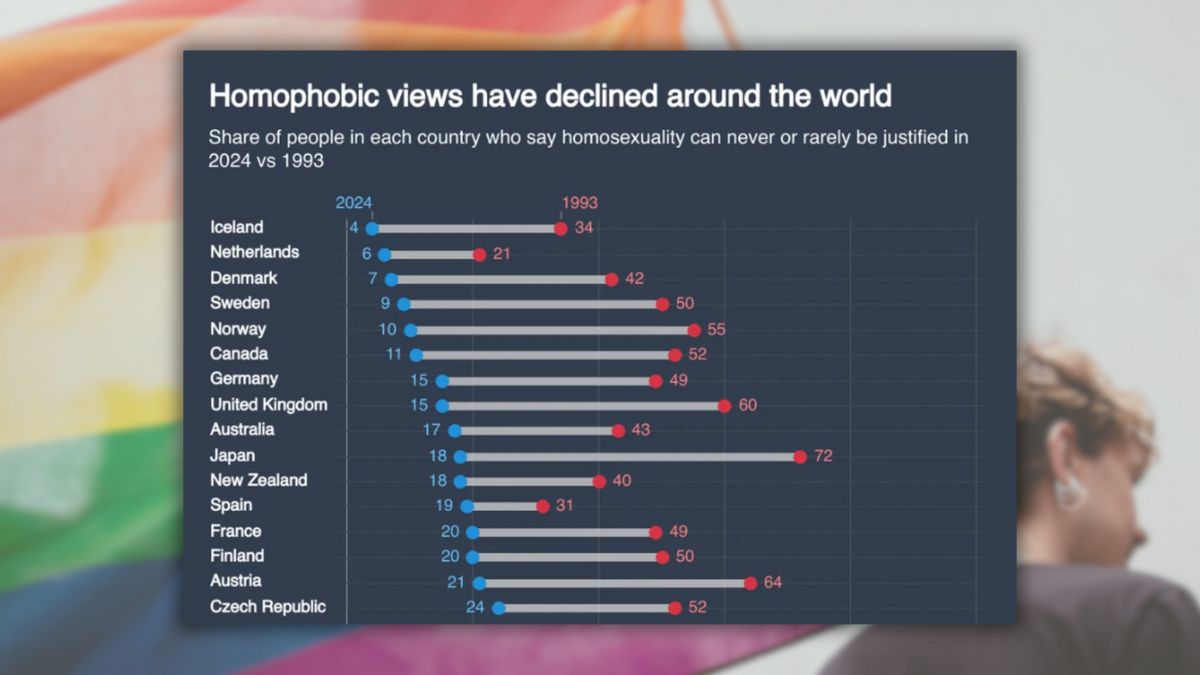
In August 2025, a chart purporting to show homophobic views declining across the world spread online.
Screenshots of the chart spread on Reddit and Facebook. Text at the top of the image read:
Homophobic views have declined around the world Share of people in each country who say homosexuality can never or rarely be justified in 2024 vs 1993.
This data was based on authentic research from the Integrated Values Surveys, which combines two large-scale survey research programs known as the European Values Survey and the World Values Survey. However, as of this writing,
It is also worth noting that the Integrated Values Surveys asked a variety of questions to gauge the acceptance of homosexuality, such as whether a respondent would not like to have a homosexual neighbor. The chart in question did not include all the surveys' data about views on homosexuality but only showed the result of answers to one question, which asked whether homosexuality "can never or rarely be justified."
Since the chart accurately reflected the data but omitted some context, we've rated this claim as mostly true.
The chart first appeared on the r/DataIsBeautiful subreddit on Aug. 11, 2025, and the Reddit user who posted it, _crazyboyhere_, included a credit line noting that the user made the visualization using DataWrapper, a data visualization tool. In a private message, the user also noted that the specific language from the survey question appeared in the description but that the user added the "homophobic views" language believing it was "easier for people to understand."
According to text at the bottom left corner of the chart, the source for the data itself was Our World in Data, a collaborative project between University of Oxford researchers and the nonprofit organization Global Change Data Lab.
As of this writing, the World Values Survey's president, Christian Haerpfer, was an associate professor of political science at the University of Vienna, and a sociology professor at Tilburg University in the Netherlands, Ruud Luijkx, headed the European Values Survey.
Here's the Our World in Data visualization tool using Integrated Values Surveys data from 1993 to 2022, filtered to show only the countries in the chart examined here.
As evidenced above,
The chart from the claim examples also omitted some context about when the data was collected. The years in the Our World in Data tool represented "the latest year of each Integrated Values Surveys wave, which is not necessarily the year of the survey." For example, the 2022 wave included surveys conducted between 2017 and 2022.
In other words, the data from the image that purportedly showed attitudes toward homosexuality in 2024 came from survey data between the years 2017 and 2022, not 2024.
Furthermore, when data for a certain country was not available, the Our World in Data tool — the source for the chart from the claim — simply swapped in the closest available data point. For example, the graph from the claim said that in New Zealand, 18% said homosexuality was never or rarely justified in 1993. At first glance, that matched the Our World in Data graph — but a closer inspection revealed that data for "1993" in New Zealand actually came from the 1995-1998 survey wave.

A screenshot of the additional information for New Zealand when hovering over the country in the "Our World in Data" tool that visualizes changing attitudes on homosexuality. (Our World in Data)
Finally, the image from the rumor did not show all of the countries with available data. A graph with that data is available below; based on the additional information, the number of respondents who said homosexuality was never or rarely justified appeared to decline from 1993 to 2022, but some countries omitted from the original claim did see an increase in homophobia. For example, in Croatia, 63.7% of respondents said homosexuality was never or rarely justified during the 2022 survey wave, representing an increase from 55% during the 1998 wave.
This wasn't the first time Snopes has investigated a claim about data. For example, we previously looked into a rumor that a poll showed U.S. President Donald Trump's approval rating rose to 54% after an August 2025 summit with Russian President Vladimir Putin.