
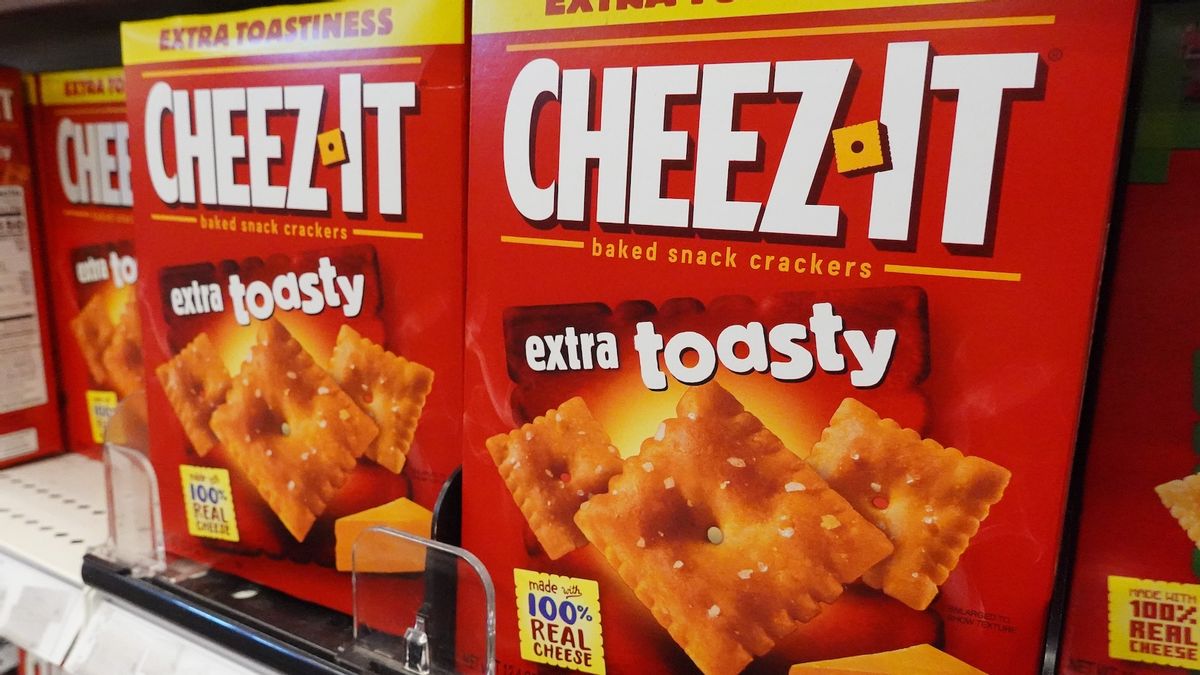
There are people in this world who believe the makers of the snack product pictured below stealthily changed its name at some point from "Cheez-Its" or "Cheez-Itz" to "Cheez-It."
According to an August 2024 post on X and other social media posts, however, its name has always been Cheez-It, singular:

(@timecaptales / X)
If you don't know where you stand on The Great Cheez-It/Cheez-Its/Cheez-Itz Debate — or indeed weren't even aware that there was such a debate — you're about to learn.
Rumors of an unpublicized name change have percolated for years on social media, mainly in the form of memes and posts like the following:
At issue is the true and original name of the popular, cheese-flavored cracker. One glance at the packaging confirms that the product is currently called Cheez-It.

Courtesy of the Kellogg's Company
But despite the evidence before their eyes, some people swear they grew up devouring boxes of a product labeled Cheez-Itz or Cheez-Its. When did they change the name to Cheez-It, they ask? Why didn't they tell us?
Or, is there something deeper, more metaphysical, at play?
A phenomenon called the "Mandela Effect" is often evoked as a possible explanation for such a disparity. As some (including Snopes) define it, the Mandela Effect is a collective misremembering of a fact or event that produces a feeling of disorientation or cognitive dissonance. Others speculate these differences between what is real and what we remember as real are instances of "slippage" between parallel universes.
Commonly cited examples of the Mandela Effect (so named because it originated in a discussion about public confusion surrounding the date of Nelson Mandela's death) include the conviction that Ed McMahon was a spokesperson for the Publishers Clearinghouse Sweepstakes (he wasn't), and that the comedian Sinbad played a genie in the 1990s film "Shazaam" (he didn't).
But memory is fallible, and we needn't conjure up parallel universes or "glitches in the Matrix" to explain how these things happen. Psychologists use the term "confabulation" to refer to the creation of false memories.
"These false memories may consist of exaggerations of actual events, inserting memories of one event into another time or place, recalling an older memory but believing it took place more recently, filling in gaps in memory, or the creation of a new memory of an event that never occurred," explains a guide for mental health professionals.
Factually speaking, it's easy to disprove that the name on Cheez-It boxes was ever anything other than "Cheez-It," singular. The Cheez-It website notes that the product first hit store shelves in 1921, bearing this logo:

Courtesy of the Kellogg's Company
And here, for good measure, is a newspaper advertisement dating from 1930. Note the name:

Snopes style note: It's perfectly acceptable to refer to the crackers themselves, in plural, as "Cheez-Its," as in: "Watch me eat this massive handful of Cheez-Its at one go."