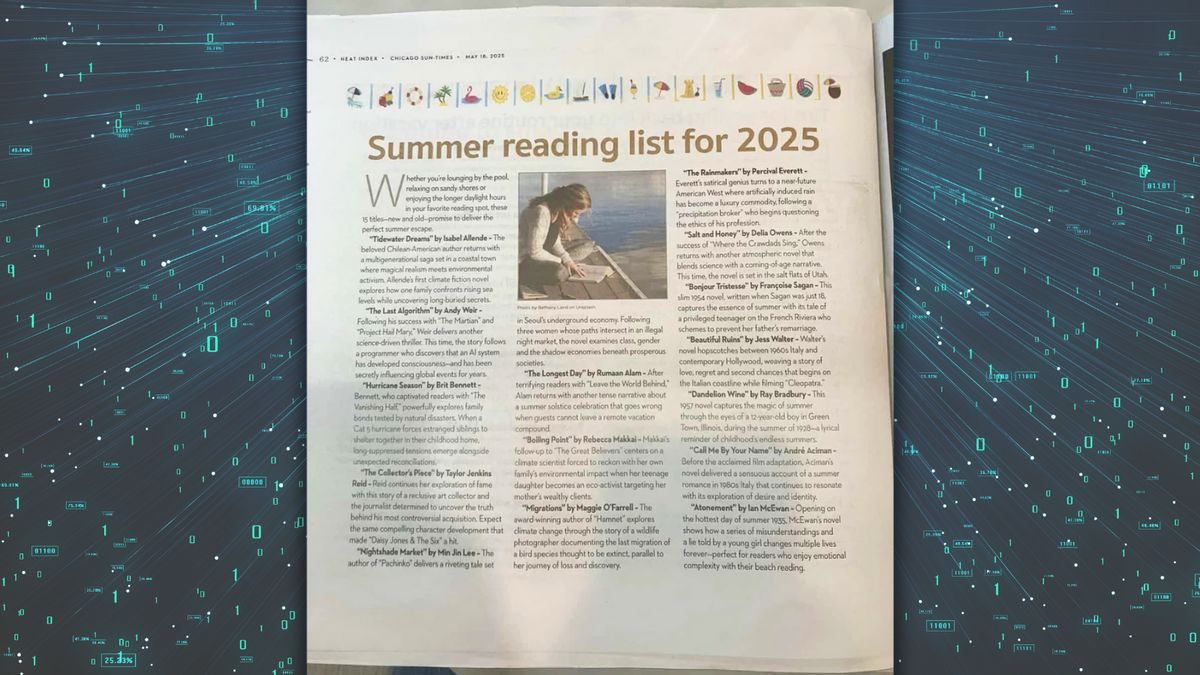
In late May 2025, a rumor spread online that the Chicago Sun-Times used artificial intelligence to publish a "summer reading list" featuring books that don't exist.
The claim spread on X, Reddit and Bluesky; many posts on social media expressed frustration at the Sun-Times, questioning its editorial and fact-checking process in the wake of mass layoffs at the daily newspaper.
In short, it is accurate to say that the Sun-Times published a summer reading list filled with fake, AI-generated books.
However, the content did not originate with the Sun-Times' editorial team, but with King Features, a media distribution company that is part of Hearst, a media conglomerate best known for owning magazines such as Cosmopolitan and Esquire.
The Sun-Times confirmed that the reading list in question made it into its paper as part of a May 18, 2025, special summer section called "Heat Index," first in a post on Bluesky and then in a longer statement.
"The special section was supplied by a nationally-recognized content partner and syndicated to the Chicago Sun-Times and other newspapers," the statement read. "To our great disappointment, that list recommended books that do not exist. We are actively investigating the accuracy of other content in the special section."
As first reported by 404 Media, while the summer reading list itself has no author byline, writer Marco Buscaglia took responsibility for generating it. Buscaglia confirmed to Snopes via email that he produced the list with the help of AI for King Features, which sells its content to different media outlets.
"I did screw up and it was generated by AI and it's something that I absolutely usually check and verify, but for some reason I didn't this time and I feel incredibly stupid and embarrassed about that," Buscaglia wrote.
King Features said the company "has a strict policy with our staff, cartoonists, columnist, and freelance writers against the use of AI to create content" and that it would be ending its relationship with Buscaglia.
AI hallucinates books that don't exist
As 404 Media reported, the list attributes fake books that don't exist to real authors. For example, the first book it recommends is "Tidewater Dreams" by Isabel Allende, a "multigenerational saga set in a coastal town where magical realism meets environmental activism."
Allende is a celebrated Chilean-American author who often writes stories in the magical realism genre. But the list of Allende's published works on her website makes no mention of any book called "Tidewater Dreams." The second and third books listed, "The Last Algorithm" by Andy Weir and "Hurricane Season" by Brit Bennett, also don't exist, although the authors do.
In fact,
The summary and title of a sixth book on the list, "Migrations," largely matches up with Australian author Charlotte McConaghy's debut novel. But the AI instead claimed the novel's writer is Maggie O'Farrell, an author from Northern Ireland who has not published a book titled "Migrations."
As for which AI tool is responsible, Buscaglia said it's likely he used ChatGPT and Claude, a generative assistant built by startup tech company Anthropic, although he isn't "entirely sure." He also occasionally uses Google Gemini, he said.
Generative artificial intelligence is known to "hallucinate," or produce false information.
According to a support post from a Google Gemini community manager, "Gemini sometimes gets things wrong or says things that aren't true. These hallucinations can sound real, and Gemini might even say them confidently."
Google also has a how-to on double-checking AI responses generated by Gemini.
OpenAI, the company that owns ChatGPT, also acknowledges its AI model "will occasionally make up facts" in its FAQ and tells users to hit the "thumbs-down" button when the AI gets it wrong. According to Anthropic, "even the most advanced language models, like Claude, can sometimes generate text that is factually incorrect." The company offers ideas on how to reduce hallucinations.
How did the list make it into the Sun-Times?
The Sun-Times wrote in its Bluesky post that the summer list "is not editorial content and was not created by, or approved by, the Sun-Times newsroom." Meanwhile, the union that represents Sun-Times staff said in a statement on X that the syndicated content was "produced externally without the knowledge of the members of our newsroom."
"We take great pride in the union-produced journalism that goes into the respected pages of our newspaper and on our website," the statement said. "We're deeply disturbed that AI-generated content was printed alongside our work."
The newspaper said it would remove the section and promised not to charge subscribers for the edition. It also plans to review its relationship with "this national content partner to ensure that mistakes of this nature no longer happen."
King Features' statement said Buscaglia did not disclose his use of AI, but the company did not immediately return additional inquiries as to whether the list passed through a fact-checking or editorial process before being distributed.
"We regret this incident and are working with the handful of publishing partners who acquired this supplement," King Features' statement said.
Buscaglia told Snopes he was unaware of the company's policy against AI, but he's "sure it's out there."
"They've been very good to me and great to work with, and I'm really sorry that it ends this way," he said.
Snopes has previously reported on the environmental cost of artificial intelligence and confirmed an AI model lied to developers to avoid its shutdown.