
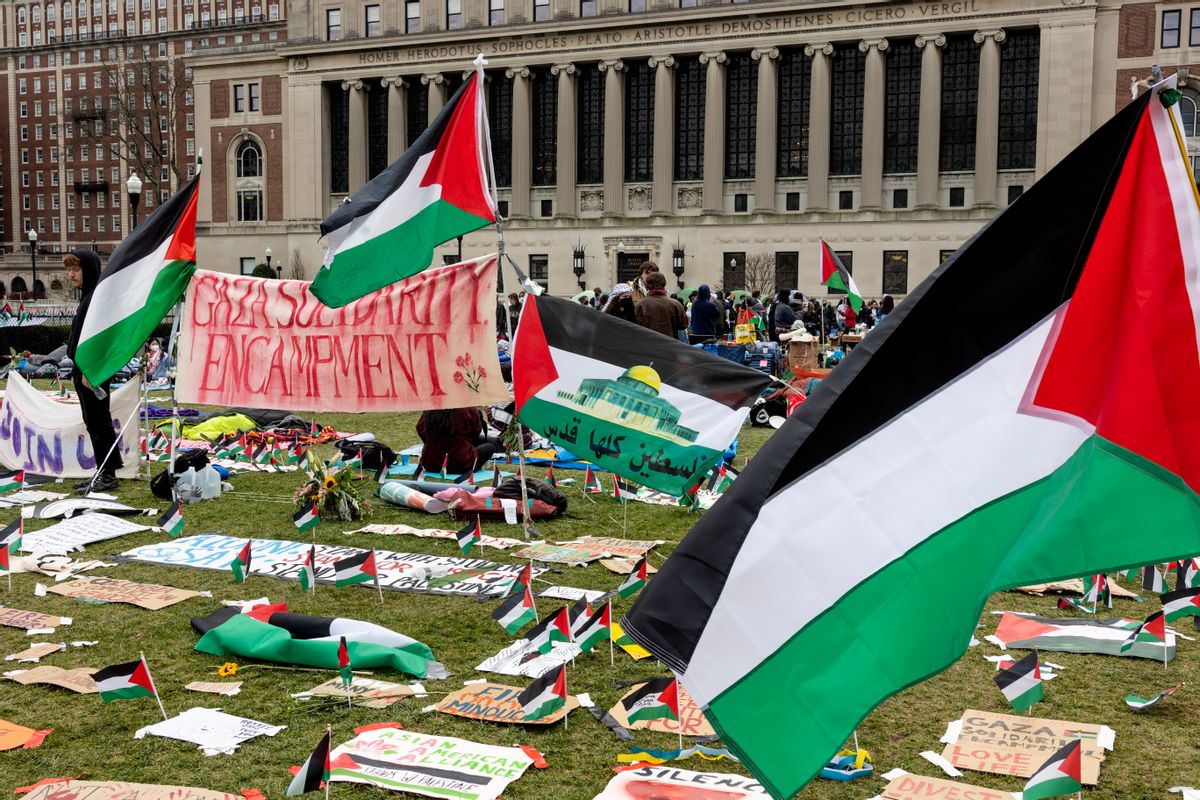
In March 2025, immigration agents arrested Palestinian activist Mahmoud Khalil, who helped lead pro-Palestine demonstrations on Columbia University's campus in New York City. This action came as part of U.S. President Donald Trump's promise to crack down on pro-Palestine student activists who have protested Israel's war in Gaza since spring 2024. Barnard College at Columbia University also faced widespread criticism for expelling pro-Palestine student activists in early 2025.
However, this is not the first time Columbia University has taken disciplinary action against student protesters. Many people online pointed out how the university expelled a student for leading anti-Nazi demonstrations in the 1930s. A number of posts highlighted an article from 1936 in which Columbia students demanded the reinstatement of a student protester.

(Bluesky user DaveAnthony)
The above article is real. In 1936, Columbia University expelled Robert Burke, a student who led anti-Nazi demonstrations on campus that year. His appeal to be reinstated was denied. We found numerous articles and pamphlets from that time detailing his expulsion. As such, we rate this claim as true.
Burke led protests in May 1936, including an anti-Nazi picket and a mock book burning. The protests were a response to the university accepting an invitation to participate in Heidelberg University's anniversary celebrations in Nazi-led Germany.
Burke was chosen as the president of the Columbia University class of 1938, and he was a member of the American Student Union. Per The New York Times, the university expelled Burke in June 1936 after he led protests that May. In September 1936, he spoke to a rally of 500 people after the dean announced he would not reconsider his decision to expel the student.
A June 1936 report in the Communist newspaper The Daily Worker also quoted a letter from the college dean announcing the decision to expel Burke: "After very careful consideration and consultation concerning your situation, I have finally come to the conclusion that it would be in the best interests of all concerned if you did not register in Columbia College next fall."
A student letter to The Columbia Spectator in September 1936 criticized the administration's claim that Burke acted in a "disgraceful" manner and that the discipline was due to his individual conduct. The letter contended:
It has been attested by sworn witnesses that Burke used no obscene language, that he sought to maintain an orderly picket line and meeting. Burke himself has apologized three times for any disorder that may have occurred. Such an apology has been accepted from others who were at the demonstration as given in good faith.
Further, the administration has contended that the case is one of individual conduct, and has refused to recognize the American Student Union as the rightful representative of all who took part in the anti-Nazi protest. Yet, it is attested and proven that Burke as well as all other students who took part in the meeting did so as a member of the American Student Union and under the jurisdiction of its committee. It cannot be denied that the entire demonstration was the Union's demonstration and not a personal prank played upon the University by Bob Burke.
A 1936 New York Times story quoted university President Nicholas Murray Butler defending the decision, saying the invitation to Heidelberg University "was accepted promptly and as a matter of administrative routine."
In a report explaining the school's decision to attend the anniversary celebrations, Butler emphasized that Harvard, Yale and Columbia had agreed to protest if the anniversary celebration was used for Nazi propaganda purposes. The report stated:
After fully weighing all the facts, it seemed to be highly undesirable for Columbia University to depart from its usual practice in reference to celebrations of this kind or to yield one jot or title of its ideals and its hopes to the repressive and dictatorial government of any totalitarian state. […] On the contrary, it seemed important to emphasize the fact that what was to be celebrated was five and a half centuries of steadily increasing freedom of thought and of expression and five and a half centuries of worthy scholarship in many fields. If the unhappy developments of the past five years are to be permitted to wipe out all recognition of the vast achievement of the German people and the German spirit, then indeed are we yielding our university freedom to the rule of force.
The Spectator frequently criticized Butler for his silence on Nazi Germany and his perceived courtship of German institutions. According to the book "The Third Reich in the Ivory Tower: Complicity and Conflict on American Campuses," Butler responded to the protests and criticism by saying the university's interests were strictly academic: "We may next expect to be told that we must not read Goethe's Faust, or hear Wagner's Lohengrin, or visit the great picture galleries at Dresden, or study Kant's Kritik, because we so heartily disapprove of the present form of government in Germany."
A September 1936 pamphlet organized and distributed by the American Student Union and the American Civil Liberties Union asked students to demand Burke's reinstatement through protests, petitions and speaking to various student bodies. The pamphlet read:
Burke's expulsion is an attempt to stifle student opinion. It is a challenge to every advocate of democratic education. It is a shocking forerunner of that kind of arbitrary, ruthless academic dictatorship to which education has been subjected in Germany. Columbia sent a representative to Heidelberg; are Heidelberg methods coming to Columbia?
Burke filed a lawsuit against Columbia University but dropped it in 1937. He did not return to college as a student. In 1938, he returned to campus briefly to address the Young Communist League.