
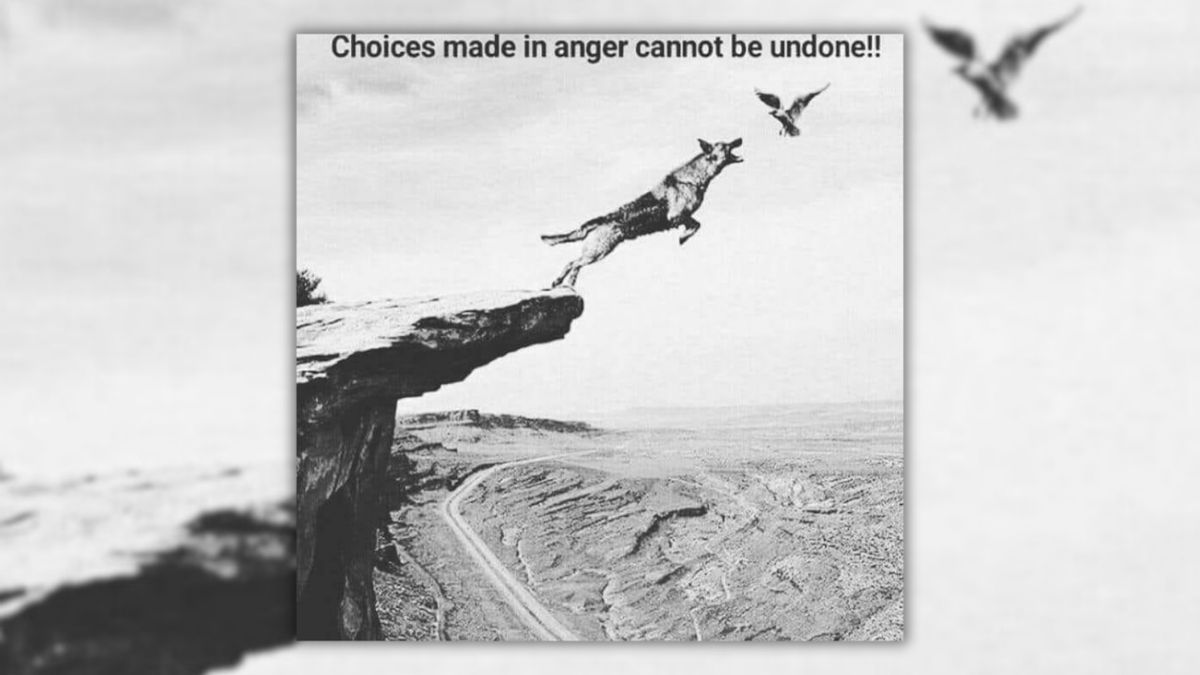
- For years, internet users have shared an image, allegedly dated 1931, that purportedly depicts a coyote chasing a roadrunner off a cliff in New Mexico and supposedly served as the inspiration for the creation of "Looney Tunes" characters Wile E. Coyote and the Road Runner, who first appeared in 1949.
- The image was fake, meaning it was not an authentic photo. It first appeared online in 2016 and appeared to be a digital manipulation of a 2007 image depicting a mountain biker on the Gold Bar Rim trail in Moab, Utah.
- The characters' creator, Chuck Jones, spoke at length over the course of his career about his inspirations for the characters coming from Mark Twain's book "Roughing It" and satirizing other popular cartoons at the time.
An image circulated online in April 2026 that internet users claimed was animator Chuck Jones' inspiration for Warner Bros. iconic "Looney Tunes" cartoon characters Wile E. Coyote and the Road Runner.
Users shared the purported image on social media and Reddit as early as 2018, but the claim picked up renewed traction after Warner Bros. released a trailer for "Coyote vs. ACME," a feature film starring the characters in question that is set to be released in August 2026.
The purported image featured an alleged coyote chasing a bird off a cliff. Some versions were in black and white while others were in color, and some also included the phrase, "Choices made in anger cannot be undone!!"
Other versions of the image featured a blurb that read, "Photo that became the inspiration for Warner Bros. 'Road Runner and Wile E. Coyote' Looney Tunes cartoons of a coyote leaping to his death to catch a roadrunner (1931, New Mexico)."
In cartoons featuring these characters, Coyote typically tries to capture the Road Runner, usually inflicting severe damage upon himself before ultimately failing.
The claim that the image inspired the characters was false.
Craig Kausen, Jones' grandson, told Snopes via email, "In my 40 years being around my grandfather, I never heard even a glimpse that he was inspired by any photograph. I have also checked with my mother, Linda Jones, and she says this is not true either."
To start, the image was a
The user who posted the original image said in the posts that the shot was captured in 2007 at Moab, Utah's Gold Bar Rim mountain biking trail, rather than in New Mexico, as the claim suggested. The earliest instance of the manipulated image showing the canine and bird
In addition, a popular post featuring this image on Reddit was from the "fakehistoryporn" subreddit, which described itself as a forum "dedicated to Fake History."
Keen-eyed readers will note that the background of the image in both the original and the purported "Looney Tunes" version are identical in angle with details that match in both versions.
The viral image is cropped significantly from the original — not to mention made grainier and black and white — removing a prominent cloud formation on the right side. However, the shape of the shrubbery behind the subjects matches in both versions, as do the positioning of the clouds, shadows, and even the tiny dots of automobiles on the road below.
If the two images were indeed independent of one another, it is highly unlikely that they would match the exact same angle at the exact same time of day with the same cloud formations in the sky.
Further, the bird depicted in the viral image does not appear to be a roadrunner, which features a long, narrow tail and more angular shape than the bird depicted. The bird in the image resembled a hawk or crow, but we could not determine the species. The "coyote" in the photo appeared closer to a German shepherd based on its shape and the dark patches of its coat, as coyotes in Utah "are brownish-gray or light gray to reddish in color with a cream-colored belly," according to Wild Aware Utah, an organization that aims to educate Utah residents about regional wildlife.
It's also possible the Utah trail captured in the image would not have even been available to traverse in 1931, as mountain biking was not a widely popular sport until the 1970s. Snopes reached out to Utah's office of tourism for more information on the history of Gold Bar Rim trail and will update this article if we hear back.
The actual origin of Wile E. Coyote and Road Runner
While the purported photograph was a fake, animator Chuck Jones, who died in 2002, cited his influences for Coyote and Road Runner in various career retrospective interviews and his 1989 illustrated memoir, "Chuck Amuck: The Life and Times of an Animated Cartoonist."
In the chapter about the two characters in question, titled "Never take a right turn at Albuquerque," Jones pointed to his own "frustration and war with all tools" as inspiration alongside classic comedians such as the Marx Brothers and Laurel and Hardy.
Crucially, the memoir included this passage:
While the Coyote had lurked somewhere in the cluttered back rooms of my mind ever since, at the age of seven, I read about this enchanting creature in Mark Twain's "Roughing It"—just waiting for a chance to star—it wasn't until I was more than grown that the opportunity came up.
In Kausen's email to Snopes, he confirmed Twain as his grandfather's major influence for the characters. "He would travel to Arizona and New Mexico regularly in the 1940s and saw roadrunners chasing each other throughout the landscape," Kausen wrote. "However, two roadrunners did not make an interesting cartoon in his opinion so he reached back into his memories of reading Mark Twain books when he was young."
A passage from "Roughing It" is particularly relevant to the character of Wile E. Coyote. Twain wrote:
The coyote is a long, slim, sick and sorry-looking skeleton, with a gray wolfskin stretched over it, a tolerably bushy tail that forever sags down with a despairing expression of forsakenness and misery, a furtive and evil eye, and a long, sharp face, with slightly lifted lip and exposed teeth. He has a general slinking expression all over. The coyote is a living, breathing allegory of Want. He is always hungry. He is always poor, out of luck, and friendless. The meanest creatures despise him, and even the fleas would desert him for a velocipede. He is so spirtless and cowardly that even while his exposed teeth are pretending a threat, the rest of his face is apologizing for it. And he is so homely! So scrawny, and ribby, and coarse-haired, and pitiful.
Jones elaborated on the Twain influence in a 1999 interview with The Research Library at Animation Art Conservation. He said:
I found the Coyote in the fourth chapter of Roughing It, which is a journal he wrote about traveling by stagecoach to Carson City, Nevada. During that period, he kept hold of the things he'd seen and among them were things like tarantulas, and so on. Twain opens that chapter with a description of the coyote, which is about as accurate as anybody has ever described one. He, also, humanized him. And that was kinda news to me. I hadn't run into anything where I felt that a coyote was like a human being.
In "Chuck Amuck," Jones explained that the characters' original appearance, in 1949's "Fast and Furry-ous," was meant to be a satire of other popular cartoons who were constantly "in the pursuit of one another" such as Tom and Jerry or Elmer Fudd and Bugs Bunny.
He wrote that the characters' first outing was "an absolute and dismal failure, as satire" but audiences loved it and the characters took off.
As for the New Mexico setting described in the claim photograph, it appeared likely that in addition to Jones' travels, it was inspired at least in part by background painter Robert Gribbroek — responsible for creating and rendering the backgrounds upon which animation cells were filmed — moving to Taos, New Mexico in 1936, according to the Zaplin Lampert Gallery in Santa Fe.