
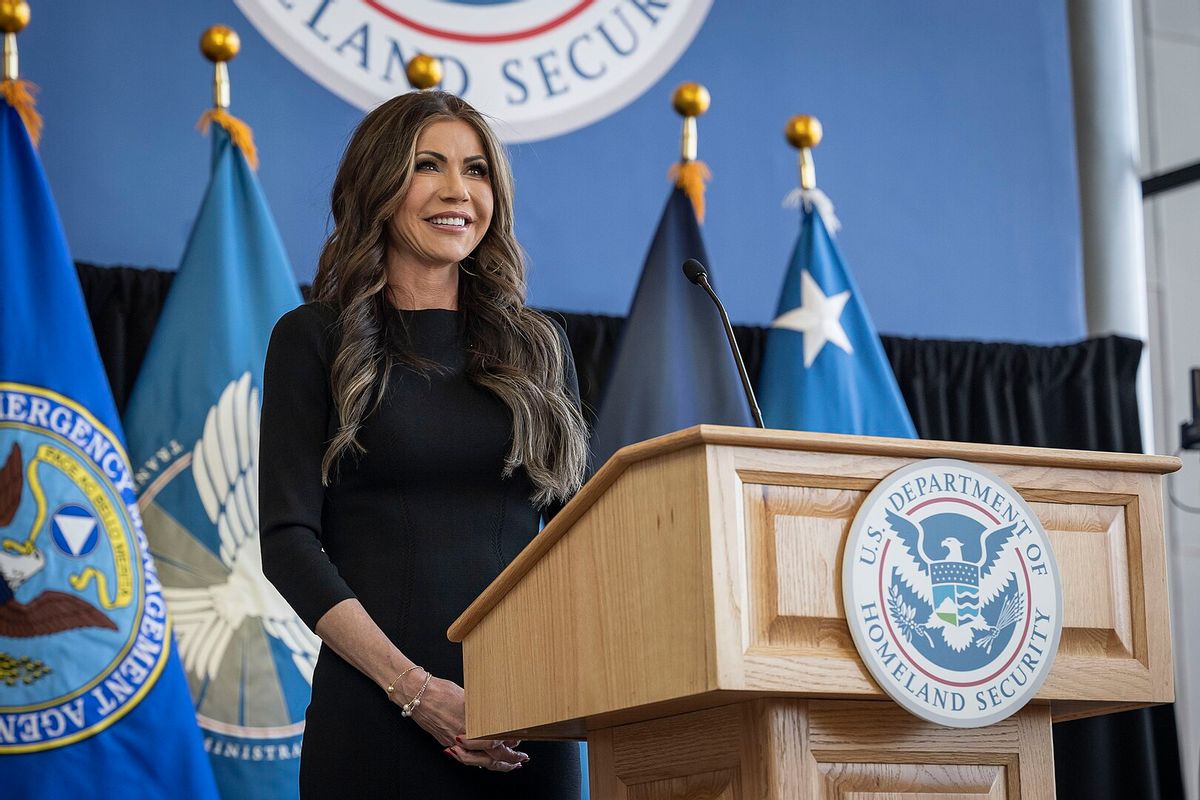
In February 2025, as U.S. President Donald Trump called for an end to diversity, equity and inclusion practices in the federal workforce, reports claimed the Department of Homeland Security — led by Secretary Kristi Noem — had removed bans on conducting intelligence activities on people based on their sexual orientation or gender identity.
Such reports shared copies of the original DHS report, which showed a rule that originally prohibited personnel from conducting intelligence activities based only on a person's "race, ethnicity, gender, religion, sexual orientation, gender identity, country of birth, nationality, or disability." The latest such report appeared to have removed the references to sexual orientation and gender identity.
The claim is correct that the current DHS report detailing such a rule no longer states how it applies to sexual orientation or gender identity. We looked at an older copy of the report as well as the latest copy and found the reference had been omitted. As such, we rate this claim as true.
The claim emerged from the language used in the policy manual for DHS' Office of Intelligence and Analysis. In an archived copy of the policy manual from Jan. 19, 2025, a rule states that Open Source Intelligence Collection personnel cannot conduct intelligence activities on individuals or groups on the basis of their race, religion and more. This copy of the manual explicitly includes "gender identity" and "sexual orientation":
(iii) OSIC Personnel are prohibited from engaging in intelligence activities based solely on an individual's or group's race, ethnicity, gender, religion, sexual orientation, gender identity, country of birth, nationality, or disability. The use of these characteristics is permitted only in combination with other information, and only where (1) intended and reasonably believed to support one or more of I&A's national or departmental missions and (2) narrowly focused in support of that mission (or those missions).
The current manual (as viewed on March 3, 2025, and archived here) omits references to sexual orientation and gender identity entirely. It also replaced the word "gender" with "sex." The rule now states intelligence activities cannot be conducted on an individual or group solely on the basis of their "race, ethnicity, sex, religion, country of birth, nationality, or disability."
(iii) OSIC Personnel are prohibited from engaging in intelligence activities based solely on an individual's or group's race, ethnicity, sex, religion, country of birth, nationality, or disability. The use of these characteristics is permitted only in combination with other information, and only where (1) intended and reasonably believed to support one or more of I&A's national or departmental missions and (2) narrowly focused in support of that mission (or those missions).
The change has led to speculation in numerous reports that intelligence activities, including surveillance, can now be carried out on people based solely on their sexual orientation and gender identity. We have, however, been unable to determine why this change took place.
In response to our questions on why the term "sexual orientation" was removed from the manual, a DHS spokesperson said the department would not surveil someone on the basis of their sexual orientation:
The DHS Office of Intelligence and Analysis has not, does not, and will not engage, in any "surveillance" based on a person's sexual orientation. Following the presidential guidance in Executive Order No. 14168, "Defending Women from Gender Ideology Extremism and Restoring Biological Truth to the Federal Government," the language in the section of the policy manual referenced was changed to match the underlying statutory language in Title VI of the U.S. Code. I&A continues to follow federal case law establishing that discrimination on the basis of sexual orientation is a form of sex discrimination, and therefore the substance of the policy has not changed.
While the U.S. Equal Employment Opportunity Commission does include "sexual orientation" as a protected category within cases of sex discrimination, we do not know how this will apply in practice under a Trump administration and why this change was necessarily made by the DHS. We also await the department's response on why it removed "gender identity" from the rule.
The "intelligence activities" conducted by the office are identified thusly in the policy manual:
In service of the broader mandates described above, I&A engages in intelligence activities encompassing the entire intelligence cycle, setting intelligence requirements; collecting (overtly or through publicly available sources) information responsive to those requirements for serialization in intelligence reports; and analyzing, producing, and disseminating analytic products.
However, according to a 2024 analysis from the Brennan Center for Justice, the DHS' Office of Intelligence and Analysis has a long history of carrying out civil rights abuses in the name of gathering intelligence. It has surveilled racial justice demonstrators and interviewed people in prison without sufficient constitutional protections, as well as targeting journalists.
The above change occurred after a Trump administration executive order in January 2025 that called for "the termination of all discriminatory programs, including illegal DEI and 'diversity, equity, inclusion, and accessibility' (DEIA) mandates, policies, programs, preferences, and activities in the Federal Government, under whatever name they appear."
This is not the only instance of the Trump administration's policies adversely impacting members of the LGBTQ+ community. Trump's executive orders in his second term have aimed to restrict people from changing gender markers on their passports, to expand the ban on transgender service members, to reinstate the global gag rule that blocks funding for reproductive health care, and to direct federal agencies to prevent gender-affirming care for people under 19. Additionally, according to some reports, the Equal Employment Opportunity Commission stopped investigating claims alleging discrimination based on sexual orientation and gender identity.