
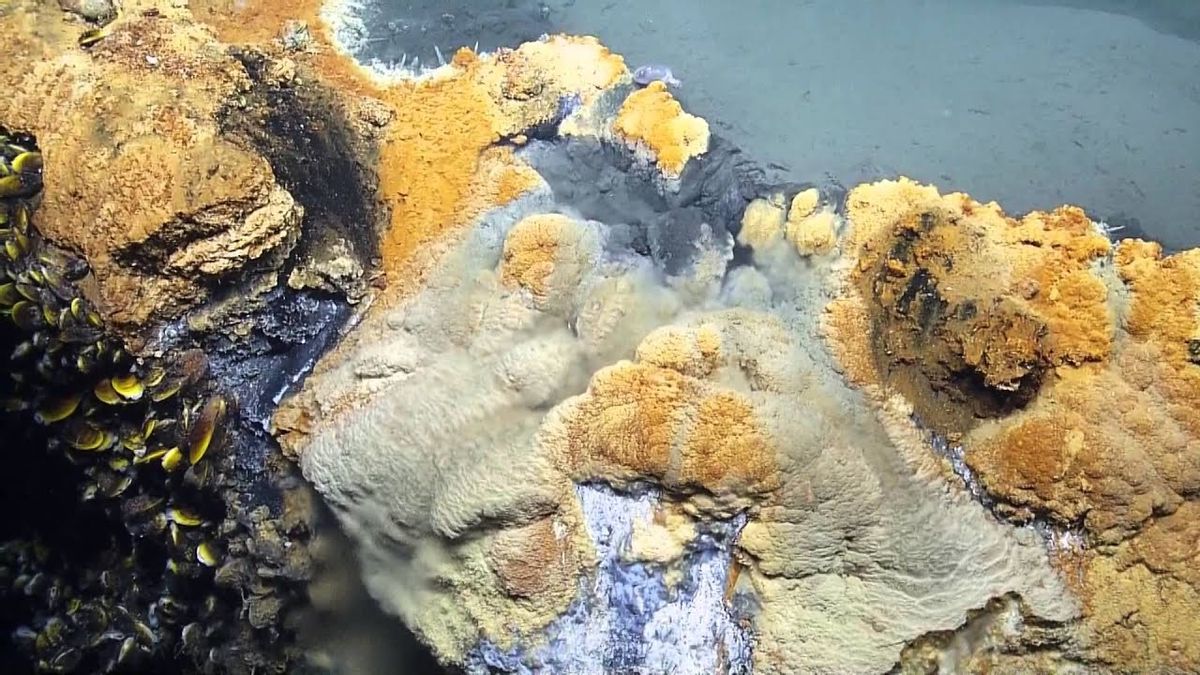
As the rumor goes, an oceanic area off the eastern coast of Mexico is a "Jacuzzi of Despair," a pool of oceanic water that kills anything that enters it.
A January 2025 Reddit post (archive) makes the claim, displaying an image of a deep-sea brine pool, a toxic body of heavy water and chemicals that rests along the seafloor.
Deep in the Gulf of Mexico lies the 'Jacuzzi of Despair,' a deadly brine pool that kills anything that enters its waters.
byu/CrypticLyfe inDragonsDogma
Posts across social media platforms including Instagram and Facebook have made the same assertion.
The claim was mostly true. Marine scientists indeed call a deep-sea brine pool in the Gulf of Mexico (or Gulf of America, per U.S. President Donald Trump) a "Jacuzzi of Despair," or "Hot Tub of Despair." However, while it's true that most organisms that enter the water will die due to its toxic effects, some chemosynthetic organisms — organisms that create energy through chemicals in the pool — may survive.
Researchers discovered the brine pool
In essence, brine pools are underwater lakes on the ocean floor, formed by dense, salty brine that does not mix with seawater above, according to Ocean Exploration Trust
Brine pools are
OET says on its website (emphasis ours):
Deep on the ocean's floor, there exist lakes of salty brine, formed from salt seeping out from deposits underlying the seafloor, saturating pools to such an extent that they refuse to mix with the surrounding water. The salinity of these pools is so great that they are toxic to most sea life, but certain highly adapted chemosynthetic organisms have found ways to survive and even thrive on the shores of these undersea lakes.
OET operates a 223-foot research ship, Exploration Vessel Nautilus. The research initiative was ongoing, as of this writing, and involved remote-operated vehicles (ROVs) that project leaders
Researchers captured footage of the in-question brine pool during two cruises to find what they call "cold seeps" — locations along the seafloor "where hydrocarbons that are normally trapped deep beneath the seafloor escape into the water column." Cold seeps can provide homes to toxic waters like brine pools, as OET described on its website (emphasis ours):
At some seep sites, seawater interacts with ancient salt deposits found deep in the seafloor, producing a highly saline fluid (brine) that can be more than four times more saline than seawater. When this brine is expelled, it is far denser than the overlying seawater and does not mix very easily with it. In some cases, the brine forms large pools, rivers or lakes.
This highly saline environment is toxic for most organisms, but we did encounter beds of mussels and fields of tube worms that have adapted to life in this extreme habitat by processing seep gases and chemicals into energy. A larger brine pool was dubbed the "Hot Tub of Despair," referring to its warm temperature (19°C) and high salt content—which can be fatal to many animals unlucky enough to fall in. This site was found nearly 3,300 feet below the surface of the Gulf of Mexico and is a circular pool 100 feet in circumference and 12 feet deep.
In other words,
OET wrote on its YouTube channel: "On one hand, [brine pools]
After the expedition, OET published an album of photos showing organisms that

(OET)
As OET noted,

(OET)

(OET)