
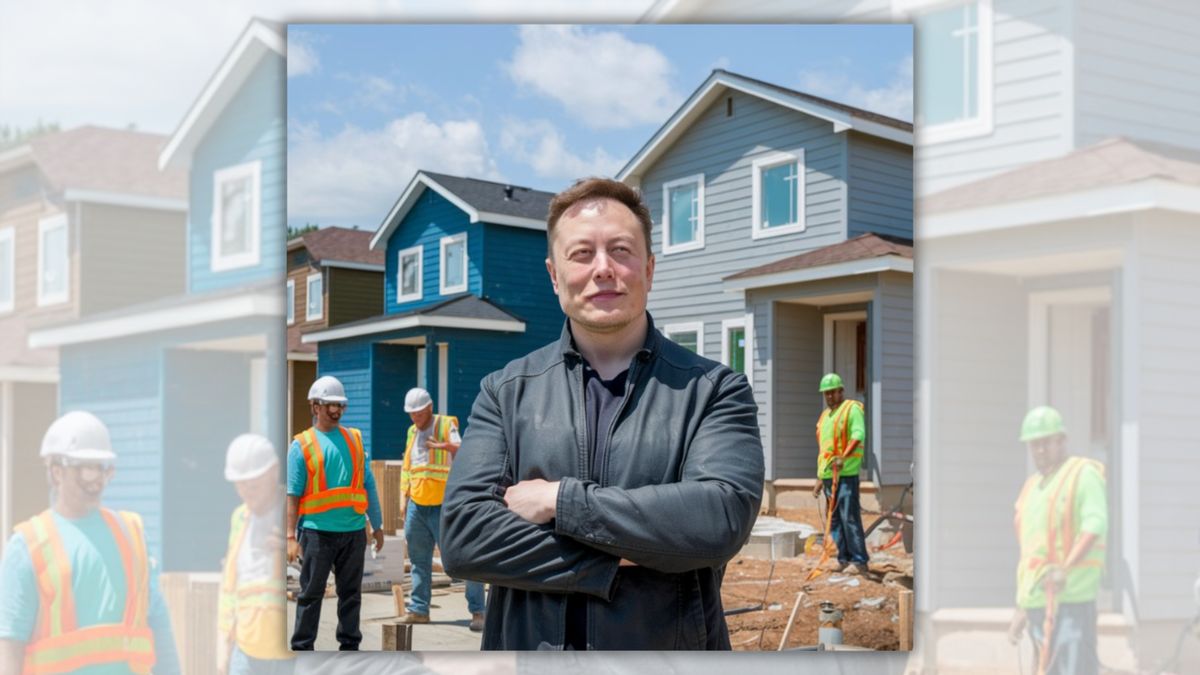
In late March 2025, a rumor spread online that Elon Musk, the tech billionaire and adviser to U.S. President Donald Trump, had invested $5 million to build affordable housing for low-income families.
The story circulated weeks after The Associated Press reported that Musk's Department of Government Efficiency (DOGE) initiative had halted a $1 billion affordable housing program as part of cuts and freezes at the U.S. Department of Housing and Urban Development.
One example of the claim, a March 27 Facebook post (archived), had around 37,000 reactions and 11,200 comments, many of which suggested the commenters believed the story was true. The text of that post read:
Elon Musk Spends $5 Million to Build Housing for Low-Income Families, Creating Sustainable Communities
Elon Musk has invested $5 million to build affordable housing for low-income families, aiming to provide safe and sustainable living conditions. The funds will support the construction of new homes in underserved areas, ensuring that families have access to affordable housing options. Musk's contribution reflects his commitment to addressing housing inequality and creating lasting impact in communities in need.

(Facebook page Daily News Feed)
Additional instances of the rumor appeared in other (archived) popular Facebook posts (archived) that, in the bodies of the posts or in comments, contained links to different websites hosting an article that claimed to share additional details about Musk's alleged investment.
Snopes readers searched our site and wrote in looking for information about the claim.
In short, there was no demonstrable evidence that Musk had invested $5 million to build affordable housing for low-income families. As a result, we've rated this claim false.
First, although the article some posts linked to claimed that Musk had "recently announced a $5 million investment to build affordable housing for low-income families," a Google search for the terms "Elon Musk," "$5 million," "low income" and "housing" found no coverage of such an announcement — which would have made headlines if it were true — in legitimate news outlets. Musk's official X account also showed no evidence that he had invested in low-income housing.
Furthermore, the article about the investment, which appeared on content-farm websites with generic names, was likely the product of artificial intelligence (AI) software. The AI text detectors GPTZero and ZeroGPT both found with high confidence that the text of the article was AI-generated.
The article included an image of Musk and a house with text reading, "$10,000 HOUSE." That image was the thumbnail of a YouTube video about Musk that misleadingly spliced together real footage of tiny houses from the modular home company Boxabl.
Musk has said that he owns a $50,000 version of the company's Casita house — which at the time of this writing cost between $60,000 and $70,000 according to the company's website — and that he uses it to host visitors. It was not immediately clear how much, if anything, Musk has invested in the company, although Boxabl has touted Musk's ownership of one of its products on its website and in multiple Securities and Exchange Commission filings.
Regardless of Musk's level of involvement in the company, there was no evidence Boxabl had built homes specifically for low-income families. Instead, as Business Insider reported in 2023, the company's highest-profile projects have been a Department of Defense contract to build Casitas at the Guantánamo Bay detention center and a deal to construct worker housing at an Arizona copper mine.
The claim about Musk investing in housing for low-income families was one of several positive — but fictional and seemingly AI-generated — stories about the billionaire that we investigated in early 2025, including a rumor that he paid the medical bills of a 7-year-old with a rare neurological disorder and also arranged for an experimental device produced by his company Neuralink to be implanted in the child's brain.