
In mid-April 2026, users on X (archived) and Facebook (archived) wrote about "the boys who refused to die" from the Buchenwald concentration camp in Nazi Germany. Alongside the story, the social media posts included a black-and-white image of what appeared to be a row of shirtless boys sitting on a bench against a building in a muddy camp. The posts said:
One famous photo shows young survivors sitting together after liberation — thin but alive, some smiling weakly for the first time in years. These boys had been used for forced labor, medical experiments, or simply kept as "future workers." In the final weeks, when the Nazis tried to evacuate the camp on death marches, the older prisoners hid the children in the block, risking their own lives.
Snopes readers sent us emails asking whether the image was real.
While there are real images of the surviving children from Buchenwald concentration camp, the image in the social media posts was not one of them. That image was generated with artificial intelligence. Therefore, we've rated the image fake.
Evidence of AI generation
The image has several errors consistent with the kinds of mistakes regularly made by artificial intelligence tools that generate or edit images.
Most notably, there are five feet shared between the two boys closest to the camera. The first two feet in the image logically connect with the first boy's legs, but there is a third leg with a third foot that the boy rests his left hand on. While that may be the second boy's leg, an additional foot is visible behind the second boy's other leg, a foot that does not seem to belong to the third boy in the image.
We've highlighted the disconnect below:

(Facebook page Historical Life/Snopes illustration)
Beyond the first couple of children, many of those in the background have hands fusing with their legs, bodies fusing with others' bodies, and extra feet.
Additionally, the texture of the closest boy's face is unnaturally smooth, another common indicator of an AI-generated image.
The story of the Buchenwald boys
In the final few months of World War II in Europe, prisoners in concentration camps were moved around or executed as Allied forces liberated camps. Many Jewish children came to Buchenwald in early 1945 from camps such as Auschwitz when those camps were liberated by Soviets on the eastern front.
T
The children's quarters, called Block 66, offered the Jewish children protection from the indiscriminate violence of the Nazi SS. The camp resistance gave the boys there additional food and warm clothing. They were not assigned labor and did not have to wear the badges on their clothes the SS could use to identify them as Jewish.
Tens of thousands of prisoners in the Buchenwald concentration camp were executed as the Allied forces neared in April 1945. Even so, the soldiers who liberated the camp found approximately 900 children and adolescents who survived. Most of the surviving children were from the children's block. Among those survivors was future Nobel Peace Prize winner Elie Wiesel.
The soldiers who liberated Buchenwald were shocked by what they saw and took many photos of the camp and the people within it to document the conditions of the prisoners for future war crime trials.
Real photos of children from Buchenwald
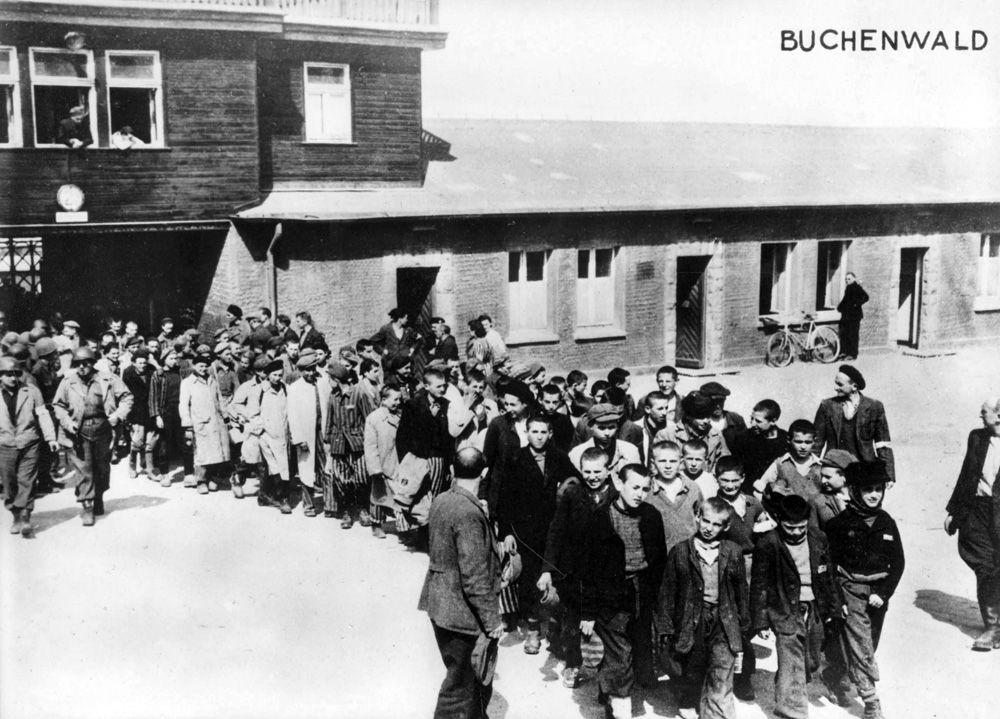
When the soldiers arrived, the children were largely wearing oversized striped outfits standard for the camp. For example, the children in this photo are wearing the striped uniforms.
A photo of four adolescent boys shows that even one month after the camp's liberation, their ribs still prominently showed from the starving conditions they lived in before. The boys still had short hair from when the Nazis shaved their heads.
Children's Block 66 had few windows, unlike the building visible in the AI-generated image. In another photo, a group of injured boys from Buchenwald sat in front of an unnamed building with no visible windows, possibly Block 66. Again, the boys' heads were closely shaven, even though the photo had been taken between April and June 1945, after the camp's liberation.
The boys remained thin with closely shaven heads even as they took trains out of the camp in June 1945.