
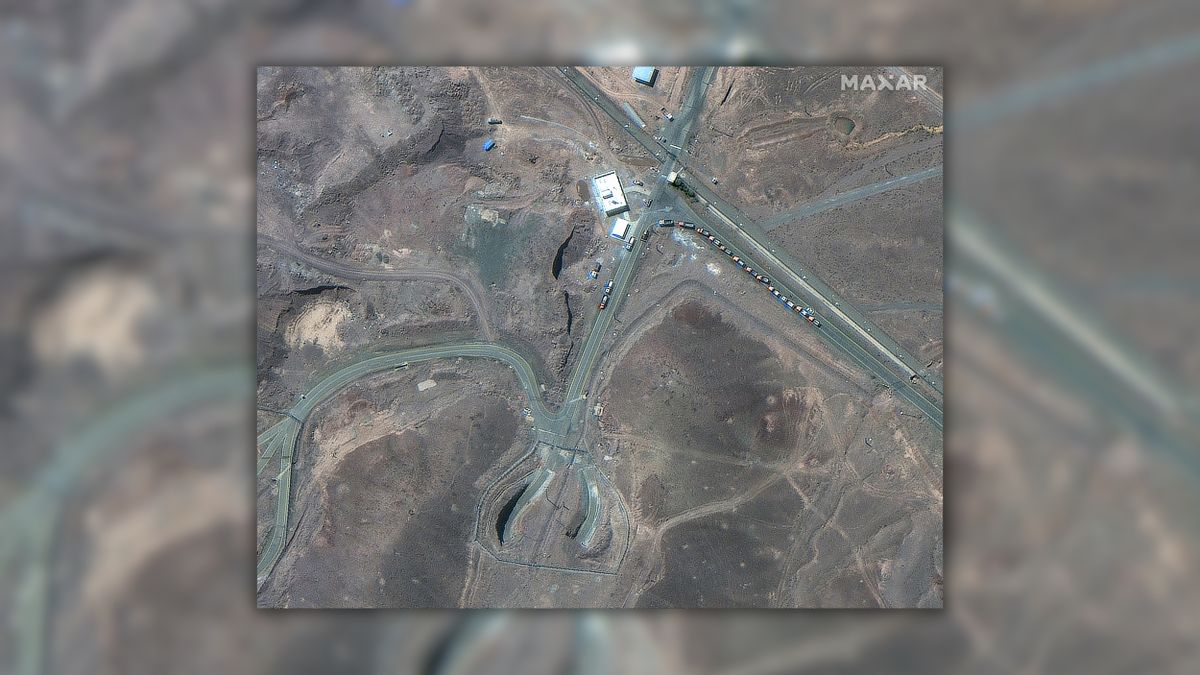
In mid-June 2025, escalating conflict between Israel and Iran culminated in U.S. military strikes on Iranian nuclear facilities. A satellite image purporting to show Iranian preparations at the Fordo fuel enrichment plant before these strikes took place circulated widely on social media, with claims that it provided evidence Iran moved nuclear materials to avoid destruction.
For example, one X account posted (archived) the image with the caption "MAJOR BREAKING: CBS has obtained aerial photos of the Fordow nuclear site before the bombings and claim it shows evidence that Iran REMOVED its nuclear material beforehand. 16 trucks were spotted moving material," receiving more than 604,900 views within hours. There were several other posts (archived and archived) on X with the image attached.

(CalltoActivism/X)
On Reddit, one account posted (archived) the image with caption "Iran 'moved enriched uranium before U.S. strikes' to secret location" receiving 17,000 reactions within hours.
What We Know
The satellite image was authentic. Maxar Technologies, an American space technology company specializing in geospatial intelligence, captured the image on June 19, 2025. According to Maxar's caption (archived) on Getty Images, the satellite imagery revealed "16 cargo trucks lined along the main road approaching the underground tunnel entrance of the Fordo Fuel Enrichment Facility. The unexpected presence of these trucks may indicate significant movement or logistics activity prior to military action."
Additional satellite imagery from June 20 showed further activity. According to Maxar's caption (archived), the June 20 image captured "a group of vehicles repositioned 1.1 kilometers northwest of the Fordo underground site. New revetments and transport activity are visible, indicating possible staging or protective dispersal ahead of reported U.S. airstrikes."
A Maxar spokesperson told Snopes via email that the company analyzed the imagery from June 19 and stated:
The truck activity seen in the imagery is likely related to the vehicles bringing dirt to the tunnel entrances so they could be blocked/sealed up. Our subsequent imagery on June 22 shows that several of the tunnel entrances had been sealed with dirt.

(Maxar)
Nuclear experts offered different interpretations of the satellite imagery. Jeffrey Lewis, a professor at the Middlebury Institute of International Studies, told Snopes via email that "the image shows Iran burying the entrances. Most trucks appear to be for that purpose, but other trucks were present and we do not know what those trucks were doing." Lewis noted that many of those trucks "are visible in another image taken by Airbus showing them burying the entrances."

(Airbus Space and Defence)
David Albright, a former U.N. nuclear inspector who heads the Institute for Science and International Security, told NPR (archived) that "one would assume that any enriched uranium stocks were hauled away," pointing to the truck activity as potential evidence of material movement.
A senior Iranian source told Reuters (archived) that they have moved "almost all of the country's highly enriched uranium to a secret location" before the strikes.
The United States conducted (archived) "Operation Midnight Hammer" in the early morning hours June 22, 2025, local time, using B-2 Spirit stealth bombers to drop 30,000-pound Massive Ordnance Penetrator bunker-buster bombs on Fordo and other Iranian nuclear facilities, including Natanz and Isfahan.
What We Don't Know
While the satellite imagery documented truck activity, the specific purpose remained open to interpretation. Maxar's analysis suggested the trucks were bringing dirt to seal tunnel entrances, but this activity could also have facilitated material removal before the sealing occurred.
No independent international organization confirmed that enriched uranium was actually moved, or in what quantities. Claims about materials being moved to a "secret location" provided no details about where such materials might be housed or whether they remained under international monitoring.
In a statement to the International Atomic Energy Agency (IAEA) Board of Governors on June 23, IAEA Director General Rafael Grossi confirmed that "craters are now visible at the Fordo site, Iran's main location for enriching uranium at 60%," suggesting the use of ground‑penetrating munitions consistent with U.S. assessments. He added that "no one, including the IAEA, is in a position to have fully assessed the underground damage at Fordo." Given the bombs' explosive payload and the "extreme vibration‑sensitive nature of centrifuges," he said, "very significant damage is expected to have occurred."