
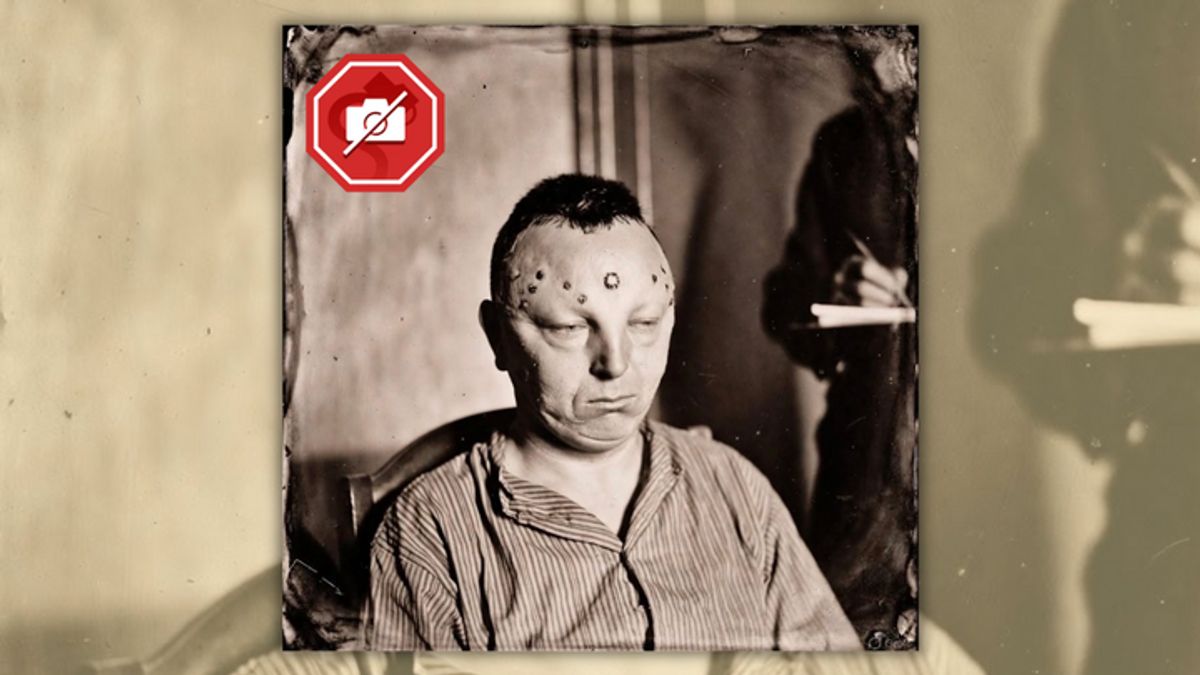
In early 2026, an
The claim spread on Facebook (screenshotted), Instagram and YouTube. Snopes readers contacted us to ask whether Peterson's story was real. Here's how one popular Facebook post (screenshotted) described Peterson's life:


In 1948, James Peterson was lobotomized for being gay. His parents committed him after discovering his love for another man. The asylum labeled it "sexual perversion" and "treated" him with a transorbital lobotomy—ice picks hammered above his eye sockets into his frontal lobe. It took just 15 minutes, but it erased his vibrant, artistic spirit forever. The doctor assured his parents: "Your son's perversion is corrected."
What returned was an empty shell—no desires, no passions, not even for life.
However, many of these posts of the image included a watermark in the bottom right corner indicating that someone created the picture using Grok, the generative artificial intelligence tool on X (screenshotted, screenshotted). As such, we have rated this image as fake.


A closer look at the James Peterson image revealed that it was generated using Grok, X's artificial intelligence tool. (Facebook user Yesterday's Wisdom/Wikimedia Commons)
There's no evidence that Peterson, specifically, ever existed. However, doctors did use lobotomies to "treat" homosexuality in the 20th century as a form of "conversion therapy," a widely discredited practice that attempted to change a person's sexuality or gender identity.
The earliest version of the image appeared to be posted (screenshotted) on Dec. 27, 2025, by a Facebook account called Yesterday's Wisdom (screenshotted), which frequently publishes fake historical images and videos generated by artificial intelligence. It was not

A Google search for information about a man named James Peterson who matched the details of the story returned no relevant results from reputable publications. An additional Google search set to find webpages from before December 2025 also found no evidence that Peterson ever existed.
Many of the posts circulating online claimed that Peterson's supposed partner donated the photograph and medical documents to an LGBTQ+ archive, which makes it especially suspicious that no credible records of Peterson show up online.
A reverse image search for the picture of Peterson determined that the image did not appear to be inspired by or an enhanced version of any legitimate photo of a real person with lobotomy scars.
Posts claimed that Peterson underwent a "transorbital lobotomy." However, real transorbital lobotomies did not involve creating incisions because cuts happened through the eye sockets. That means no visible scarring occurred — as shown in credible images of patients after transorbital lobotomies — unlike the circular scars in the image of Peterson.
A physician named Walter J. Freeman II developed the now-obsolete transorbital lobotomy in the
One Smithsonian Channel documentary reported that roughly 40% of Freeman's patients were gay men.