
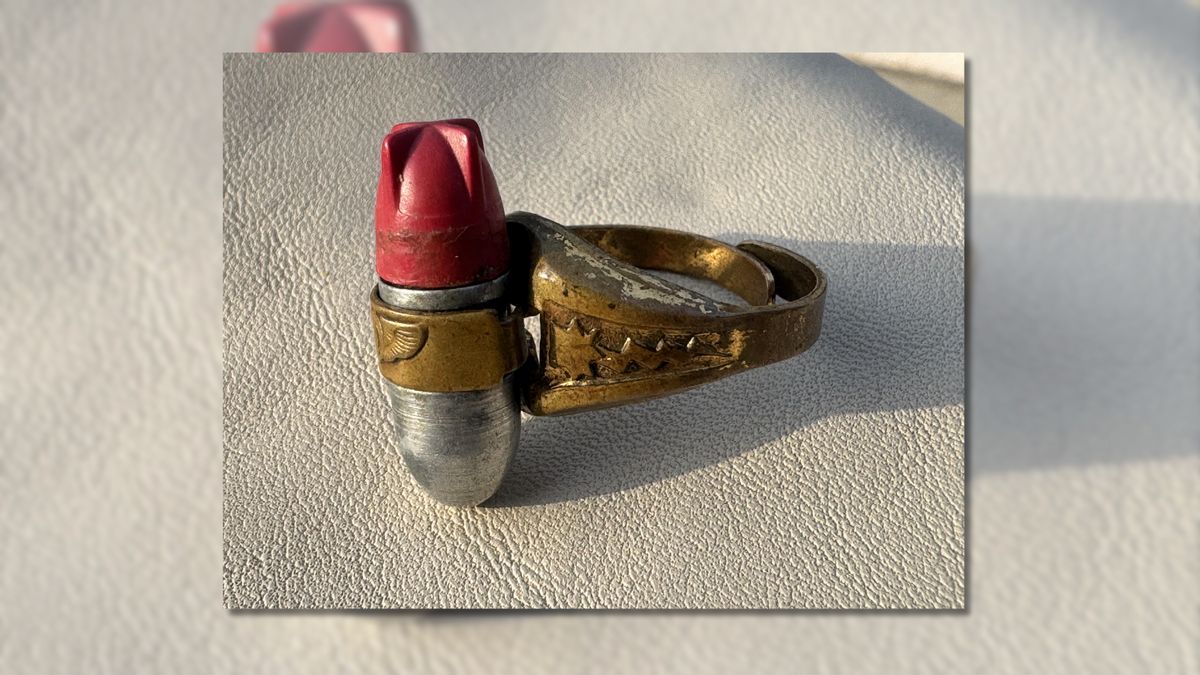
In June 2025, several posts appeared on social media sites like Facebook, Threads and Reddit claiming that, in 1947, the cereal brand Kix offered a promotion for a "Lone Ranger Atomic Bomb Ring" that contained radioactive polonium-210, the same substance used in 2006 to fatally poison former Russian intelligence official Alexander Litvinenko. The posts poked fun at the nuclear optimism of the years immediately following the U.S. atomic bombings of Hiroshima and Nagasaki in World War II.
Snopes found a newspaper advertisement from 1947 promoting the ring, searching on eBay revealed some for sale and a popular YouTube video
It is notable that the social media posts called the ring the "Lone Ranger Atomic Bomb Ring," while Kix and its owner
The posts were also incorrect in implying that the rings were dangerous. While polonium-210 can be deadly, according to
The newspaper advertisement promised that the ring contained "Actual Atoms—split to smithereens," and that after taking the ring into a dark room and letting your eyes adjust, viewers would be able to "see frenzied flashes of light—caused by released energy of atoms splitting like crazy."
The advertisement was a little over-the-top, but according to Frame it was correct. He said the ring was a miniature spinthariscope, a device invented by mistake in 1903, when the British physicist William Crookes spilled a radioactive sample onto a zinc sulfide screen and noticed small flashes of light (officially called scintillations) under a microscope.
Radioactivity is a fancy way to say "atomically unstable." This means that all radioactive atoms will eventually decay, at a time frame between minuscule fractions of a second and trillions of years. When that decay happens, the atom's nucleus will indeed split. This type of radioactive decay is called "alpha decay," and the piece of the atom that splits off (an atom of
When Crookes looked through the microscope, he correctly identified the flashes as alpha particles crashing into the zinc sulfide and releasing energy in the form of light. Frame said scientists quickly found better, more efficient ways to measure decay. However, the spinthariscope did stick around in the form of various science toys, including the Atomic Bomb Ring.
In fact, George Zweig, one of two physicists who independently proposed the subatomic particle called the quark, said in a 2014 lecture at Brown University (transcript) that the Atomic Bomb Ring was his introduction to nuclear physics:
My first exposure to nuclear physics came at the age of 10 in 1947, two years after the atomic bomb had been dropped on Hiroshima. One of my favorite after-school radio programs was the "Lone Ranger," sponsored by Kix breakfast cereal. Quite unexpectedly during a commercial break, the announcer asked his little listeners to send away for an "Atomic Bomb Ring." After mailing in my name, address, 15 cents, and a Kix box top, I received the ring, took it into a dark closet full of winter coats, and waited till my eyes had adapted to the dark. Removing the red cap and peering along the long axis of the "bomb," I was rewarded with brilliant punctate flashes of light as one α-particle after another, emitted from a tiny piece of radioactive polonium, barreled into a zinc sulfide screen (a spinthariscope invented by William Crookes in 1903).
Frame said the ring likely used polonium-210 because it was the most accessible substance that could produce the alpha particles required to make the effect work. However, polonium-210 has a relatively short half-life of 138 days, meaning that approximately half the polonium in the ring would have been gone within about four and a half months. In other words, a vintage Atomic Bomb Ring isn't going to be producing any scintillations.
Even while the ring's effect was still happening, though, kids weren't really in danger. Alpha radiation can be dangerous when ingested, but it's also the easiest type of radiation to block — even a sheet of paper is enough, according to the National Institutes of Health.