
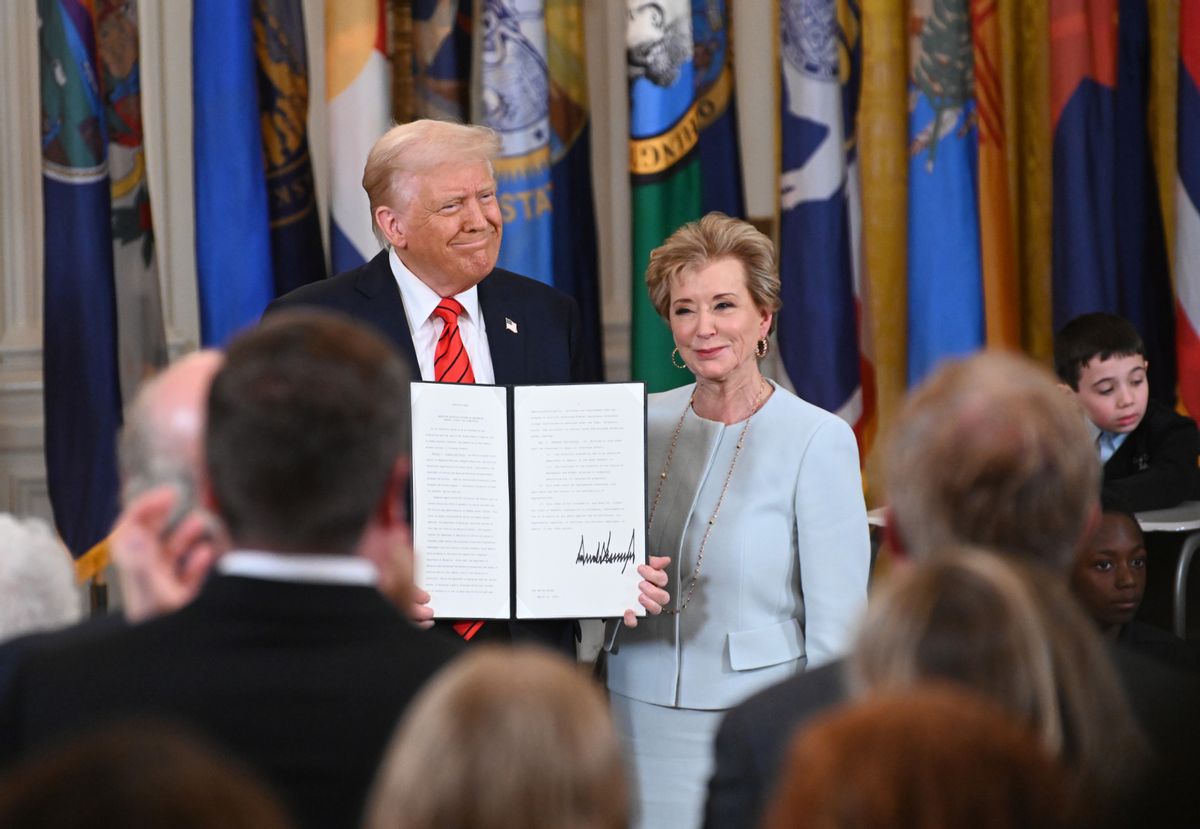
On May 15, 2025, U.S. Education Secretary Linda McMahon claimed that 70% of the country's
"When we see scores that 70% — 70% of eighth-graders can't read at grade level or read proficiently, and that actually, when you go into high school, you see that same percentage," McMahon alleged in a
McMahon
However, that 70% data point isn't indicative of grade-level proficiency — in fact, the Education Department's own website for NAEP data cautioned that it "does not represent grade-level proficiency as determined by other assessment standards (e.g., state or district assessments)." Thus, we rate this claim a mixture of truth and falsehood.
The Education Department notes that NAEP achievement levels "are to be used on a trial basis and should be interpreted and read with caution" until "the Commissioner of the National Center for Education Statistics (NCES) determines that the achievement levels are reasonable, valid, and informative to the public," which has not happened as of this writing.
It is also worth noting that 2024 NAEP scores for 12th-graders — the only high-school level tested — aren't out yet; in fact, the last time the federal government tested 12th-graders on the NAEP was in 2019, when 37% of high schoolers met or exceeded the NAEP Proficient reading level. Thus, it is not possible to verify McMahon's claim regarding high schoolers' proficiency levels, as the publicly available information is outdated.
Explaining the NAEP Proficient level
As referenced by McMahon, in 2024, 70% of eighth-grade students read below the NAEP Proficient level.

(National Assessment of Educational Progress)
The National Assessment Governing Board, which sets policy for the NAEP, defined "NAEP Proficient" as "competency over challenging subject matter, including subject-matter knowledge, application of such knowledge to real-world situations, and analytical skills." Detailed explanations of the different NAEP levels are available online.
The governing board called the idea that the NAEP Proficient level is equivalent to grade-level proficiency a "common misconception" and listed it as a myth in an informational sheet:
Myth: The NAEP Proficient level is like being on grade level.
Fact: NAEP Proficient means competency over challenging subject matter. This is not the same as being "on grade level," which refers to performance on local curriculum and standards. NAEP is a general assessment of knowledge and skills in a particular subject.
The board even said in its explainer about the NAEP Proficient level that "NAEP Proficient is defined differently than other uses of the term," thus outright contradicting McMahon's claim that it represents how many students "can read proficiently."
Not every student is tested; instead, NAEP uses a representative sample. The assessment also cannot be used "to figure out 'grade level,' which depends on performance on local curriculum and tests," according to the board.
Education policy experts often criticize the assessment criteria for setting unrealistic standards: "Scholarly panels have reviewed the NAEP achievement standards and found them flawed," Tom Loveless, former director of the Brown Center on Education Policy at Brookings, wrote in 2016. "The highest scoring nations of the world would appear to be mediocre or poor performers if judged by the NAEP proficient standard."
The NAEP website addresses this criticism, calling its standards an "aspirational goal" for what students should be able to do.
NAEP also previously tracked whether state standards for reading proficiency map onto NAEP levels, and according to 2022 data, only six states have reading proficiency standards at the NAEP Proficient Level. In contrast, 48 states had standards at or above the NAEP Basic level, one step below NAEP Proficient.
In 2024, 67% of eighth-grade students met or exceeded the NAEP Basic level. That was a drop from 73% in 2019.