
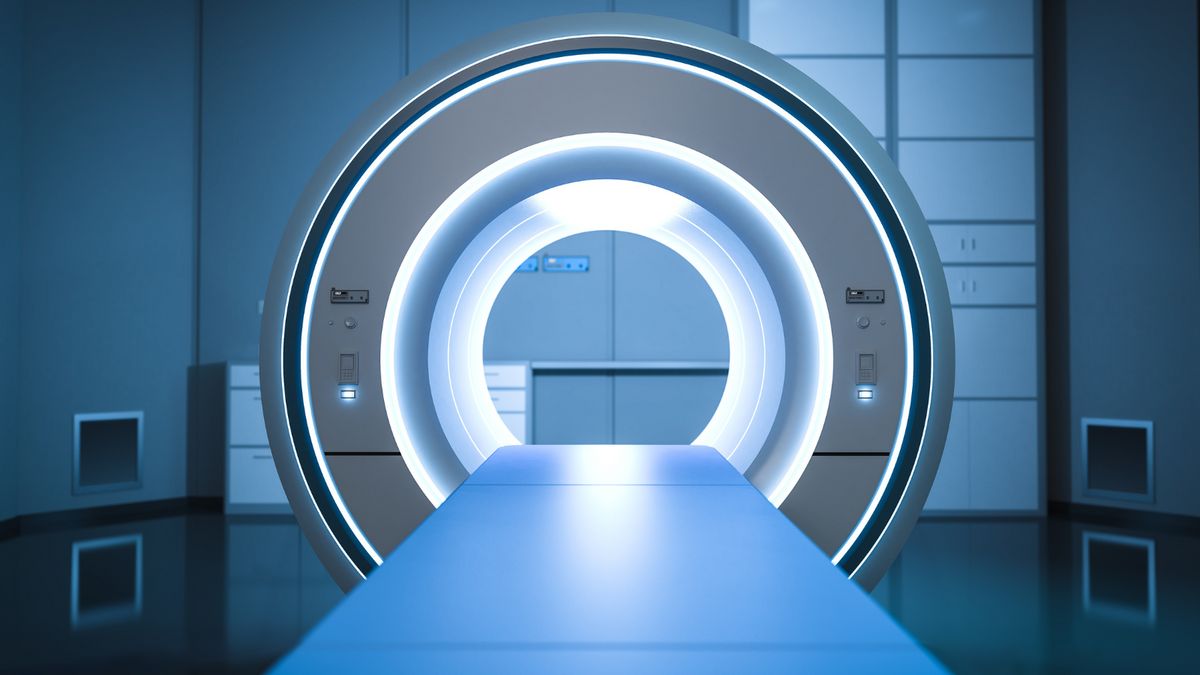
In July 2025, social media posts claimed a 61-year-old man died after being pulled into an MRI machine while wearing a metal chain.
The man was not a patient but walked into the MRI room while a scan was in progress, the posts claimed. Police reportedly said the man was at the hospital with someone else, according to the posts.
Snopes readers emailed us and searched our website to determine if the claim was true.
Police in New York confirmed that a 61-year-old man died after he was pulled into an MRI machine at a medical facility. The victim wore "a large metallic chain around his neck, causing him to be drawn into the machine," the Nassau County Police Department said in a statement. Therefore, we've rated this claim true.
Officers responded to a 911 call at Long Island's Nassau Open MRI on July 16, 2025, the statement said. When officers arrived, they learned that a 61-year-old man entered "an unauthorized Magnetic Resonance Imaging (MRI) room while the scan was in progress," according to the police department.
The man, who was not identified in the police statement, "was wearing a large metallic chain around his neck," which led to him being drawn into the machine, resulting in a medical episode, police said. Medical personnel took the man to a local hospital in critical condition, and he died the following day, according to police.
Police said an investigation into the man's death is ongoing.
Though police did not name the victim,
News 12 Long Island spoke to Adrienne Jones-McAllister, a woman identified as his wife.
Jones-McAllister told News 12 that, while in the exam room, she asked a technician to get her husband to help her off the table after she had an MRI on her knee. According to News 12, the
A spokesperson for the police department told Snopes it was unable to comment on Jones-McAllister's accusation that a technician allowed her husband into the exam room. We also reached out to Nassau Open MRI, the medical facility, for more information, and we will update this story if we receive a response.
Jones-McAllister told News 12 she saw her husband "walk toward the table" and the machine "snatch him." According to a person who identified themselves as Jones-McAllister's daughter in a GoFundMe campaign, Jones-McAllister and the technician "tried for several minutes to release him before the police were called."
"He was attached to the machine for almost an hour before they could release the chain from the machine. Unfortunately, on July 17th, he lost his battle after having several heart attacks following the tragic incident," the GoFundMe campaign said.
MRIs produce 'strong magnetic field'
MRIs "produce a strong magnetic field," the National Institute of Biomedical Imaging and Bioengineering explains on its website. This will attract magnetic objects, including everything from small items such as keys and cellphones to larger items like oxygen tanks, according to the U.S. Food and Drug Administration (FDA).
If these objects "become projectiles," or objects that propel through the air, they "may cause damage to the scanner or injury to the patient or medical professionals," the FDA says.
The Cleveland Clinic advises people to "leave all jewelry and other accessories at home or remove them before your MRI scan," adding that "metal and electronic items aren't allowed in the exam room because they can interfere with the magnetic field of the MRI unit, cause burns or become harmful projectiles."