
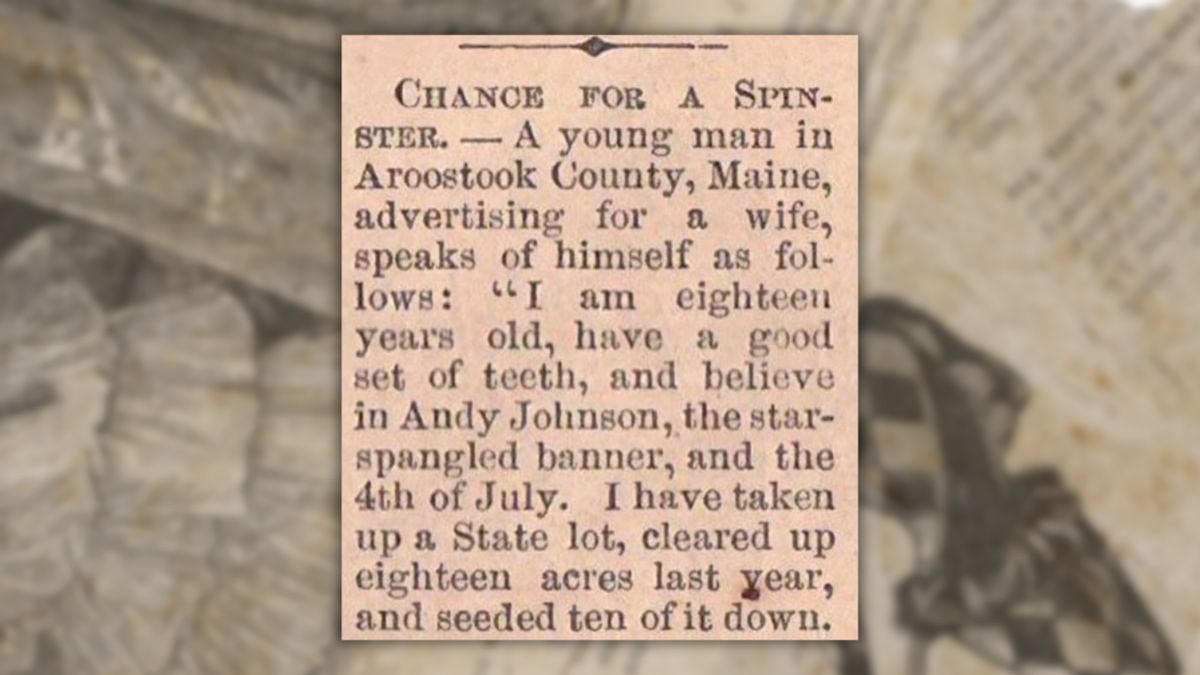
Rumors that a screenshot of a 19th-century newspaper clipping authentically depicted an article written by an 18-year-old man seeking a wife circulated online in March 2026.
Users on social media platforms like X (archived) shared the purported ad, which also made the rounds on Reddit as the subject of a popular thread.
The article in the screenshot read in full:
Chance for a Spinster. — A young man in Aroostook County, Maine, advertising for a wife, speaks of himself as follows: "I am eighteen years old, have a good set of teeth, and believe in Andy Johnson, the star-spangled banner, and the 4th of July. I have taken up a State lot, cleared up eighteen acres last year, and seeded ten of it down. My buckwheat looks first-rate, and the oats and potatoes are bully. I have got nine sheep, a two-year-old bull, and two heifers, besides a house and barn. I want to get married. I want to buy bread-and-butter, hoop-skirts, and waterfalls for some person of the female persuasion during life. That's what's the matter with me. But I don't know how to do it."
Looking for a wife in 1865 pic.twitter.com/5YWWag7isA
— Max Roser (@MaxCRoser) June 19, 2017
The "Chance for a Spinster" ad shared in the claims was authentic and originated on Page 551, Issue 453 of popular magazine Harper's Weekly, cover dated Sept. 2, 1865, in a section labeled "Humor of the Day."
The section featured satirical stories and simple jokes like, "What is the oldest tree known to man? — The elder tree, of course."
However, further research showed that the ad did not originate as satire, even though its inclusion in a humor section was what popularized it.
Instead, it appeared to be an authentic response from a man named John Morris to a classified ad in a Maine newspaper that eventually got picked up as a humor item in Harper's Weekly and other papers.
The June 30, 1865, edition of the Aroostook Times (later named the Houlton Times), provided to Snopes by archivists at the University of Maine, featured a classified ad from a woman named Sarah B. Lambert in Greenpoint, New York, who claimed to offer advice for finding a marriage partner. The ad read:
Matrimonial.
Ladies and Gentlemen: If you wish to marry you can do so by addressing me. I will send you, without money and without price, valuable information that will enable you to marry happily and speedily, irrespective of age, wealth or beauty. This information will cost you nothing and if you wish to marry, I will cheerfully assist you. All letters strictly confidential. The desired information sent by return mail. Please inclose postage or stamped envelope, addressed to yourself.
In fact, the June 30 ad appeared to be marketing for Lambert's collection of marriage advice called "Matrimony; or Marriage Made Easy," a pamphlet that can be read digitally through Texas A&M's archive.
In the same document, Baldwin also advertised a matchmaking service in which "a respectable lady or gentleman residing in any part of the Loyal States, seeking a favorable Matrimonial alliance, can send an advertisement ... giving description of their personal appearance, position in society, together with their wishes in regard to the person they desire to correspond with."
Baldwin claimed she would put the inquirers in "direct communication with congenial spirits of the opposite sex."
"Loyal states" referred to The Union during the American Civil War, which is likely why
The letter from Morris appeared in the July 6, 1865, edition of the same paper with additional context not shown in Harper's Weekly later reprinting. It was published under the headline "Spicy Correspondence."
Morris wrote to the paper to forward the letter he sent to Lambert — the one later republished in Harper's Weekly — but also to share the response he claimed to have received from Lambert in response.
He wrote, "Mr. Editor: I believed in Sarah B. Lambert, I trusted in Sarah B. Lambert, and I wrote to her, inclosing the requested postage stamp for help; and here is what Sarah B. Lambert wrote back to me."
The rest of Morris' letter appeared as reprinted in Harper's Weekly and appeared to be an authentic response to Lambert's ad.
However, Lambert's original ad may have been what would now be considered trolling
Her response to him, according to Morris, read:
Your letter asking for advice and assistance in regard to obtaining a wife is received. In reply I have to state that within a short distance of New York is an Asylum for idiotic and imbecile females, among whom I have no doubt you will readily find a congenial and acceptable mate. No Charge. Yours truly, Sarah B. Lambert
The Aroostook Times again followed up on July 21, 1865, publishing that Morris received a new response addressed to "Mr. John Morris, the man, who wants a wife, somewhere in Aroostook County" written in "delicate hand" and urged Morris to send a response to the paper "that he may make himself better known to the fair creature who has interested herself in writing him."
They added, "If he is really in a hurry for a wife, now is his chance."
Before Morris' letter to Lambert made the national stage in Harper's Weekly, other papers in Maine similarly reported on his letter in a jesting tone, including Lambert's suggestion to visit an "asylum."
In sum, the article was authentic but appeared to originate as a private letter in response to a classified ad, which was then made public and became the 19th-century equivalent of a "dunk post," a modern internet phenomenon in which an original poster's message is shared and mocked.