
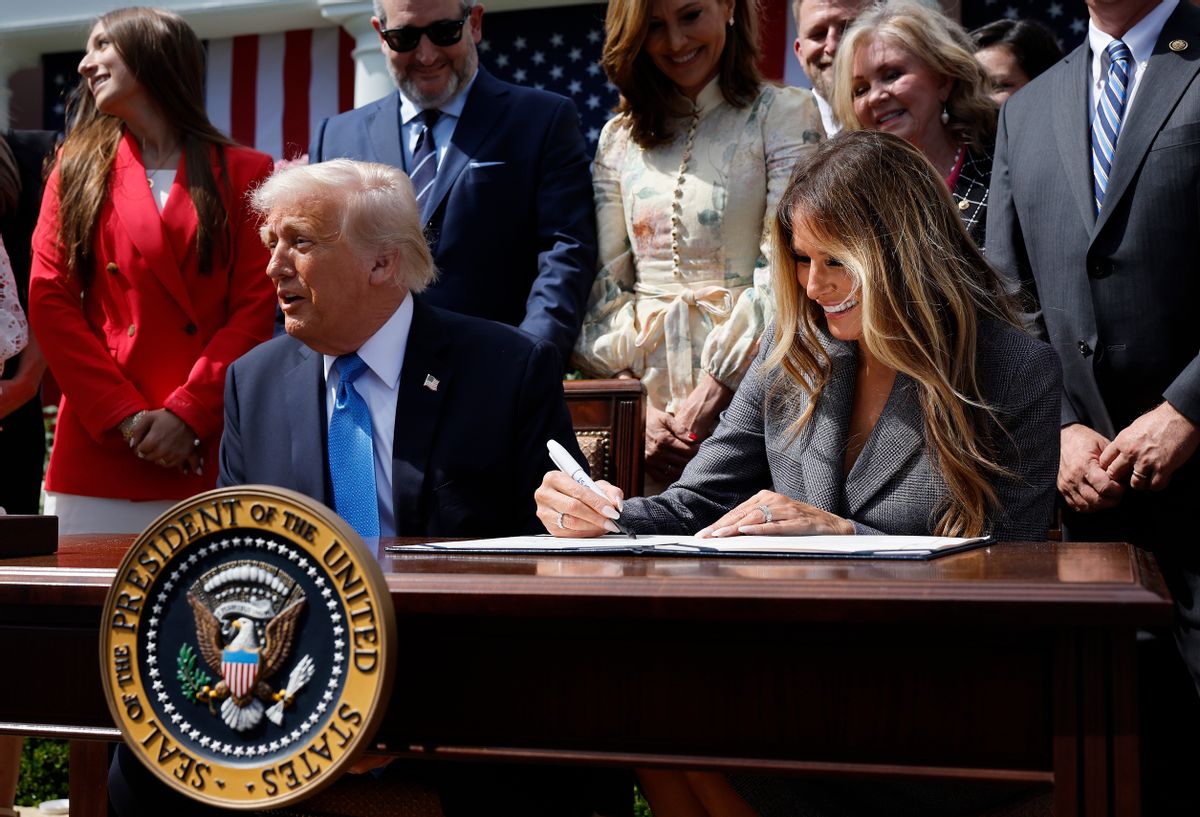
In mid-May 2025, as U.S. President Donald Trump signed the Take It Down Act — a
Snopes received numerous queries from readers who shared several posts and memes claiming the first lady signed an executive order.

(X user @thetonymichaels)
However, Melania Trump did not sign an executive order. Instead, she signed a document that officially ratified into law a bill that was passed by Congress. The president signed the document first, making the law official, before encouraging her to do so as well. Therefore, Melania Trump's signature was purely symbolic because, as first lady, she has no legislative authority. As such, we have rated this claim as mostly false.
According to
The legislation
- an adult subject where publication is intended to cause or does cause harm to the subject, and where the depiction was published without the subject's consent or, in the case of an authentic depiction, was created or obtained under circumstances where the adult had a reasonable expectation of privacy; or
- a minor subject where publication is intended to abuse or harass the minor or to arouse or gratify the sexual desire of any person.
At the White House event for the signing, the president noted that Melania Trump had ushered the bill forward. After Donald Trump signed the bill into law, he encouraged his wife to sign the document. She appeared to mildly object when he said: "C'mon, sign it anyway. She deserves to sign it." The exchange can be seen below.
Per photographs on Getty Images, the first lady can be seen signing the document. When the president holds it up, her signature is visible below his.

(Chip Somodevilla/Getty Images)

(Chip Somodevilla/Getty Images)
However, social media users erroneously stated that Melania signed an executive order. According to the American Civil Liberties Union, an executive order is a written directive signed by the president to order the government to take specific actions. A bill, on the other hand, is a piece of legislation that needs to be passed by Congress and signed by the president to become law. An executive order does not require congressional approval to be implemented and Congress cannot simply overturn it.
The Associated Press noted that Melania's signature was a purely
Per Melania's speech at the signing:
This legislation is a powerful step forward in our efforts to ensure that every American—especially our young people—can feel better protected from their image or identity being abused through non-consensual intimate imagery or NCII.
Artificial Intelligence and social media are the digital candy of the next generation—sweet, addictive, and engineered to have an impact on the cognitive development of our children. But unlike sugar, these new technologies can be weaponized, shape beliefs, and sadly, affect emotions and even be deadly.
The