
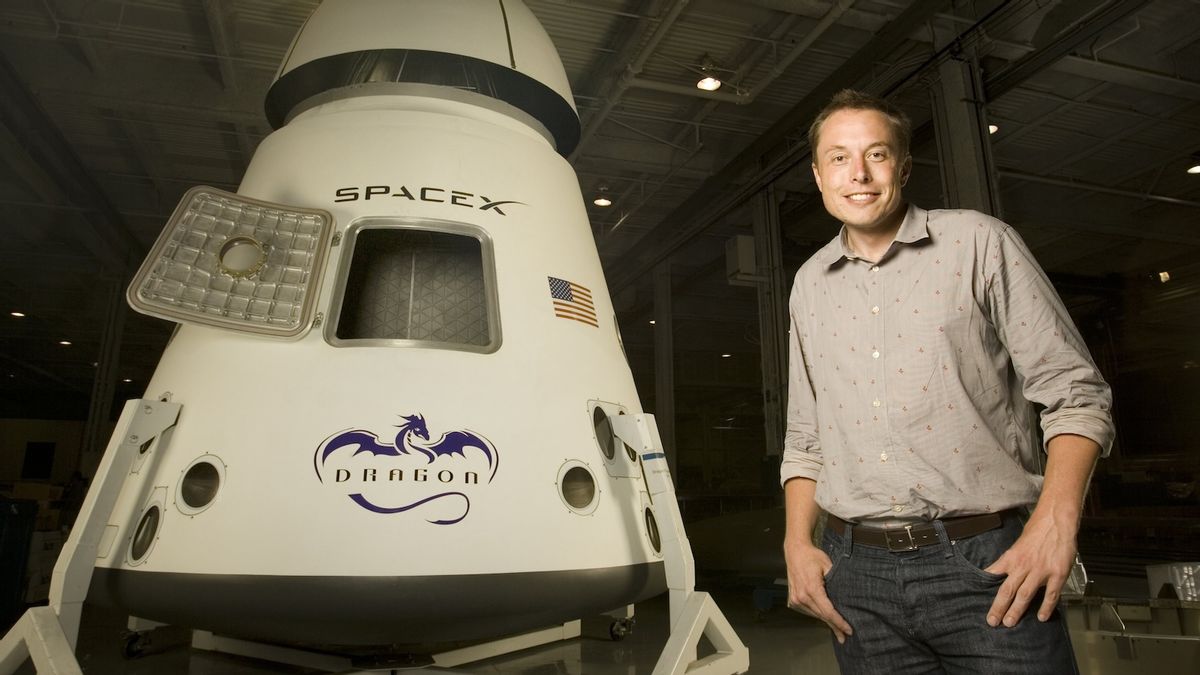
A viral meme in the mid-2010s claimed that South African-born Elon Musk — one of the most influential tech entrepreneurs of our time as the founder of SpaceX and CEO of Tesla — was once, in his brother's words, an "illegal immigrant" in the United States.
This isn't the first time Snopes has attempted to fact-check this claim. In 2016, we explored whether Musk's immigration status had ever been "illegal," pointing out that his pathway from student visa to U.S. citizenship in 2002 appeared to involve various legal visa programs and categories.
The claim gained traction again on social media platforms like Reddit and Facebook after an old interview resurfaced in 2024, in which Musk's younger brother, restaurateur Kimbal Musk, mentioned their uncertain immigration status while recounting the early days of their tech startup, Zip2.
For instance, on March 8, 2024, an Instagram account shared the following clip from that 2013 interview with the Musk brothers, where they discussed their prior U.S. immigration statuses:
So, was Elon Musk ever truly an undocumented immigrant in the U.S., or does this story have more nuance?
Snopes reexamined the claim about Musk being a former undocumented immigrant, searching for any new developments in the eight years since we first explored the claim about his U.S. legal status.
Musk's Murky Immigration Timeline
N

(Elon Musk/X)
However, on Sept. 29, 2024, Musk followed up with another post that many interpreted as anti-migrant, in which he claimed, "The Biden/Harris administration has been flying 'asylum seekers', who are fast-tracked to citizenship, directly into swing states like Pennsylvania, Ohio, Wisconsin and Arizona. It is a surefire way to win every election." That post had more than 103 million views as of this writing. (Snopes investigated a set of claims very similar to this in March 2024.)
A new report by The Washington Post, published Oct. 26, 2024, attempted to uncover the truth about Musk's own pathway to U.S. immigration, concluding that he "worked illegally in the United States as he launched his entrepreneurial career after ditching a graduate studies program in California."
For its report, The Washington Post spoke with several of Musk's former business associates in Silicon Valley from the 1990s and with immigration experts. The report did not clarify whether those immigration experts had any direct working knowledge of Musk's immigration case.
It's also worth noting that under the Privacy Act of 1974, U.S. Citizenship and Immigration Services does not share or discuss personal immigration information about U.S. citizens and lawful permanent residents due to privacy considerations. Much of what we know about Musk's pathway to citizenship comes directly from his statements to the media. Although we reached out to Musk for clarification, he had not responded as of this writing.
Derek Proudian, a board member for the Musks' former internet startup Zip2, which they founded in late 1995, told the Post, "Their immigration status was not what it should be for them to be legally employed running a company in the U.S.," adding, "We don't want our founder being deported."
The Post also referenced an unnamed 2020 podcast, in which Musk reportedly said he had a "student-work visa" in 1995 after deferring his studies. Musk stated in the podcast, "I was legally there, but I was meant to be doing student work," adding to The Post, "I was allowed to do work sort of supporting whatever."
The outlet unearthed several documents, including an email Musk apparently wrote in 2005 to Tesla co-founders Martin Eberhard and JB Straubel. Reportedly submitted as evidence in a defamation lawsuit between Musk and Eberhard, the email included Musk's account of his decision to defer Stanford to launch his internet startup, but it did not confirm Musk's past immigration status. Per the Post's recounting of the email:
"I didn't really care much for the [Stanford] degree, but I had no money for a lab and no legal right to stay in the country, so that seemed like a good way to solve both issues," Musk wrote. "Then the internet came along, which seemed like a much surer bet."
The day after the Post published its report on Musk's apparent past illegal status in the U.S. on Oct. 26, 2024, he responded on X, asserting that he did have a J-1
I was on a J-1 visa that transitioned to an H1-B.
They know this, as they have all my records.
Losing the election is making them desperate.— Elon Musk (@elonmusk) October 27, 2024
The U.S. Citizenship and Immigration Services website describes a J-1 classification as authorized for individuals participating in approved programs for teaching, researching, lecturing, studying, observing or consulting. Musk obtained Canadian citizenship several years prior to enrolling at Stanford University in 1995. Canadians generally do not need a U.S. entry visa if they have an F-1 student visa or J-1 visa. However, U.S. Customs and Border Protection does require Canadian students to obtain an I-20 Certificate of Eligibility from their chosen U.S. institution or exchange program.
The Origin of the 'Illegal' Claim
This claim that Musk once had "illegal" status in the U.S. seemed to stem from the 2013 interview at the Milken Institute Global Conference. During the interview, Kimbal Musk recalled that venture capitalists they met in 1996 (before Elon graduated from the University of Pennsylvania) "realized that we were illegal immigrants."
Elon Musk laughed and corrected him, saying it was more of a "gray area."
This potentially tongue-in-cheek response fed the narrative that Musk lived in the U.S. as an undocumented immigrant between 1995 and 1997, prior to becoming a U.S. citizen in 2002. A closer look at the timeline paints a more complicated picture.
Born in South Africa in 1971, Musk moved to Canada in 1989 after securing Canadian citizenship through his mother, model and dietitian Maye Musk, who was born in Regina, Canada. Musk's move marked his first step toward legal immigration to North America.
In 1992, Musk transferred from Queen's University in Ontario, Canada, to the University of Pennsylvania (UPenn), Philadelphia. While reports indicate that Musk enrolled in UPenn on a student visa, they don't specify the visa type. Immigration consultancy Papaya Global claimed he arrived in the U.S. on an F-1 foreign student visa, but this detail remains unconfirmed. Musk's documented legal authorization to reside in the U.S. seems to have begun with this initial student visa.
Although Musk did not graduate UPenn until 1997, it's unclear whether he engaged in Optional Practical Training (OPT), a temporary work authorization often granted to international students in the U.S., during this time.
In a 2013 South by Southwest (SXSW) keynote address, Musk described obtaining his H-1B visa, a temporary nonimmigrant legal work authorization that allowed him to work for U.S. companies after completing his studies. However, he didn't mention when he secured the H-1B visa:
"I came out to Silicon Valley to do a Ph.D. at Stanford [University in 1995], in applied physics and material science to work on ultra-capacitors for use in electric cars. And that's what I was going to do, and then I decided to put that on hold to start a company. But since I already had my undergrad, I could then get a H-1B visa and that kinda thing. So, the H-1B visa requires a degree. But other than that, if that wasn't the case, I probably would've stopped education sooner."
Below is a snippet of the longer interview from SXSW, shared to X in 2022.
Misinterpretation and the 'Gray Area'
Kimbal Musk's comments in 2013, from which the rumors about Elon Musk's immigration status evidently sprang, may have been hyperbolic. Legal gray areas can sometimes arise with nonimmigrant temporary visas, especially if administrative delays occur between visa statuses, but no concrete evidence shows Musk unlawfully residing in the U.S. during this period.
Since our initial fact-check in 2016, public interest in Musk's immigration status has persisted, particularly with the meme's resurgence in 2024. Updated sources further confirm that while Musk's immigration status may have been complex at certain points, and despite claims made by The Washington Post, no credible evidence supports that he was an "illegal immigrant," in his brother's words.
In sum, the claim that Elon Musk once held "illegal" status in the U.S. remains unproven. Musk's joke about being in a "gray area" hints at complexities but doesn't constitute evidence. Available evidence indicates he followed a legal path through student visas and H-1B temporary employment visas, allowing him and his brother to establish Zip2 in 1995. Musk later became a U.S. citizen in 2002, though the full details of his prior legal status remain partially unverified. There is no credible evidence that he was ever fully "illegal" during his more than three decades in the U.S.
We will continue to monitor this story for any additional documentation or insights into his early visa status, and we will update this article as more information becomes available.
Snopes' archives contributed to this report.