
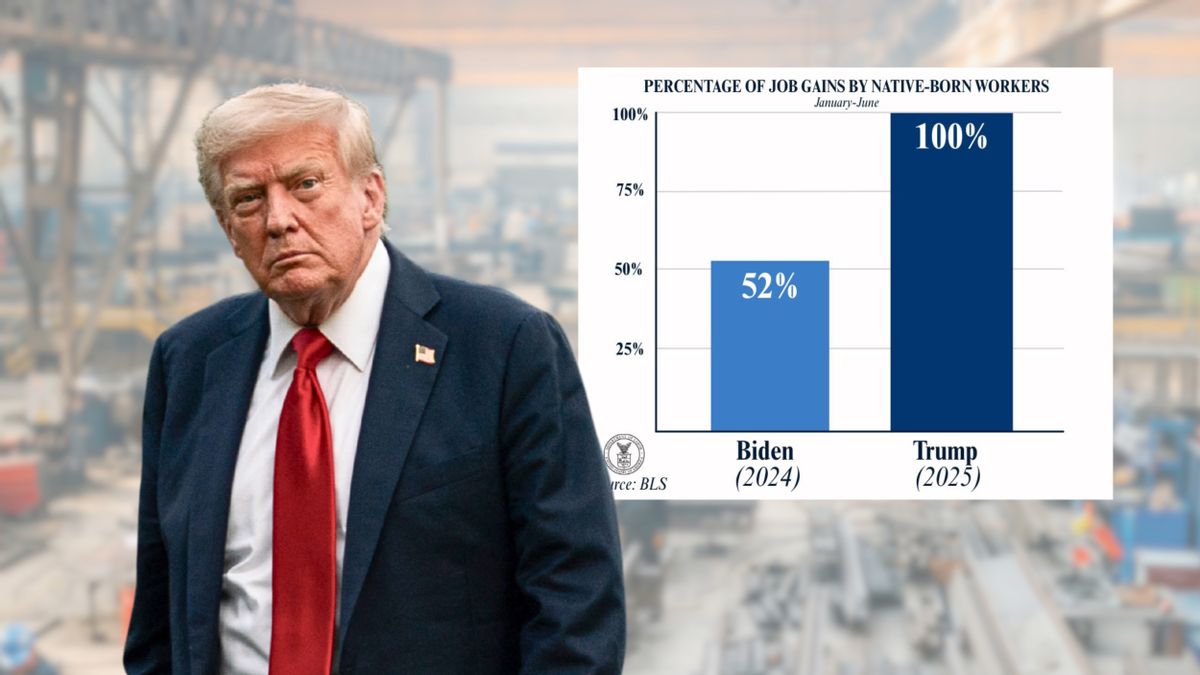
On July 7, 2025, the U.S. Department of Labor posted (archived) on X: "Under @POTUS, native-born workers have accounted for ALL job gains since January. American Workers First!"
The post was accompanied by a graph titled "American jobs for AMERICAN WORKERS" showing the percentage of job gains by native-born workers from "January to June" with bars indicating 52% for Biden (2024) and 100% for Trump (2025). In the bottom left corner, the graph cited the Bureau of Labor Statistics as the source.

(USDOL/X)
The same graph also appeared on the Facebook page of U.S. Rep. Mary Miller, an Illinois Republican, along with the following caption (archived): "The American people are the hardest-working, most innovative, and highly skilled in the world. Thanks to President Trump, our native-born workforce is finally getting the respect and priority it deserves after being forgotten by Joe Biden!"
We rated the claim true. But while native-born workers did account for all job gains
We attempted to contact the Labor Department's press office for clarification on its methodology and data sources. We also reached out to the BLS for comment on the use of its employment data in the social media posts. Neither agency responded to our requests for comment by publication time.
Analysis of the data
According to BLS data accessed through the Federal Reserve Economic Data system, employment levels by nativity and total employment levels from the Current Population Survey (Household Survey) — which was not seasonally adjusted — were as follows:
Trump period (
- Native-born employment: Increased from 130.573 million to 132.652 million (+2.079 million)
- Foreign-born employment: Decreased from 31.774 million to 31.231 million (-543,000)
- Total employment: Increased from 162.347 million to 163.883 million (+1.536 million)
- Native-born share of job gains: 100%
Biden period (January 2024-June 2024):
- Native-born employment: Increased from 129.807 million to 130.906 million (+1.099 million)
- Foreign-born employment: Increased from 29.842 million to 30.867 million (+1.025 million)
- Total employment: Increased from
159.6 50 million to 161.774million (+2.124 million) - Native-born share of job gains: 51.7
%
Note: We used employment data from the Current Population Survey (Household Survey) for all calculations, as this is the only BLS survey that provides employment breakdowns by nativity. We did not use the All Employees, Total Nonfarm data from the Current Employment Statistics (Establishment Survey) in order to ensure methodological consistency
We used the following

The data analysis confirmed that native-born workers accounted for 100% of non-seasonally adjusted job gains during the January-June 2025 period, as foreign-born employment decreased by 543,000 jobs during this timeframe.
What non-seasonally adjusted data means
According to the definition of seasonal adjustment by BLS, non-seasonally adjusted data includes the effects of recurring seasonal influences such as weather, holidays and school schedules. This means the employment figures reflect normal seasonal patterns that occur every year, such as post-holiday layoffs in January or summer hiring increases.
Most employment data reported in the news is seasonally adjusted, which removes these predictable seasonal effects to show underlying trends more clearly.
Presidential transition timing
Trump took office on Jan. 20, 2025, meaning Biden was still president for the first 19 days of January 2025. Therefore, the Trump period in the Labor Department's graphic included nearly three weeks when Biden was still president — meaning not all the job data during that period could accurately be attributed to Trump.