
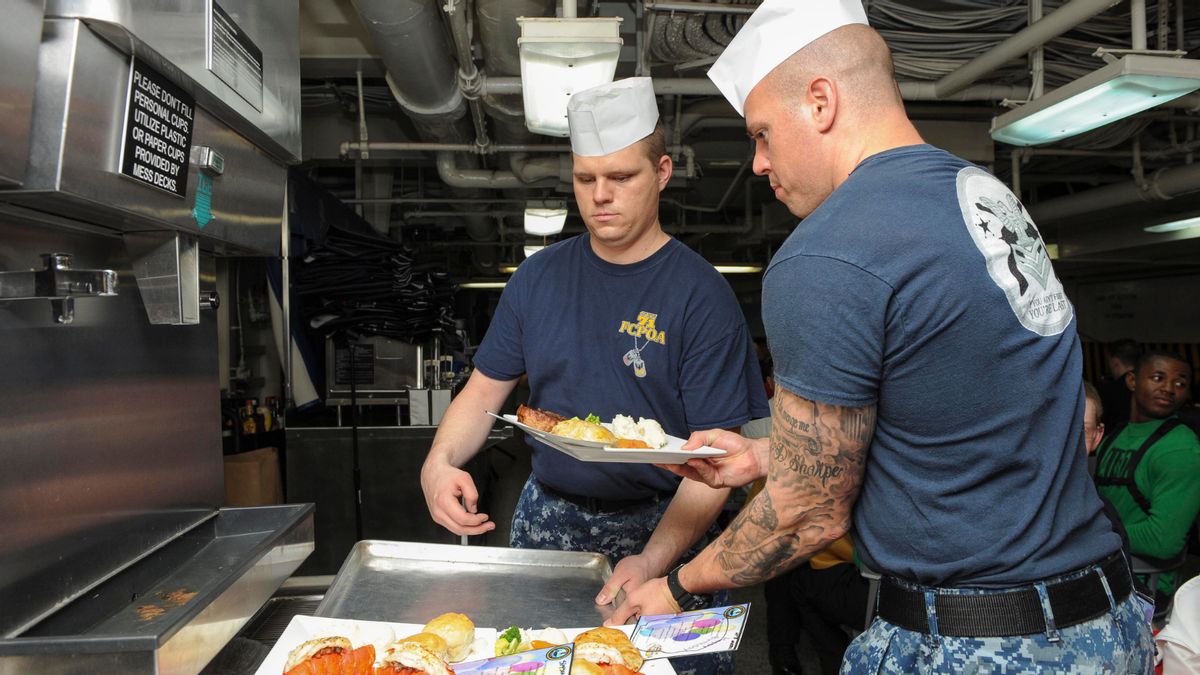
In February 2026, a rumor circulated online that the U.S. Navy charges its service members for their meals while they are enlisted and on sea duty or living in barracks.
Social media users on X and Facebook (archived), as well as in a thread on Reddit, chimed in on these alleged charges, most expressing surprise at their purported existence. For example, one X account wrote (archived), "The Navy continues to charge sailors for meals while deployed."

Some people,
Also its literally prison food btw https://t.co/PKhpA57Qyp
— 🏳️⚧️Jolene_Donuts 🏳️⚧️ @Slashback probably (@Jolene_Donuts) February 18, 2026
The Navy, as well as other branches of the military, offers a Basic Allowance for Subsistence, often referred to as BAS, for service members. This is intended to offset the cost of their meals.
Speaking via email, a Pentagon official said BAS is considered part of a service member's pay and is deposited directly into their bank account monthly. "Members provided with meals, such as those on sea duty or living in the barracks, are entitled to BAS; however, the Department deducts the cost of the meals from their BAS for their convenience," the official wrote. Members in basic training do not receive BAS.
The official said the 2026 BAS for enlisted members is $476.95 with a daily food rate of $13.65 over 30 days, totaling $409.50. They added, "These members do not incur an out-of-pocket cost, and, in fact, they retain the $67.45 difference between the amount of their BAS and the amount collected."
Therefore, because money that is considered part of a service member's pay is deposited into a service member's bank account and then the food cost is deducted, we have rated this claim as true.
Where the policy originated
The policy was introduced on Jan. 1, 2002, according to the Military Compensation and Financial Readiness website, which states it was "intended to defray a portion of the cost of food for the service member, its level is linked to the USDA's food cost index." The website further states that prior to 2002, "the military provided room and board (or rations) as part of a member's pay."
The
Just weeks after the policy change, in a January 2002 issue of The Hill Top Times (a newspaper servicing Hill Air Force Base in Ogden, Utah), a Navy official clarified that, "Charges, at the discount meal rate, will be directly deducted from the member's pay account … Members directed to use the dining facility will have three meals a day deducted from their pay whether meals are eaten or not."
An exception is made for "enlisted members on duty at a permanent station and assigned to single (unaccompanied) Government quarters, which do not have adequate food storage or preparation facilities, and where a Government mess is not available, and the Government cannot otherwise make meals available."
As an example, in 2025, enlisted service members received a BAS of $465.77 per month according to the Defense Finance and Accounting Service data. By comparison, officers received $320.78 per month.
In December 2025, the USDA's lowest estimated monthly food cost for a 20- to 50-year-old male in 2025 was $309.20, which was deducted from the BAS whether or not that service member ate the allotted three meals a day.
Where the claim originated
The rumor originally surfaced due to an article titled "Sailors Should Not Pay for Meals at Sea" that appeared in a February 2026 issue of Proceedings, a magazine the U.S. Naval Institute publishes.
The Naval Institute is a nonpartisan, nonprofit organization focused on "the professional, literary, and scientific understanding of sea power and the critical issues shaping global security," according to its website.
The
Proceedings further cited official US policy that allowed the Secretary of Defense — Pete Hegseth, as of this writing — the "opportunity to reduce the meal rate by however much can be attributed to operating expenses." The article stated that the "Secretary, therefore, has the authority to reduce the cost of meals to $0."