
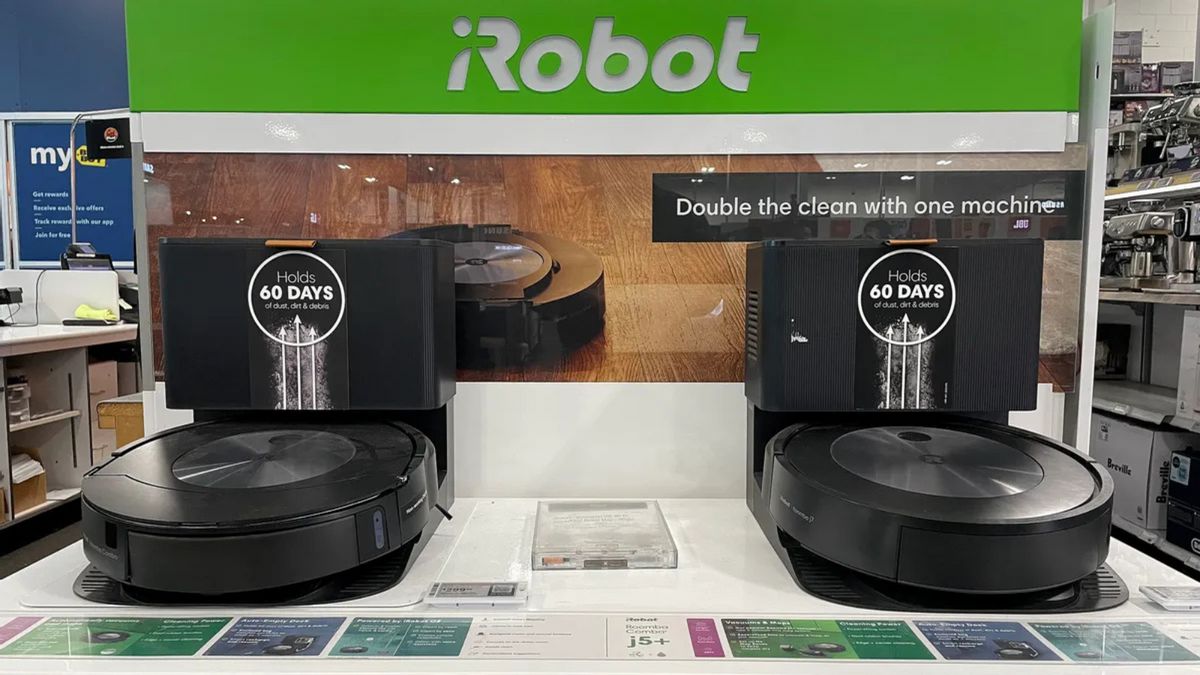
In December 2022, MIT Technology Review published an article, titled, "A Roomba recorded a woman on the toilet. How did screenshots end up on Facebook?" The article explained exactly what its headline stated — that in 2020, photos taken by Roomba robot vacuums, some of which could be viewed as potentially compromising, made their way onto Facebook.
A viral video posted to Facebook in May 2025 re-upped interest in the story, and Snopes readers searched the site wondering if it was true. It was.
According to a statement from iRobot in the article, the photos in question were not taken by commercially available Roombas, however. Instead, they were from "special development robots with hardware and software modifications that are not and never were present on iRobot consumer products for purchase"; owned by "paid collectors and employees," who the company said signed agreements acknowledging that the robots would be capturing photos and videos for training; and that featured a "bright green sticker that read 'video recording in progress.'"
According to the story, the vacuums took pictures of their surroundings for the purpose of training artificial intelligence models. In order for a robot to understand what it's looking at, however, a human first needs to tell the robot what various objects are.
MIT Technology Review wrote that iRobot did not allow them to see the consent forms, and the company did not allow reporters to speak with any of the employees or paid collectors. In a follow-up story, however, several individuals who tested the special robots told MIT Technology Review they felt misled by the consent agreement they signed and were concerned about how iRobot used their data.
It is important to note that in this case, the robots were not commercially available, and whether or not iRobot breached its data privacy agreement, the robots were labeled as being able to take photo and video. IRobot's privacy policy contains the following section on how it uses data from Roombas:
Some of our devices are equipped with "smart technology" that can wirelessly send us data. These devices include, but are not limited to:
- Roomba j series
- Roomba i series
- Roomba s series
- Certain Wi-Fi connected Roomba 600 series
- Braava jet m series
- aair Lite Small Room Air Purifier
- aair 3-in-1 Pro Air Purifier
If you have one of these devices, we may collect information about your:
- device and app usage, like name, device number, battery life, mission information, device health and operations data,
- device replenishment like the need for new filters or other robot device parts,
- device environment like level of dirt, Wi-Fi name/credentials/signal strength, robot movement, floorplan and room names, existence and type of objects, floor type, other iRobot devices,
- partner app information (specifically the names of smart home partner apps you have downloaded.
This data is stored in a deidentified state (separated from identifiable information).
- Unless your device is enrolled in the iRobot Select program, your device will NOT automatically transmit this information to iRobot. To be able to transmit, the device needs to be (1) registered online and (2) connected to Wi-Fi, Bluetooth or the internet in some way. Apart from iRobot Select devices that require connections to operate, you can use our smart technology devices without Wi-Fi or Bluetooth data transmission, simply by disconnecting your Wi-Fi or Bluetooth from the device or by never connecting it at all. For more information on how to disconnect your device from Wi-Fi or Bluetooth, please see the section below "9. What are my choices regarding my information?".
But because most robot vacuums connect to Wi-Fi, have cameras (and some have speakers and/or microphones), there are several valid security concerns about robot vacuums — give experienced hackers enough time and they'll probably find a way to get into a system.
In 2020, for instance, researchers at the University of Maryland were able to record audio using a "laser-based navigation system" that vacuum robots use to determine where objects are.
More recently, Dennis Giese, an independent researcher who tears down and hacks robot vacuums in his spare time, helped the Australian Broadcasting Corporation hack into an Ecovacs Deebot X2 in 2024 — earlier that year, according to a separate ABC article, several Ecovacs robots were hacked in cities across America, and shouted racial slurs at their owners.