
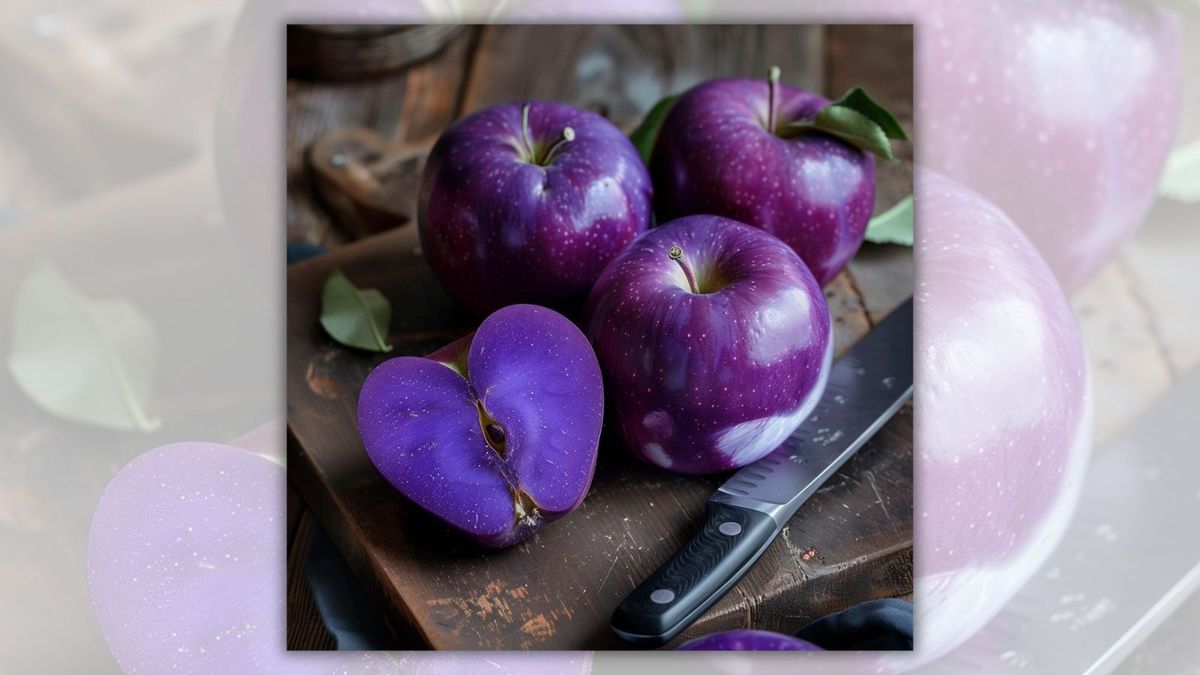
On Sept. 15, 2024, readers questioned the veracity of a photo being shared online that showed a group of purple apples on a cutting board. One of the fruits was cut in half, revealing the flesh to also be bright purple.
The image was part of a Facebook post (archived) from Sept. 11, 2024, by a user named Marian
The Purple Apple, originating from Saskatchewan, Canada, thrive in its chilly climate, boasting a flavor profile reminiscent of cinnamon and banana. Sometimes referred to as "Canadian Grapes." Their vibrant purple exterior hides a richly colored interior, making them prized ingredients, particularly in the creation of purple applesauce, celebrated by indigenous Saskatchewan peoples. This culinary tradition not only signifies cultural heritage but also fosters community unity and pride. With their health benefits and potential economic impact, purple apples serve as a symbol of resilience and connection to the land, embodying the rich tapestry of Saskatchewan's cultural and culinary heritage.
As of this writing, the post had amassed more than 100,000 reactions, 47,000 shares and 7,900 comments, many of them doubting the authenticity of the picture and caption.
For example, one commenter on the Facebook post wrote, "I am from Canada, driven all across it in the apple season; and I promise we ain't got these apples." Another said: "The fact that they're lying about not just the apple but the cultural signifigance and stuff too is not only stupid, I'd also say its offensive."
These users were right to be skeptical, as there was no evidence to support the existence of apples with both purple skin and purple flesh, in Saskatchewan or elsewhere. Additionally, the owner of the Marian spencer account confirmed the images were produced using AI software. It's for these reasons we rated this image as a fake.
The Sept. 11 post was not the only photograph of purple apples posted by the Marian spencer account. Later the same day, the same user posted two additional photos with the same caption. One showed (archived) a tree laden with purple apples, while the other showed (archived) purple apples surrounding a bowl of what appeared to be purple applesauce:

(Facebook account Marian spencer)
Reverse image searches conducted Google Images and TinEye at the time of writing found no evidence that any of the three photos had appeared elsewhere online prior to the three Marian spencer posts.
However, an AI artist named Josh Enix, who uses the handle @unnaturalist.ai on Instagram, reached out to Snopes over email to identify himself as the original creator of the images, which he posted to his Instagram account in March 2024.

(Josh Enix/@unnaturalist.ai)
(According to Enix, the Marian spencer account reposted multiple pieces of his work without permission or credit. In response, the owner of the Marian spencer account told us, "I do not claim that the image is entirely mine," and that its posts of the images included the hashtag "#unnaturalistai" in reference to Enix.)
Beyond the authenticity of the photos themselves, there was no evidence to support the posts' claims that purple apples grew in Saskatchewan or represented any aspect of the province's "cultural and culinary history."
In an email, Kim McKenzie, the owner of Symmetree Orchard in Luseland, Saskatchewan, said the posts' claims about purple apples in the province were "false," explaining: "We can grow apples in Saskatchewan but…definitely no purple ones."
Purple apples do exist elsewhere in the world, but none of these matched the apples shown in the images. For example, Black Diamond apples have skin that is a purple so deep it can be mistaken for black. Purple Bravo apples have skin that is reddish-purple or burgundy. Critically, Black Diamond and Purple Bravo apples both have flesh that is white — not purple — underneath their skin.
Another fruit sometimes referred to as a purple apple is not a true apple at all. More commonly known as the star apple or caimito, that fruit is produced by a tree in the Chrysophyllum genus. True apples, by contrast, are members of the Malus genus.
The star apple, furthermore, presents some notable differences in appearance from the fruit shown in the image investigated here. First, it is spherical, lacking the indentations that give true apples their characteristic heart shape when halved. Second, while their inner flesh or pulp can be purple in color, star apples contain a large, star-shaped cluster of seed cells at their center.
Despite some superficial similarities to the apples shown in the images, none of these purple fruits is known to grow in Saskatchewan. Black Diamond apples are grown in Tibet, while Purple Bravo apples are grown in Australia. Star apples, native to Central America and the Caribbean, are now grown in many parts of the world, including Australia and some regions of Southeast Asia and Africa — but there were no reports of the plant being cultivated in Canada.
In summary, because the Facebook images of the purple apples were described as AI art by their creator, and because there was no evidence to support the posts' claims that purple apples are grown in Saskatchewan, we have rated this claim as fake.