
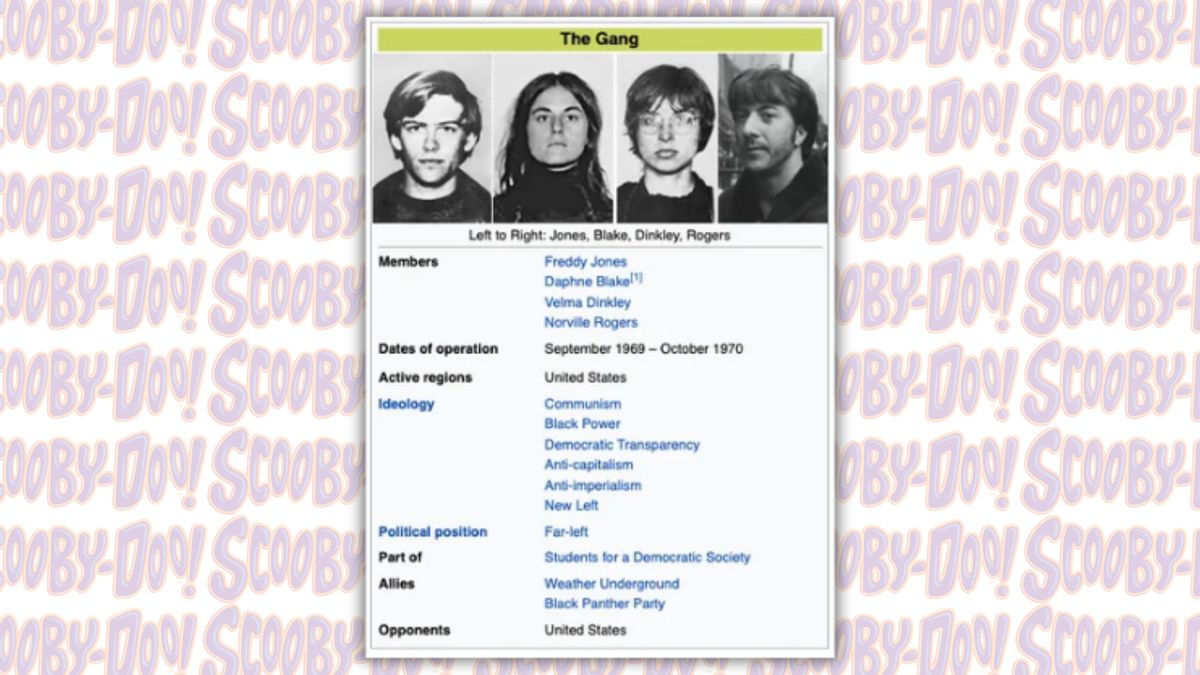
For years, an image has circulated online purportedly showing a Wikipedia sidebar featuring the photos of four people referred to as "The Gang," alongside the claim that the people depicted inspired the kids' television franchise "Scooby-Doo."
According to the alleged screenshot, the group's names matched those of the "Scooby-Doo" characters: Freddy Jones, Daphne Blake, Velma Dinkley and Norville Rogers (Shaggy's real name). It also said "The Gang" followed leftist ideologies such as communism, anti-imperialism and the Black power movement and was active in the U.S. between 1969 and 1970.
The image appeared on X, Instagram and Facebook throughout 2025. In November one Threads user said of it (archived): "Just found out scooby doo was a real gang and they was bout that life."

(Threads user @carringtonexplainsitall)
Origin of alleged screenshot
Based on a reverse image search, this screenshot of a supposed Wikipedia article appeared to
At the time of publication, no Wikipedia article for "The Gang" existed (archived)
Who's in the photos?
The creator of the screenshot used real leftist activists' photos for three of the four headshots, while one of them was a famous actor. None of the people depicted shared the names of "Scooby-Doo" characters.
The man referred to as "Freddy Jones" was actually Michael Justesen of the Seattle Liberation Front, an anti-Vietnam War movement. He was best
"Daphne Blake" was depicted by Bernardine Dohrn, a retired American law professor and former leader of the Marxist, anti-imperialist militant organization Weather Underground. She spent 1970 to 1973 on the FBI's 10 Most Wanted List.

The image used for "Velma Dinkley" was a mugshot of Diana Oughton, whom law enforcement arrested in 1969 for participating in an all-woman anti-Vietnam War protest in Chicago called the "Days of Rage" (alongside Dohrn, according to pages 13 and 30 of these FBI records). Oughton, a member of Weather Underground, died in 1970 after a bomb the group meant to detonate at a New Jersey Army base accidentally exploded in her vicinity.
The man in the fourth picture, said to show "Norville Rogers," was not a revolutionary at all. It showed actor Dustin Hoffman in the 1970s, best known for movies like "All the President's Men" and "Rain Man." There was no evidence Hoffman had been involved in any militant leftist organizations, but, as of this writing, he has repeatedly supported the (mainstream) Democratic Party.