
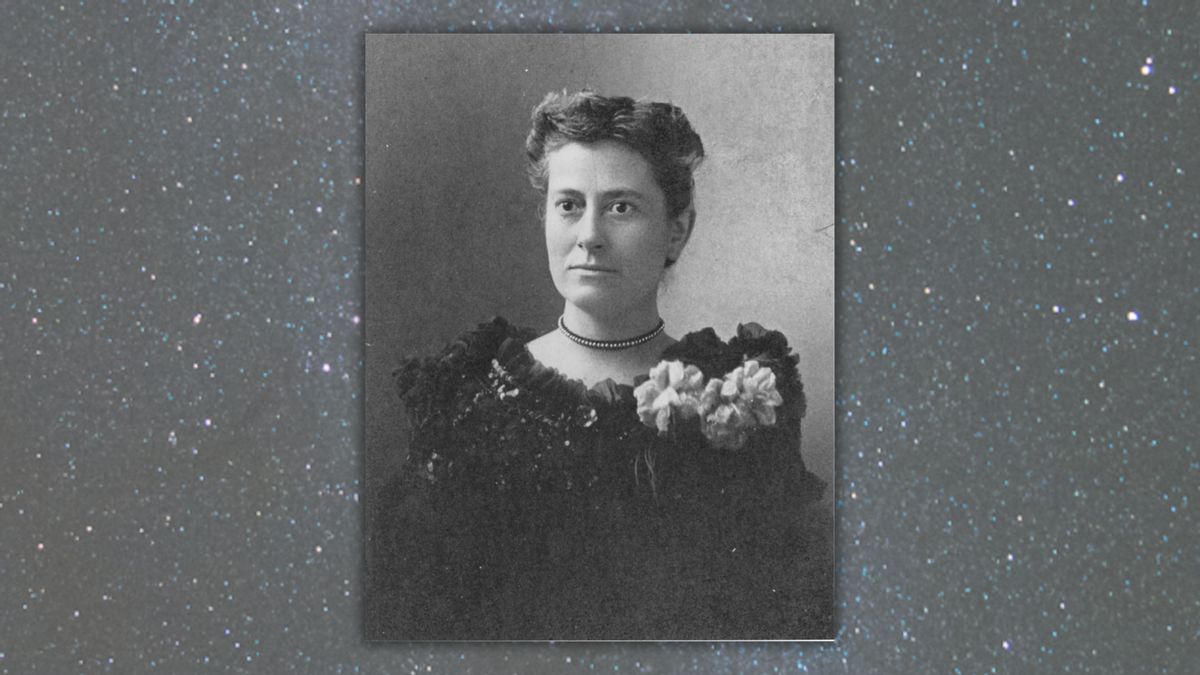
A popular Reddit thread posted in mid-March 2025 claimed a 19th-century housekeeper named Williamina Fleming became an astronomer when the director of the Harvard Observatory got frustrated with his staff and hired her instead. The thread received more than 31,000 "upvotes" as of this writing.
The claim read, "In the 1880s, the director of Harvard Observatory was often frustrated with his staff and supposedly said, 'My Scottish maid could do better!' So, he decided to hire her. Williamina Fleming ran a team for decades, classified thousands of stars, and discovered white swarfs and the Horsehead Nebula." The user who posted the claim added, "I just hope the guy she replaced ended up taking her job as a maid."
I just hope the guy she replaced ended up taking her job as a maid.
byu/office_cinderella insciencememes
The claim that Fleming went from being a maid to building a career as an astronomer is true. However, there is reasonable doubt concerning the anecdote about Harvard's director, Edward Pickering, having said, "My Scottish maid could do better," as purported in some versions of the claim.
Pickering did indeed employ Fleming as a housekeeper after Fleming's husband deserted her following their emigration from Scotland to Boston in 1878, according to the 1993 book "Women of Science: Righting the Record." However, Pickering later recounted in Fleming's obituary that "Mrs. Fleming began work at the Harvard Observatory in 1881. Her duties were at first of the simplest character, copying and ordinary computing."
There is no tangible evidence that Pickering suggested it was frustration with his current staff that led to her hiring at the Harvard Observatory.
How Williamina Fleming became an astronomer
Following the death in 1882 of Dr. Henry Draper, a pioneer of astronomical photography, his widow, Mary Anna Palmer Draper, sought to continue his work by establishing "a new astrophysical institute," according to a feature about Mrs. Draper in the January 1969 edition of the Harvard Library Bulletin by Lyle G. Boyd.
Pickering, a friend of the late Dr. Draper, offered his assistance. The institute itself never materialized, but the widow Draper's large donations and Pickering's correspondence "can now be recognized as the first stage in the evolution of the monumental Henry Draper Memorial that Mrs. Draper finally established the Harvard College Observatory, under Pickering's direction, to photograph and classify the spectra of stars," wrote Boyd.
It is here that Fleming was first brought into the field by Pickering. In a letter to Draper dated Dec. 31, 1886, Pickering wrote:
The general catalogue of stellar spectra prepared with the 8 inch telescope is progressing steadily and well. Unfortunately for us, Miss Farrar who has measured all the plates until recently, is about to get married and will go to Texas. She has computed faithfully for the past five years at the Observatory and has shown special aptitude. She is now instructing Mrs. Fleming who has assisted me, and who I think will take her place satisfactorily.
The "plates" referenced in Pickering's letter allude to the original method for capturing astronomical images, "essentially an early form of photography that used glass plates to capture images of the night sky," according to the Maria Mitchell Association, a nonprofit organization dedicated to another pioneering female astronomer.
Harvard's collection of astronomical plates, dubbed the Harvard Plate Stacks, now "spans over 550,000 glass plate negatives and spectral images, covering both the Northern and Southern Hemispheres," according to the university. "The Harvard Plate Stacks make up over a century of irreplaceable scientific observations and represents the first full image of the visible Universe. Hundreds of women studied and curated the Harvard Plate Stacks while making discoveries of their own, but their work often went unrecognized."
According to a page about Fleming on the Harvard University Library Open Collections Program website, included as part of the "Women Working, 1880 - 1930" collection, Pickering was correct in his assessment of the former housekeeper. The page reads:
Fleming quickly proved Pickering right by developing a new system to classify stars according to their spectra, or the unique pattern of lines caused by the refraction of a star's light through a prism. Thanks to her new classification system, which became known as the "Pickering-Fleming System," Fleming cataloged over 10,000 stars within the next nine years. In 1890, she published her findings in the Draper Catalogue of Stellar Spectra.
Fleming was part of a group known as the "Harvard Computers," who "discovered variable stars, studied stellar spectra and counted galaxies, to name a few of their duties," according to Harvard's website dedicated to the historical figures. The page continues, "In 1899, Mrs. Fleming received the official title of Curator of Astronomical Photographs, the first such Corporation appointment of a woman at Harvard."
The university also houses The Williamina Fleming Collection of Astronomical Glass Plate Photographs, which it describes as a collection of "the most significant plates used in the discoveries, research, and work process of the Women Computers and astronomers at Harvard College Observatory."
In addition to "10 novae, 52 nebulae, and 310 variable stars," one of Fleming's most notable discoveries included the Horsehead Nebula in 1888 — a horse-shaped cloud found within the Orion constellation — though she didn't receive credit for it until years later.
According to a 2017 article about the Harvard Computers published by the BBC:
Wolbach Library unveiled a new display in early July showcasing Fleming's work, including the log book containing the nebula discovery.
"When the [Horsehead Nebula] was discovered, it was just a little 'area of nebulosity in a semi-circular indentation,'" says librarian Maria McEachern, who has helped the team sort through the notebooks.
"Years later that it became known as the Horsehead Nebula," McEachern says. A male scientist at another institution who named it was the one who got credit.
"It wasn't even until recently that people have been doing more scholarship and finding out that, yes, she's the one who really found it."
In August 1893, Fleming spoke at the Congress of Astronomy and Astrophysics during the World's Columbian Exposition in Chicago (the World's Fair). Her speech, titled "A Field for Woman's Work in Astronomy," was reprinted in the Scientific American Supplements magazine in November 1893. The issue is available to read for free on the Internet Archive.

(Scientific American Supplements Vol. 36 No. 932 (November 1893))
Early in the speech, she named other pioneering women in the field — including the aforementioned Maria Mitchell — and said, "A great many women of today must have a similar aptitude and taste for Astronomy and if granted similar opportunities would undoubtedly devote themselves to the work with the same untiring zeal, and thus greatly increase our knowledge of the constitution and distribution of the stars."
Fleming's final major discovery was that of white dwarfs, "very hot and dense stars that are white in color," in 1910. Additionally, the Harvard library hosts numerous pages of Fleming's handwritten diaries from 1900 as well as the glass plates she and the other members of the Harvard Computers created during their time working at the Harvard Observatory.
Fleming died of pneumonia in 1911 at the age of 54.