
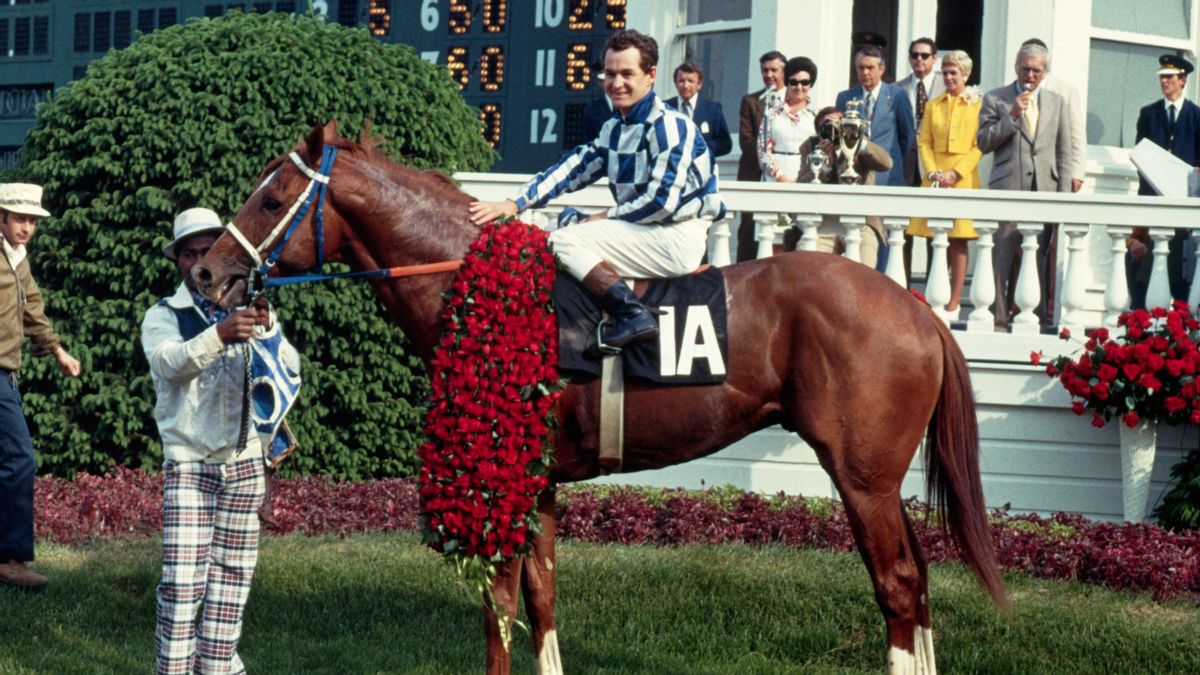
In early May 2025, rumors circulated that every horse racing in the 2025 Kentucky Derby, horse racing's most-watched event of the year, was a descendant of one of its most famed competitors, Secretariat.
The Kentucky Derby, alongside high-profile races the Preakness Stakes and the Belmont Stakes, is known as the Triple Crown of thoroughbred racing.
Secretariat was a thoroughbred horse best known for winning the Triple Crown in 1973 and even clocks in on ESPN's list of the top North American athletes of the 20th century.
The claim about Secretariat's progeny spread on social media platforms such as Facebook (archived) and Instagram (archived), in addition to sparking lively conversation on Reddit, as the annual race at Churchill Downs in Louisville, Kentucky took place on May 3. A horse named Sovereignty took first place and its owners took home the $5 million prize.
The claim that all the horses who participated in the 2025 Kentucky Derby, including Sovereignty, were descendants of Secretariat is true.
The Jockey Club, which manages the U.S.' premier register of Thoroughbreds called "The American Stud Book," also manages what it calls "the Thoroughbred industry's official database," Equineline.com.
The website describes itself as "the industry's premiere [sic] online service and international source for Thoroughbred and American Quarter Horse pedigrees, race records, mare produce records and sire reports." The database allows users to search the lineage of thoroughbred horses for free up to five generations.
In the parlance of horse breeding, a "sire" refers to the male parent while a "dam" refers to the female parent. A "foal" refers to a young horse.
Searches for each horse in the 2025 Kentucky Derby show a lineage that can indeed be traced back to Secretariat as a sire, ranging from as recent as four generations ago to as far back as seven generations. According to Kentucky's Courier-Journal, Secretariat had more than 660 registered foals.
According to the database, the horses Burnham Square, Final Gambit, Flying Mohawk, Grande, Publisher, Render Judgment, Sandman, Tiztastic, and 2025 winner Sovereignty are listed within five generations of Secretariat.
Because there is a paywall for lineage beyond five generations, we instead traced the line backward for each horse starting with the sire and dam of each participant that didn't show Secretariat within five generations, but revealed foals of Secretariat such as Terlingua and Weekend Surprise.
Through this method, we were able to verify the remaining horses as having shared lineage with Secretariat. Admire Daytona, Baeza, Citizen Bull, Coal Battle, Journalism, Luxor Café, Neoequos, Owen Almighty and Rodriguez can be traced within six generations of Secretariat.
Finally, horses within seven generations of Secretariat include American Promise, Chunk of Gold and East Avenue.
Inbreeding is also very common within thoroughbreds. For example, Owen Almighty's sire, Speightstown, came from a dam named Silken Cat. Silken Cat was sired by Storm Cat, who came from the aforementioned Terlingua. In this line, it was Terlingua who was originally sired by Secretariat. Owen Almighty's dam, Tempers Rising, also counted Storm Cat among its lineage, meaning Owen Almighty's sire and dam shared relatives.
Accusations of fraud within thoroughbred breeding have occurred, which prompted a response from The Jockey Club in the past, though the organization did not return a request for comment about the specifics of how it combats the issue.
However, a report from The New York Times on Nov. 26, 1978, dug into the revocation of a registration certificate for a horse named Alhambra Prince following blood testing that proved the sire was not who the owner said it was, ultimately resulting in a lawsuit.
The article states that the Jockey Club had "computerized the genetic characteristics of all 7,000 stallions on stud farms in the United States and Canada" at the time and that "by checking a horse for the presence or absence of certain 'markers' in its blood, testers can now determine with 100 percent accuracy whether the listed sire could have sired the horse in question."
Secretariat, still headline news at the time, got a mention in the NYT piece as well:
Last year, eyebrows were also raised when Secretariat's first crop of sons and daughters, who had brought an average price of $377,000 when they were sold at public auction as yearlings in 1976, went to the races and failed miserably. But Secretariat's second crop of runners has done well enough this year to make the 1973 triple crown winner the season's leading sire of 2 year‐olds.
According to Jockey Club spokesmen, only two owners of Secretariat's progeny have requested blood‐type parentage analysis — and the two fillies in question, one from the first crop and one from the second, both checked out satisfactorily.
"You know how gossip is," says Calvin S. Rainey, executive secretary of The Jockey Club. "But we have all kinds of safeguards. If you have a farm and you're cheating, one of your employees usually is going to talk. We investigate this all the time."
The Jockey Club explained the history of their verification process in an email Snopes:
The Jockey Club originally relied on independent certifications from mare and stallion owners. When blood testing parentage verification technologies were developed and perfected for large scale deployment in livestock, The Jockey Club incorporated that technology into the registration process, and blood typing became mandatory with the 1987 foal crop. As the science continued to improve and parentage verification transitioned from blood to hair testing, The Jockey Club transitioned as well and has required parentage verification using DNA from hair root bulbs since 2001. The Jockey Club actively monitors the science of parentage verification for new technologies as part of our unyielding commitment to the integrity of pedigrees recorded in "The American Stud Book."
The Jockey Club also utilizes a multi-layered security architecture managed by certified information security professionals using IT industry security standards and best-practices for information security management to protect its network, databases, and systems from security threats.
This information is reflected in a Frequently Asked Questions page on its website, where The Jockey Club wrote they transitioned from blood-typing to DNA testing in 2001, stating, "although blood typing was state-of-the-art for many years, DNA typing is 99.9% efficacious. This high rate provides the greatest assurance modern science has to offer for the integrity of 'The American Stud Book.'"
As written in "The American Stud Book" Principal Rules and Requirements, "Foals must be genetically typed and qualified by parentage verification by a laboratory approved and authorized by The Jockey Club."