
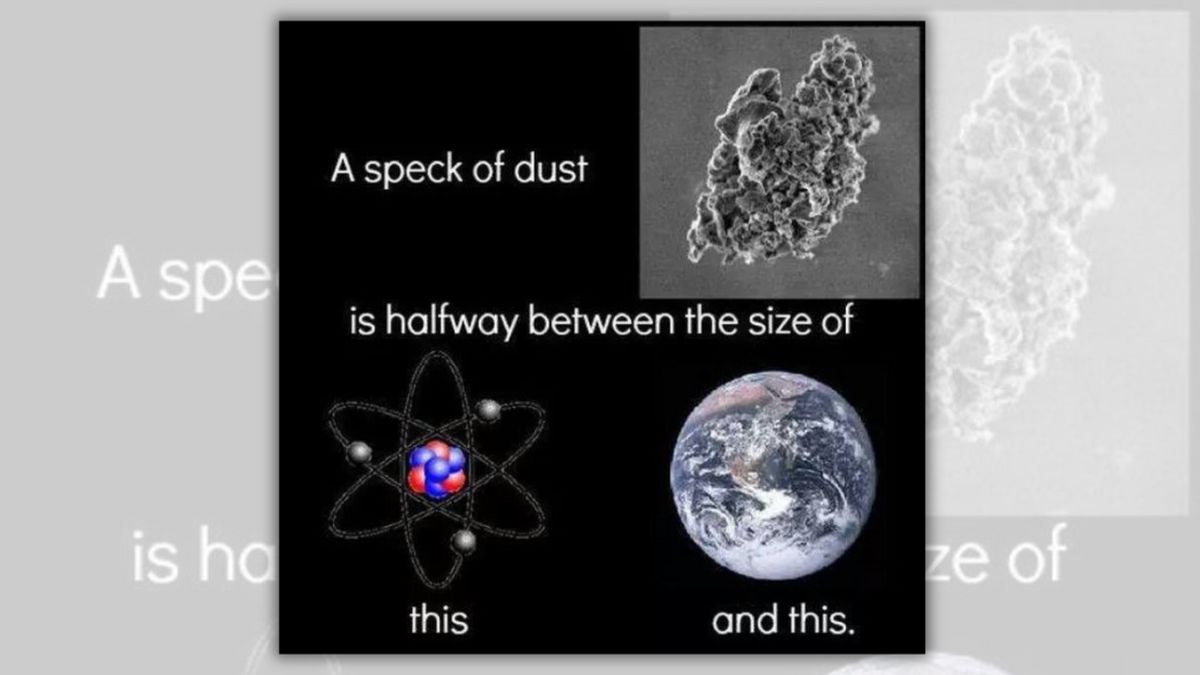
Since at least 2016, a rumor has circulated online that "a speck of dust is halfway between the size of" an atom and Earth.
Variations of the claim have appeared on Pinterest and Facebook, with one iteration that was posted (archived) on Facebook on March 31, 2025, amassing more than 16,000 reactions as of this writing. Its caption read: "Know how to visualize how small an atom is..."
However, Wendy Taylor, a particle physicist and professor of physics and astronomy at York University in Canada, said via email that it is false to say a speck of dust measures halfway between the size of an atom and Earth and that "the meaning is ambiguous."
York sent the following graphic, which shows measurements of an atom, a speck of dust and Earth.

(Image courtesy of Wendy Taylor)
"But assuming it is referring to orders of magnitude, the halfway point between -10 and +7, is -1.5, and the distance would be about 5x10^(-2) meters or 5 cm, about the width (the short side) of a credit card," Taylor added.
Avi Loeb, a professor of science and founding director of Harvard University's Black Hole Initiative, echoed Taylor's comments.
The average size of an
interstellar dust particle is measured on the spatial scale of microns, namely 10^{-4} centimeters. This scale is a factor of 10,000 larger than an atom and it therefore contains of the order of a trillion (10^{12}) atoms. The Earth contains of order 10^{50} atoms. Its size is 10^{17} times larger than that of an atom and 10^{13} times larger than a speck of dust.
Microscopic particles like dust, dirt or smoke are measured in particulate matter, or PM, according to the Environmental Protection Agency (EPA). Particulate matter, such as dust, can sometimes be large enough to see with the human eye, while at other times it is so small that it can only be detected using a specialized magnifying tool known as an electron microscope.
The EPA wrote that particulate matter, also known as particle pollution, includes:
- PM10 : inhalable particles, with diameters that are generally 10 micrometers and smaller; and
- PM2.5 : fine inhalable particles, with diameters that are generally 2.5 micrometers and smaller.
- How small is 2.5 micrometers? Think about a single hair from your head. The average human hair is about 70 micrometers in diameter – making it 30 times larger than the largest fine particle.

(EPA)
Bodner Research Lab at Purdue University in Indiana wrote that although the size of an isolated atom cannot be measured because of its physical properties, scientists can estimate the size of an atom by measuring "the distance between adjacent atoms in a covalent compound."
Earth, on the other hand, has an equatorial diameter of 7,926 miles (12,760 kilometers), according to NASA.