
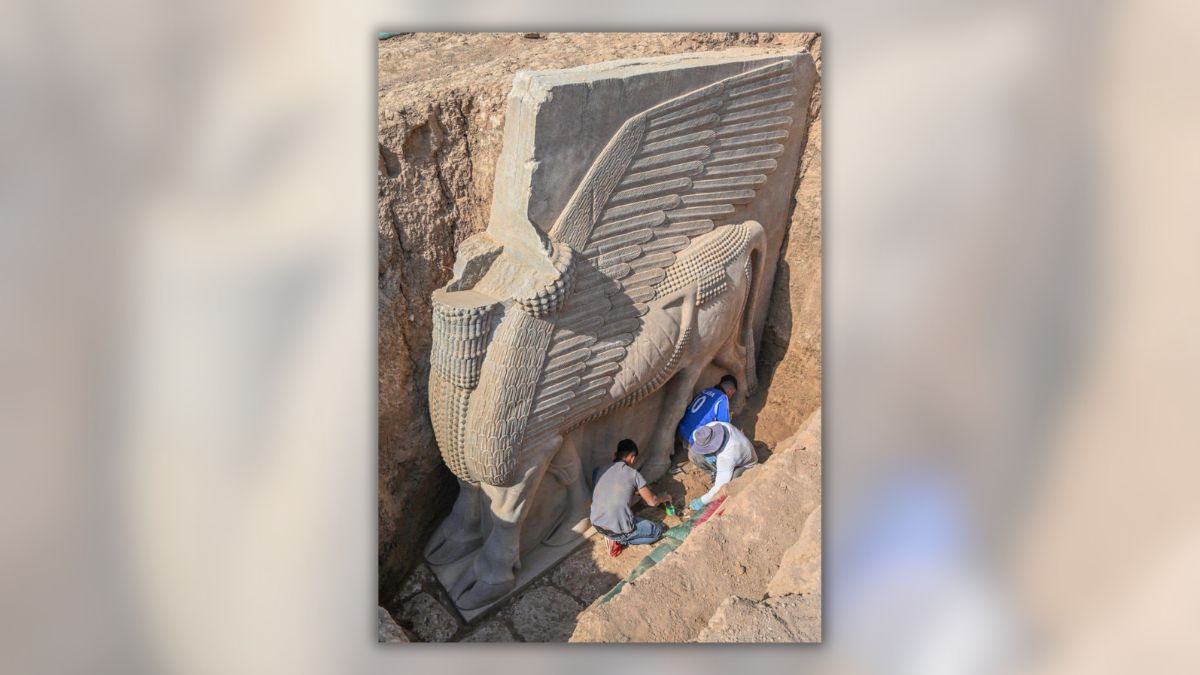
A photograph shared to social media in March 2025 showed a large, partially buried headless statue alongside excavators. With hooved feet and a winged body, the "massive 2,700-year-old" statue was said to depict an "Assyrian Deity that was excavated in Iraq" in 2023.
The photo was shared across social media platforms like Facebook, X, Threads, and Instagram. One post published to Reddit had received more than 19,000 upvotes at the time of this writing.

(reddit screenshot)
Iraq's General Authority for Antiquities and Heritage posted the photo to Facebook on
We therefore rate the claim about the statue as true.

(Facebook/General Authority for Antiquities and Heritage)
The winged bull figure is lamassu, a likeness featured in Mesepotamian art between the 7th and 9th centuries, according to Britannica. Replicas (and near-replicas) of lamassu appear in museums and institutions around the world, including the University of Chicago Library, which describes the human-headed, winged bull as being:
… a mythological hybrid, a protective deity known to "turn back an evil person," that is composed of the head of a human, the body of a bull, and the wings of a bird. These figures are depicted in the Epic of Gilgamesh, one of the textual sources for the iconography of these figures.
The [university's] lamassu has five legs, which was typical for those created during Sargon II's reign. This "double-aspect" causes the figure to appear to be standing or walking when viewed either from the front or the side, respectively. This winged-bull is almost five meters (16 feet) tall and weighs approximately 40 tons. The large sculpture fragments that were excavated at Khorsabad were packed in crates and transported to Chicago, where they were brought into the OI Museum through the wall of the gallery as it was being built in 1930. It was then restored and assembled on the same spot. Its massiveness required the floor to be reinforced and the building to be built around it, which ensures that the OI's lamassu will never be moved to another spot in the museum or loaned to another institution.
Intact replicas of lamassu are also on display at the Louvre in Paris, which describes the features as having been placed at the gateway of the ancient city of Khorsabad's courtyard.
The museum describes this ancient city as:
The Khorsabad courtyard displays the remains of a gigantic city built in under ten years in the late 8th century BC. In those days, the area that is now Iraq was part of the powerful Assyrian Empire. King Sargon II had a new capital built at Khorsabad near Mosul, but after the death of its founder the city lost its status as a capital.
French archaeologists excavated site relics in the 19th century, many of which are on display at the museum today.
According to the Louvre, in the 8th century, King Sargon II reigned over the Assyrian Empire and founded a new capital in 713 BC. Sargon chose a "sprawling site at the foot of Mount Musri in the north of present-day Iraq and called it Dûr-Sharrukin, the 'fortress of Sargon,'" comprised of an estimated 200 rooms and courtyards.
In 1990, the University of Chicago's Institute for the Study of Ancient Cultures featured a "human-headed winged bull" from the city and noted that these statues "adorned the entrances to the throne room of the Assyrian king."