
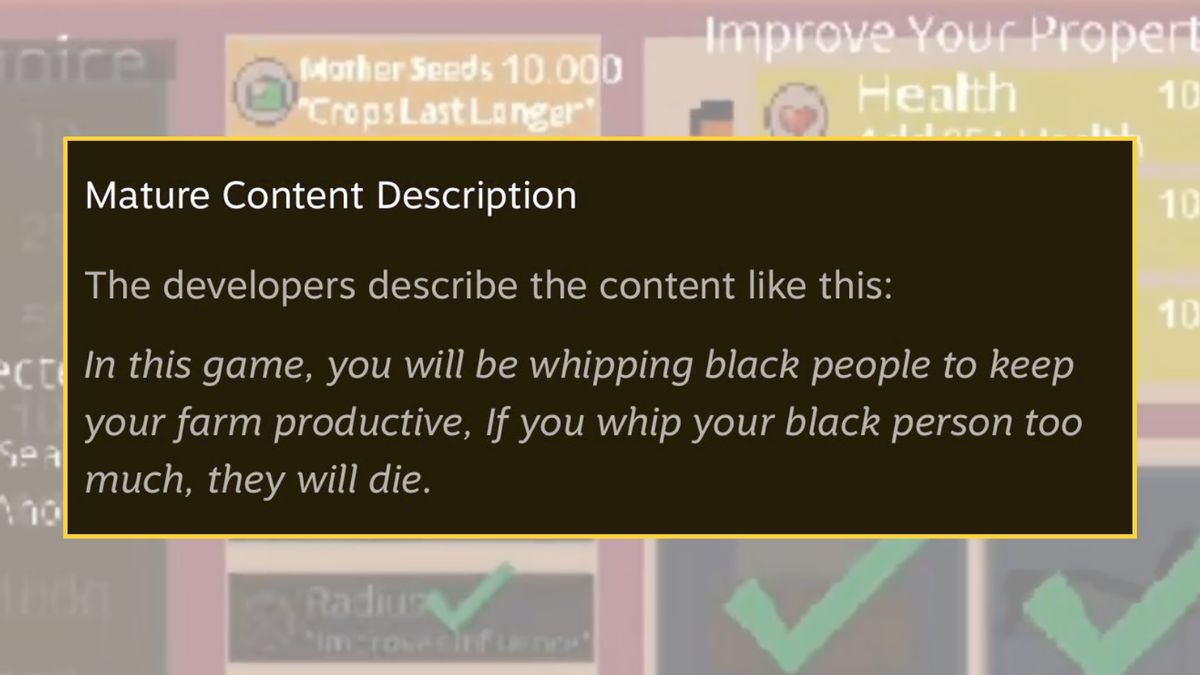
A rumor that a new video game on the popular digital games platform Steam encouraged players to engage in "whipping black people to keep your farm productive" circulated online in May 2026.
Users on social media posted a purported screenshot of a game called "Plantation Simulator" on the Steam store, including a blurb that described the game as "a simple farming simulator where you motivate workers to pick your crops!"
The claim was true.
"Plantation Simulator" was released on May 12, 2026, but was removed from sale by its developer on May 24.
The original Steam page, archived here, showed the game listed for $1.99. However, a developer update on May 21, 2026, altered the game to change the pixelated whip into a string of hearts and the Black characters into white women in bikinis.
As of May 26, 2026, the game's page was still live on Steam but not available for purchase.
The original Steam page had video and screenshots of the game that matched those shared in the claim and featured rudimentary pixelated characters including a white man in white suit whipping brown-skinned characters.
The original "mature content" description on the game's page read, "In this game, you will be whipping black people to keep your farm productive. If you whip your black person too much, they will die."
Following the game's update on May 21, the "mature content" description was changed to: "In this game, your friends wear bikinis and you can give them little kissies."
Valve, the parent company of the Steam platform, did not respond to requests for comment. We will update this article if we hear back.
A longer description of the game echoes the promotional language used to hawk similar popular resource management and simulation games such as "Farming Simulator," which puts the player in charge of an agricultural farm to make strategic management decisions.
Steam's original full description of "Plantation Simulator" read:
Step into the boots of a determined plantation owner in Plantation Simulator, a simple yet satisfying farming simulation set in America's plantation era. Your goal is simple: grow crops, manage your workers, and turn your plantation into a thriving farm!
Choose which crops to plant and watch your fields get farmed as you carefully manage production and timing. Expand your operation by producing more workers, keeping your fields productive, hiring helpers, and upgrading your property.
As your farm grows, so does the challenge. Efficient management, crop planning, farm maintenance, and worker coordination are key to maximizing profits and building the most successful plantation around.
Plantation Simulator offers a straightforward gameplay loop that rewards crop planning, fence maintenance, and worker coordination to succeed!
Features!
- Choose and grow different crops
- Manage workers to keep them productive.
- Maintain your farm fences to keep workers focused!
- Several upgrades to improve your property
After the May 21 update, "workers" was replaced with "friends" in the description, along with an additional statement that read, "But don't worry! It's all fair and happy!"
The game's creator has published other games with similar controversial angles in the past, such as "Crucifier," which is functionally a racing game in which a player acting as a Roman solider tries to whip a subject to the site of their crucifixion site before an opponent does.
It appears "Plantation Simulator" was created primarily as rage bait, based on the comments in the discussion section of the game's page on Steam.
Criticism of Valve's moderation
Former Valve employee Chet Faliszek, who had a hand in some of Valve's most successful video games of the 21st century such as "Half-Life 2," "Portal" and "Left 4 Dead," regularly posts on TikTok about his time working in the video game industry, specifically his time at that company.
Faliszek posted a video directed at the company's managers about "Plantation Simulator" on May 20 that said, "It's okay to just delete this. You don't have to make up reasoning why. You can just delete it, really."
Faliszek explained that before social media, he would personally delete accounts that were engaging in similar hateful behavior under the guise of free speech. "There was no social media so there was no outcry… We could do that and there was no outcry. But now, you know who's gonna get mad," he said.
He explained that the people making and supporting games like this one "count on your civility. They count on [using] your normalization of being a good person against you" and called it a "childish version of free speech… Where it's just like if somebody yells something, they're like, oh my God, they have to be able to yell that."
Faliszek's theory appeared to be accurate, based on a deeper look at the game's Steam reviews page. Prior to the May 21 update, the game had 56 "very positive" reviews. Most of those "reviews" appeared to be thinly veiled racist comments masquerading as an evaluation of the game.
As of May 26, the game had 424 "mostly negative" reviews, most commenting on their disappointment of the update.
In an update announcing the game would be delisted from Steam, the developer said, "We've decided to retire this game! We've think we have said what needed to be said. We saw the opportunities and took them."
Steam's controversial history
Steam's terms of service say it prohibits content that "harasses, threatens or embarrasses others, or promotes discrimination, bigotry, racism, hatred, harassment or harm against any individual or group, or "is violent or threatening or promotes violence or actions that are threatening to any person or entity."
Such terms appeared to indicate that a game like "Plantation Simulator" should not be allowed on the platform, yet this was not the first time Steam courted controversy over the type of content it sells.
In 2018, Steam removed a game that simulated a school shooting, but one month later the BBC reported a change to Steam's content policy to "allow everything."
The BBC reported Valve told the news outlet the responsibility should be on the players rather than the company, saying, "Taking this approach allows us to focus less on trying to police what should be on Steam, and more on building those tools to give people control over what kinds of content they see."
In 2024, the Anti-Defamation League's Center for Extremism released a study connecting the perpetrator of an attack on a mosque in Turkey to his Steam activity, and analyzed "458+ million profiles, 152+ million profile and group avatar images and 610+ million comments on user profiles and groups" on Steam.
The result was the discovery of 1.8 million unique pieces of "extremist or hateful content."
The organization's study concluded that "the clear gaps in Steam's moderation of this content inflict harm by exposing untold users to hate and harassment, enabling potential radicalization and normalizing hate and extremism in the gaming community."