
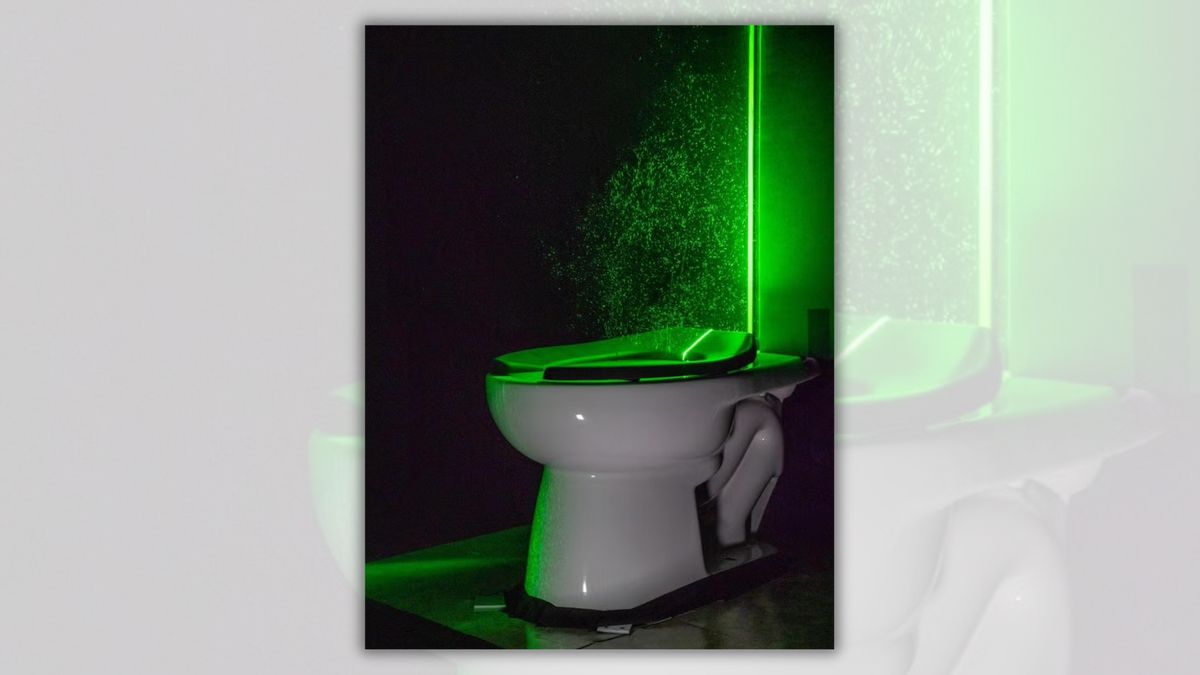
While toilet bowls are designed such that the contents are supposed to flush downward, scientists have known for decades that small particles – including those from water, waste and toilet paper – can be released upward into the surrounding air.
Research has also shown that pathogens persist in the bowl even after flushing, suggesting infections like E. coli and norovirus can spread when people come into contact with germs suspended in the air or on bathroom surfaces.
Social media users across platforms like Reddit (archive),
A study published in the peer-reviewed journal Science Reports in December 2022 found that when flushed, a toilet can rapidly expel particles up to 6.6 feet per second, reaching 4.9 feet above the toilet within eight seconds.
While the study showed a possible transmission of pathogens, it did not study the volume or the feasibility of infection. Rather, a team of engineers explained a set of circumstances that could expose a person to bacteria and viruses; they did not establish a connection between that potential exposure and infection.
In a video posted to YouTube, the University of Colorado, Boulder, displayed how aerosols from a toilet are released into the air when the lid is lifted. They used bright green lasers shone on the toilet, which was placed in a dark room, to see what is ejected from a commercial toilet when flushed.
When flushed, the toilet emits "small aerosolized particles" that range from as small as the diameter of a human hair to as large as the point of a pencil. Larger particles fall quickly while smaller particles remain suspended in the air.
Two lasers were used in the study, a study light focused on and above the toilet and a pulsing light over the same area. The constant laser showed the particles' location while the pulsing measured speed and distance. Cameras, meanwhile, took high-resolution images.
"If it's something you can't see, it's easy to pretend it doesn't exist. But once you see these videos, you're never going to think about a toilet flush the same way again," said John Crimaldi, lead author on the study and professor of civil, environmental, and architectural engineering, in a news release at the time.
"By making dramatic visual images of this process, our study can play an important role in public health messaging."
Researchers studied a commercial toilet type typically used in North American public restrooms, not those in private homes. They also only tested tap water and not solid waste or toilet paper, two variables that could have exacerbated the outcomes.
How aerosols transport also depends on the type of toilet, ventilation of the room it's located in, and water supply pressure.
Aerosol movement was largely unpredictable but was shown to spread mostly upward and backward near the rear wall. At times when the plume reached the ceiling, it moved out from the wall and spread forward into the room.

(Science Reports)
The team also measured airborne particles with an optical particle counter. This takes a sample of air through a small tube and shines a light to count and measure particles. Smaller particles were found to have the potential to bypass nose hairs and reach the lungs, suggesting they could be more hazardous to health.
Together, the results offer an understanding of these mechanisms of transport, which could help experts mitigate exposure to infections.
"People have known that toilets emit aerosols, but they haven't been able to see them," said Crimaldi. "We show that this thing is a much more energetic and rapidly spreading plume than even the people who knew about this understood."
The researchers add that more research is needed to determine how infections could spread through this transmission of aerosols.

(Science Reports)