
In May 2026, people on social media spread a rumor that U.S. President Donald Trump asked the Canadian government for a $573 billion railway bailout. According to the rumor, Canada rejected this request and instead invested $30 billion in an east-west rail corridor within its own borders.
Also according to the rumor, many of the major railways in the U.S. are owned by Canadian companies. Due to the trade conflict incited by Trump's tariffs, Canada has shifted its focus away from shipping through the U.S. so that it can instead focus on shipping to ports on either side of Canada to access European and Asian markets. Per the rumor, this has in some way left the U.S. in need of $573 billion for its railways.
For example, this Instagram post (archived) included a video of a man claiming Canadian officials told Trump, "You don't get to break it and then ask us to fix it."
Users posted other versions of the claim (archived) that included the video to TikTok (archived) and Facebook (archived). There were also several different text (archived) versions (archived) of the claim posted to Facebook (archived). Snopes readers sent us emails and searched the site wondering whether the claim was true.
In short, there was no credible evidence to substantiate the rumor. The posts spreading the claim used a style of presentation and writing that match the patterns of AI-generated content. Therefore, we've rated the claim false.
Google searches for "us $573 billion railroad bailout," "'You don't get to break it and then ask us to fix it" and "canada investing 30 billion on east west rail corridor" did not uncover any credible reporting on any individual aspect of the claim, let alone the claim in its totality. If it were true that the U.S. and Canada had a conflict over shared infrastructure that could amount to hundreds of billions of dollars, mainstream U.S. and Canadian news outlets would have reported on it.
Canadian-owned rail
The one thing the rumor does get right is that two of the major railways servicing mid-America are owned by Canadian companies.
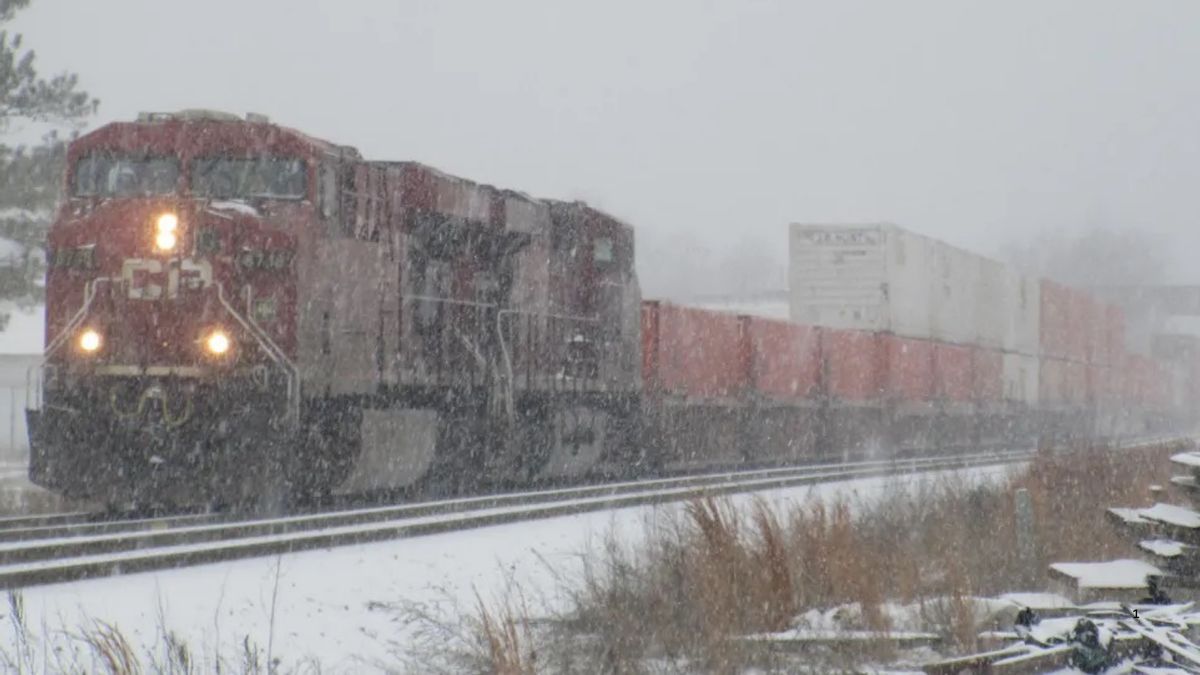
The two largest Canadian railways are Canadian National Railway Company (usually called CN) and CPKC, which was formed by Canadian Pacific's acquisition of Kansas City Southern in 2023. A CN map guide shows it owns railways that run across Canada from coast to coast, as well as railroads that run down the U.S. alongside the Mississippi River. A CPKC map shows it also owns railways running between either of Canada's coasts, plus tracks in the central U.S. from Minnesota to Texas and beyond into Mexico.
The major American railway servicing the same region is Union Pacific.
While these Canadian companies do control a major portion of America's railroads, there is no evidence that they are no longer utilizing these tracks and no evidence the Canadian government is pushing them to do so. In fact, Canada's 2026 spring economic update states the country wants to maintain and improve market access to the United States.
The update, which also states Canada wishes to double its non-U.S. exports over the next decade, says the country recently put $6 billion into investment funds for transportation infrastructure improvements.
The numbers
It's unclear where the claim that the U.S. is seeking a $573 billion railway bailout originated from, but it could be based on a $573 million investment by the Biden administration in 2022 for removing railroad crossings.
Similarly, it's unclear where exactly the claim that Canada is investing $30 billion into an east-west railroad corridor came from. However, in 2024 the administration of Canada's then-Prime Minister Justin Trudeau announced it was investing a record $30 billion into public transit projects for several Canadian metropolitan areas.
Evidence of AI generation
There was evidence of AI-generation in both the video and text versions of the rumor.
The person narrating the video is a commonly used AI-generated avatar. Although the scripts weren't exactly the same, the same narrator wearing the same white collared shirt spoke in both the Instagram and TikTok versions of the video.
The narrator in his white, collared shirt can be seen speaking about unrelated subjects on multiple TikTok accounts, as "Dr. David Sanchez, MD" and FinancialBuzz on Facebook, as Asian Guy on X and as JohnAG, The Boring Currency and numerous other channels on YouTube.
In the videos making the claims about the supposed $573 billion rail bailout, the narrator randomly raises his eyebrows and looks to his right in an identical manner multiple times in the
One of the Facebook text versions of the claim links out to an advertisement-filled blog within its own comments. Snopes has previously reported on this as a common business strategy utilizing AI-generated stories on Facebook.
The writing in both the video scripts and the Facebook posts aligns with the writing in countless other AI-generated stories shared as legitimate news. For example, both the Instagram video and the previously linked Facebook post begin by describing the remark "You don't get to break it and then ask us to fix it" as the "most humiliating sentence ever directed at an American president by an allied leader."