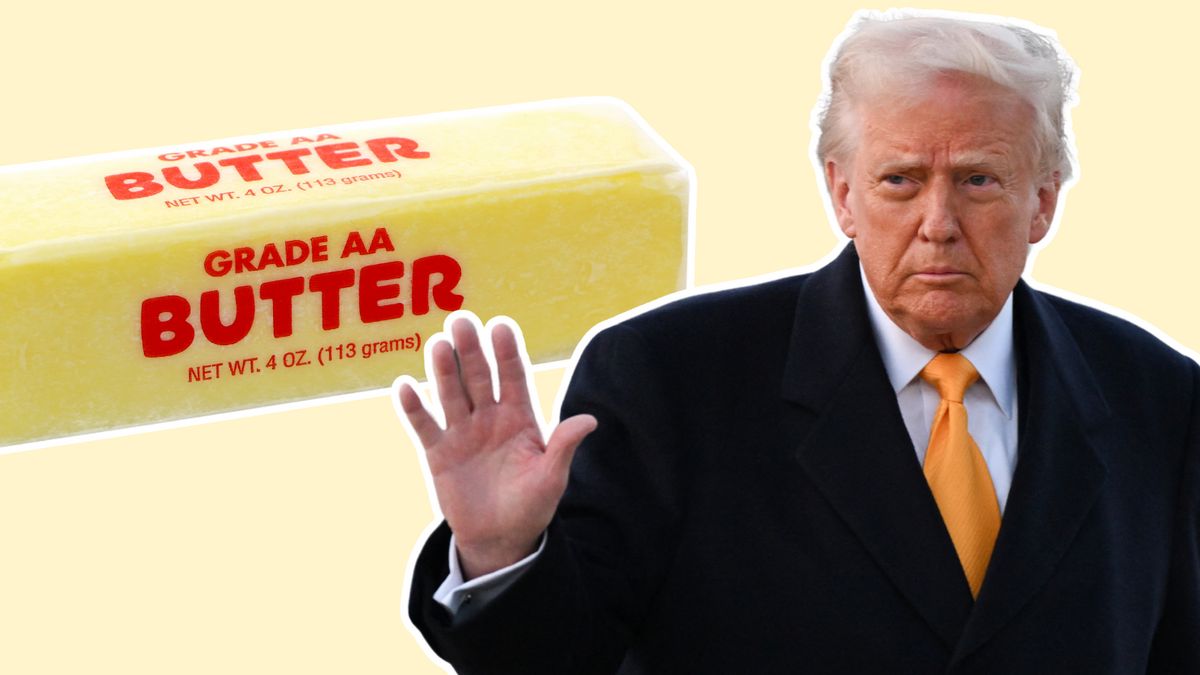
On March 7, 2025, U.S. President Donald Trump told reporters in the Oval Office that Canada had been "ripping us off for years" with high tariffs, including 250% on U.S. dairy products imported into Canada. Social media users on Facebook (archived) and X (archived) repeated the claim.

(Facebook user Ernie Brown)
One Facebook user wrote: "Canada has been charging us 250% tariffs for many years on dairy products." Snopes readers also searched our site for information about Canada and tariffs.
However, while it is true that Canada can place high tariffs on some products imported from the U.S., including dairy, online claims lacked context. The United States-Mexico-Canada Agreement (USMCA), a trade agreement negotiated by the former Trump administration in 2018, set out tariff rate quotas (TRQs) for U.S. dairy products imported into Canada. The higher tariff rates for dairy mentioned by Trump and in online claims apply only to goods imported "over access commitment," meaning above the quota agreed to by the U.S. and Canada. According to one U.S. dairy industry professional, these quotas have never been exceeded, which would trigger the higher tariff rate. Therefore, we rate this claim a mixture of truth and falsehood.
Tariffs take center stage following Trump executive orders
Tariffs are taxes imposed by a government on a person or company importing goods. Percentages are typically tied to a product's value, so a 25% tariff on a $10 product, for example, would mean a $2.50 tax for the person or company importing the product.
In practice, high tariffs could lead to high shelf prices for consumers, as importers often raise their prices to make up for the increased cost of tariffs. This is known as "price pass-through," according to the Economic Policy Institute, a nonprofit think tank that carries out economic research and analyzes the economic impact of policies and proposals.
In March 2025, tariffs were at the forefront of political discussions in the U.S. and Canada following Trump's announcement of blanket 25% tariffs on imports from countries including Canada, his subsequent amendments to that plan and then Canada's reciprocal action. On March 11, 2025, Trump announced on Truth Social that he would be placing an additional 25% tariff, totaling 50%, on steel and aluminum imports from Canada, further escalating the trade conflict between the two countries.
USMCA, Canadian supply management, tariff rate quotas and the price of dairy
The USMCA went into force on July 1, 2020, during the first Trump administration, and replaced the North American Free Trade Agreement (NAFTA) from 1994. Both agreements essentially created a trade bloc consisting of the U.S., Mexico and Canada with favorable market conditions between the three.
Following the enactment of USMCA (known as CUSMA in Canada), Canada created new preferential tariff codes to apply to products covered by the agreement: code UST for the U.S. part of the agreement and code MXT for the Mexican part. The codes appeared in Canadian customs tariff schedules to indicate when USMCA meant those countries got "preferential" tariff treatment.
For example: UST preferential tariff codes meant that under the 2025 Canadian Customs Tariff Schedule, importing butter "within access commitment" (within quota) was free, or not tariffed. However, for exports "over access commitment," a 298.5% tariff applied, and the tariff paid may not be less than $4 per kilogram.
However, despite the eye-watering tariffs for "over access commitment" dairy products, like butter, according to one U.S. industry expert, these higher tariff rates have effectively never been applied.
On March 7, the same day that Trump made his 250% tariff claim, Becky Rasdall Vargas, senior vice president of trade and workforce policy at the International Dairy Foods Association (IDFA), which represents the U.S. dairy manufacturing and marketing industry, said (our emphasis):
It is accurate that Canada imposes a tariff of approximately 250% on U.S. exports of certain dairy products into Canada, and even more with Canada's 25% retaliatory tariffs in place. However, that tariff would only apply if we were able to reach and exceed the quota on U.S. dairy exports agreed to under the U.S.-Mexico-Canada Agreement (USMCA). Frustratingly, the U.S. has never gotten close to exceeding our USMCA quotas because Canada has erected various protectionist measures that fly in the face of their trade obligations made under USMCA.
The "protectionist measures" mentioned by Vargas likely referred to Canada's supply-management system.
Under this system, provincial marketing boards overseen by the Farm Products Council of Canada control production, pricing and imports of certain goods, including dairy, to ensure enough products on the shelves and fair prices for Canadian farmers, free from potential undercutting by cheaper imported goods.
The way the Canadian government controls imports is through tariff rate quotas (TRQs). According to the National Farmer's Union of Canada: TRQs "allow a limited amount of imports to Canada at low or zero tariff rates, but above the TRQ threshold, very high tariffs are applied, making further imports uneconomic."
The supply-management system was evident in the 2025 Canadian Customs Tariff Schedule: "within access commitment" imports were often not subject to tariffs while "over access commitment" imports were.
Canada's supply-management system has previously caused issues within the USMCA. In 2022, a USMCA panel agreed that Canada breached its commitments under the agreement by reserving part of the tariff rate quotas for certain types of businesses.
The U.S., Canada and Mexico will meet to review the USMCA in 2026.