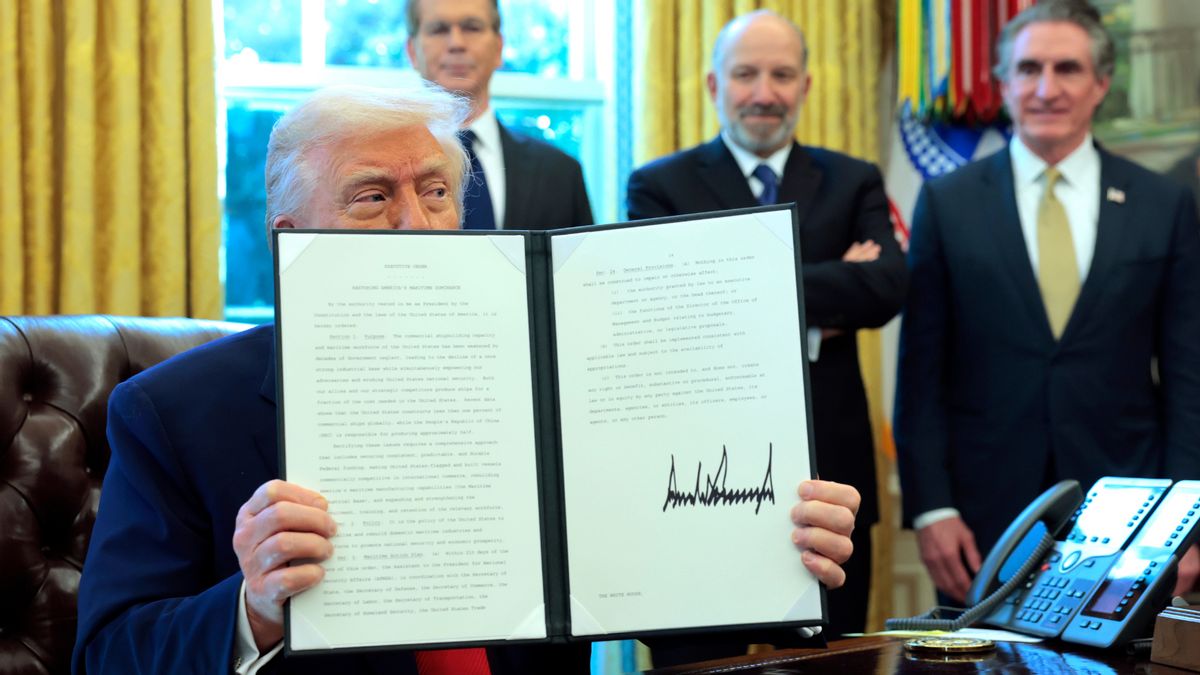
Amid rising prices and stock market uncertainty in early April 2025, claims that U.S. President Donald Trump signed a new executive order to raise the federal minimum wage to $25 per hour circulated online.
Users on social media platforms like TikTok (archived) and Facebook (archived) posted multiple videos sharing the rumor. Though there are variations in the video footage (archived), the voice-over of each video reports the same claim, which is that "Trump approved the largest minimum wage increase in U.S. history. As of the eighth of April, 2025, no American worker will be allowed to earn less than $25 per hour." According to the purported news, the wage increase would go into effect April 15, 2025.
@finqjgxi31d TRUMP APPROVES U.S. MINIMUM WAGE INCREASE OF NO LESS THAN $25 AN HOUR#fypage #fypシ゚viral #foryoupage ♬ original sound - finqjgxi31d
The videos featured authentic footage of Trump, including him signing executive orders in the Oval Office, alongside generic stock footage assembled to look like a legitimate news broadcast. Due to the popularity of the claim and its resemblance to an authentic news reel, Snopes' email inbox received numerous inquiries asking about its veracity.
However, the claim that Trump signed a new executive order to raise the federal minimum wage to $25 per hour is false. While there were four executive orders signed on April 8, 2025, according to the White House, none of them were related to minimum wage increases.
Further, the accounts sharing the claims featured other videos using the same purported news format spouting equally false claims, like Trump signing an executive order implementing 32-hour work weeks, which did not happen.
Trump's actions since taking office, coupled with past comments from key members of his administration, also suggest raising the federal minimum wage is not a priority of the White House. Trump did lower the minimum wage for federal contractors, however, when he signed an executive order on March 14, 2025, titled "Additional Rescissions of Harmful Executive Orders and Actions."
Trump rescinded a Biden-era executive order that raised the federal contractor minimum wage to $15 per hour in an effort to improve "workers' health, morale, and effort," as well as reduce "absenteeism and turnover."
Also among the revocations in the March 14 executive order was former President Joe Biden's executive order related to "ensuring a data-driven response" to the COVID pandemic and a memorandum citing "all human beings should be treated with respect and dignity and should be able to live without fear no matter who they are or whom they love."
During his confirmation hearing in January 2025, incoming Secretary of the Treasury Scott Bessent testified he did not support raising the federal minimum wage from $7.25 per hour, the rate at which it plateaued in 2009.
Vice President JD Vance also made brief, noncommital comments about the federal minimum wage during a speech at the American Dynamism Summit on March 18, 2025. Vance said:
Now, one of the debates you hear on the minimum wage, for instance, is that increases in the minimum wage force firms to automate. So, a higher wage at McDonald's means more kiosks. And whatever your views on the wisdom of the minimum wage — I'm not going to comment on that here — companies innovating in the absence of cheap labor is a good thing.
On April 8, 2025, Sen. Bernie Sanders and Rep. Bobby Scott introduced new legislation titled "Raise the Wage Act of 2025" to "raise the federal minimum wage to $17 over five years, eliminate the tipped subminimum wage over seven years, eliminate the subminimum wage for workers with disabilities over five years and eliminate the subminimum wage for youth workers over seven years."
However, the bill was considered likely to face challenges in the Senate from Trump's allies, as previous iterations of the bill had. According to Newsweek, "While House Democrats have reintroduced the measure, previous versions have stalled in the Senate. Without bipartisan backing in the Republican-controlled upper chamber, the bill's chances of becoming law are slim."
Since the White House did not announce that Trump increased the federal minimum wage via any official channel and the administration had demonstrably taken a position against raising the federal minimum wage, we have rated this claim false.