
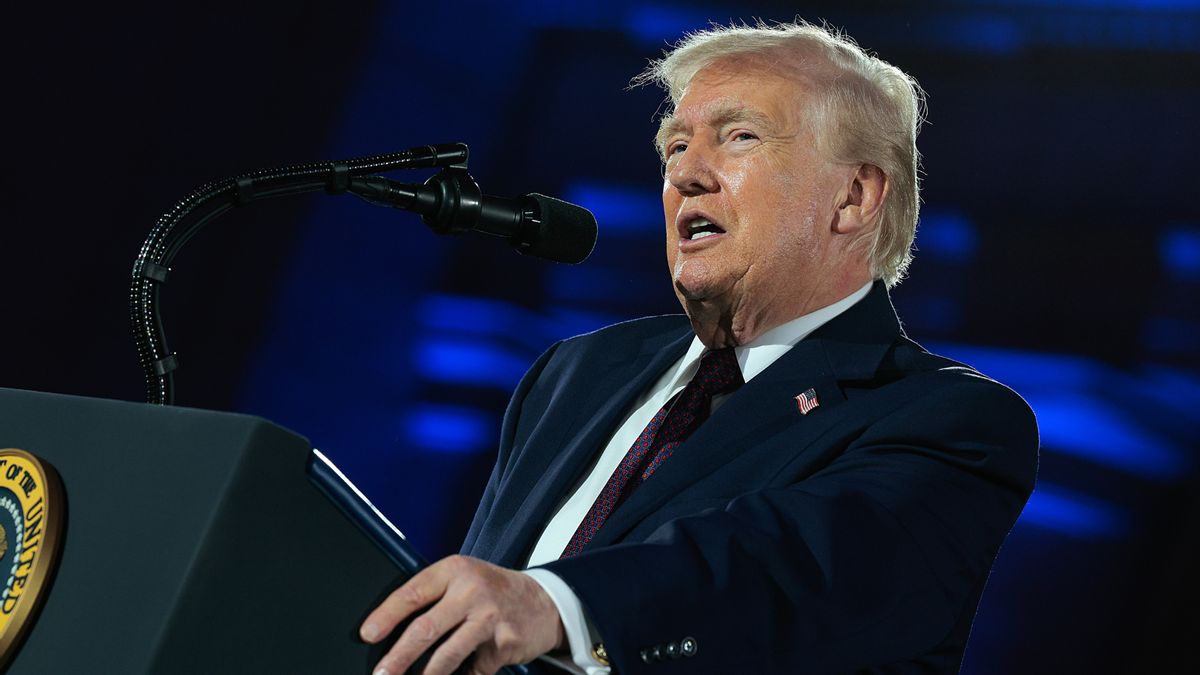
In March 2026, a video circulated online that social media users claimed authentically showed U.S. President Donald Trump saying Iran offered him the role of supreme leader.
The U.S. and Israel killed Iran's former supreme leader, Ayatollah Ali Khamenei, in joint strikes in late February 2026. The country's theocracy chose Khamenei's son Mojtaba Khamenei to succeed his father, though questions remained over the younger Khamenei's whereabouts and condition.
The video in question was authentic (meaning not created or edited using artificial intelligence or other digital tools). It showed remarks (archived) the president made on March 25, 2026, while addressing the National Republican Congressional Committee. Trump said (at 8:50):
There's never been a head of a country that wanted that job less than being the head of Iran. "I don't want it!" We listen to some of the things they say, we hear them very clearly, they say, "I don't want it." "We'd like to make you the next supreme leader." "No thank you, I don't want it."
Trump's words spread across X (archived), Facebook (archived), Instagram (archived), Threads (archived), Bluesky (archived) and Reddit (archived). Snopes readers wrote in asking, "Did Iran offer to make Trump supreme leader?"
While some social media users appeared to interpret Trump's words as the president claiming Iran had offered him the post of supreme leader, the president — who altered his voice to signify different speakers — appeared to be exaggerating conversations between Iranian officials that he'd heard about, or simply inventing them. Trump's words alone did not make that distinction clear. Therefore, we find that users who shared Trump's words with the claim that he recounted a genuine offer miscaptioned the footage.
Snopes contacted the White House Press Office and the Ministry of Foreign Affairs of Iran for comment on the matter and await replies to our queries.
The clerics on Iran's 88-seat Assembly of Experts chose Mojtaba Khamenei as new supreme leader around March 8. It was unclear when the assembly could have offered that role to Trump.
Including the appointment of the younger Khamenei, the council has chosen a new supreme leader only twice before. One key requirement in the country's constitution is that any candidate must be an Islamic scholar (mufti) who can interpret Islamic law (fiqh). Trump is reportedly a nondenominational Christian; we found no evidence he has extensively studied Islamic law or speaks Persian, the language of Iran.
It was also unclear at the time of this writing what level of communication, if any, was taking place between the U.S. and Iran. Trump told (at 8:37) the National Republican Congressional Committee that the U.S. and Iran were negotiating and that the Islamic republic "want to make a deal so badly but they're afraid to say it."
Meanwhile, Iran's Minister of Foreign Affairs Abbas Araghchi reportedly told (archived) an Iranian news program that there was "no negotiation or dialogue with the American side." Araghchi said intermediaries were passing messages between the countries but that these did not amount to negotiations.
Iran's Tasnim News Agency, citing an anonymous government source, reported on March 26 that Iran had responded to Trump's 15-point ceasefire plan with its own demands, which included compensation and war reparations and sovereignty over the Strait of Hormuz.
Given the apparent low amount of communication between the U.S. and Iran, it was unclear when Iranian officials could have offered Trump the role of supreme leader or when U.S. officials could have overheard the purported remarks Trump relayed in the March 25 speech.
For further reading, Snopes has reported widely on claims related to the Iran war.
DeepL.com provided translations from Persian into English.