
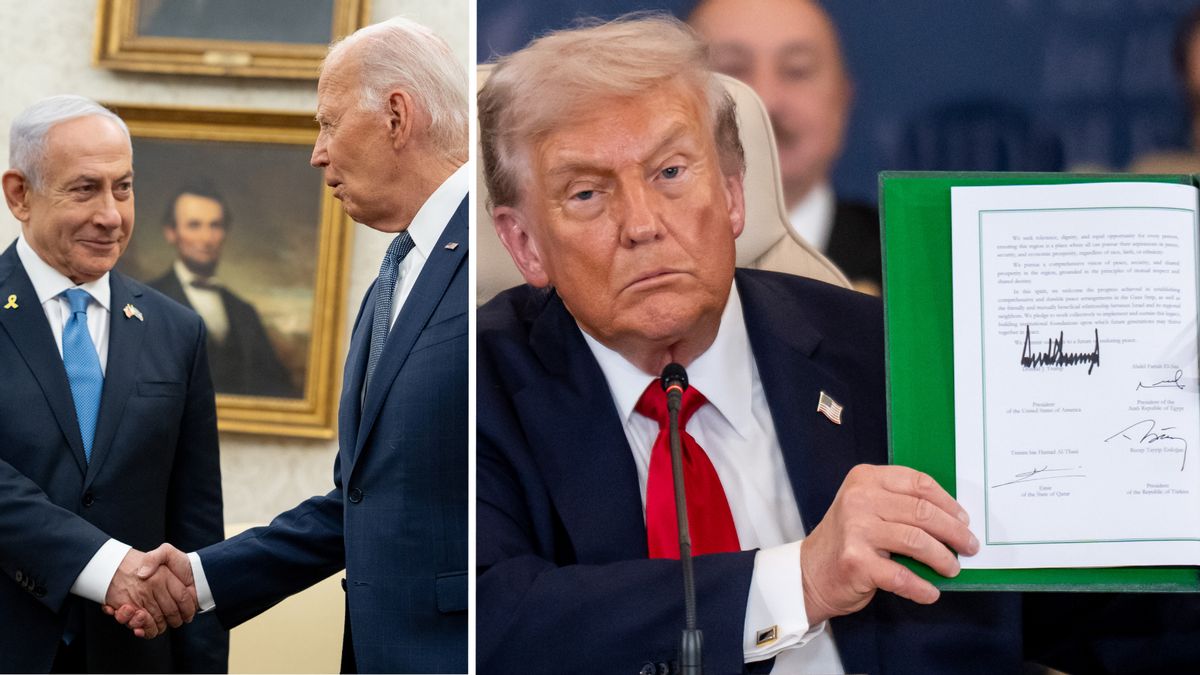
- An online rumor alleged that U.S. President Donald Trump's October 2025 ceasefire agreement to end the war in Gaza was the "exact deal" former President Joe Biden
brokered before leaving office. - Biden proposed a ceasefire deal in May 2024 that Israel and Hamas did not publicly agree to. Months later, in January 2025, he announced that Israel and Hamas did agree on a plan, one that used the "exact framework" of his May 2024 proposal. Biden's plan fell apart in March, after its first stage.
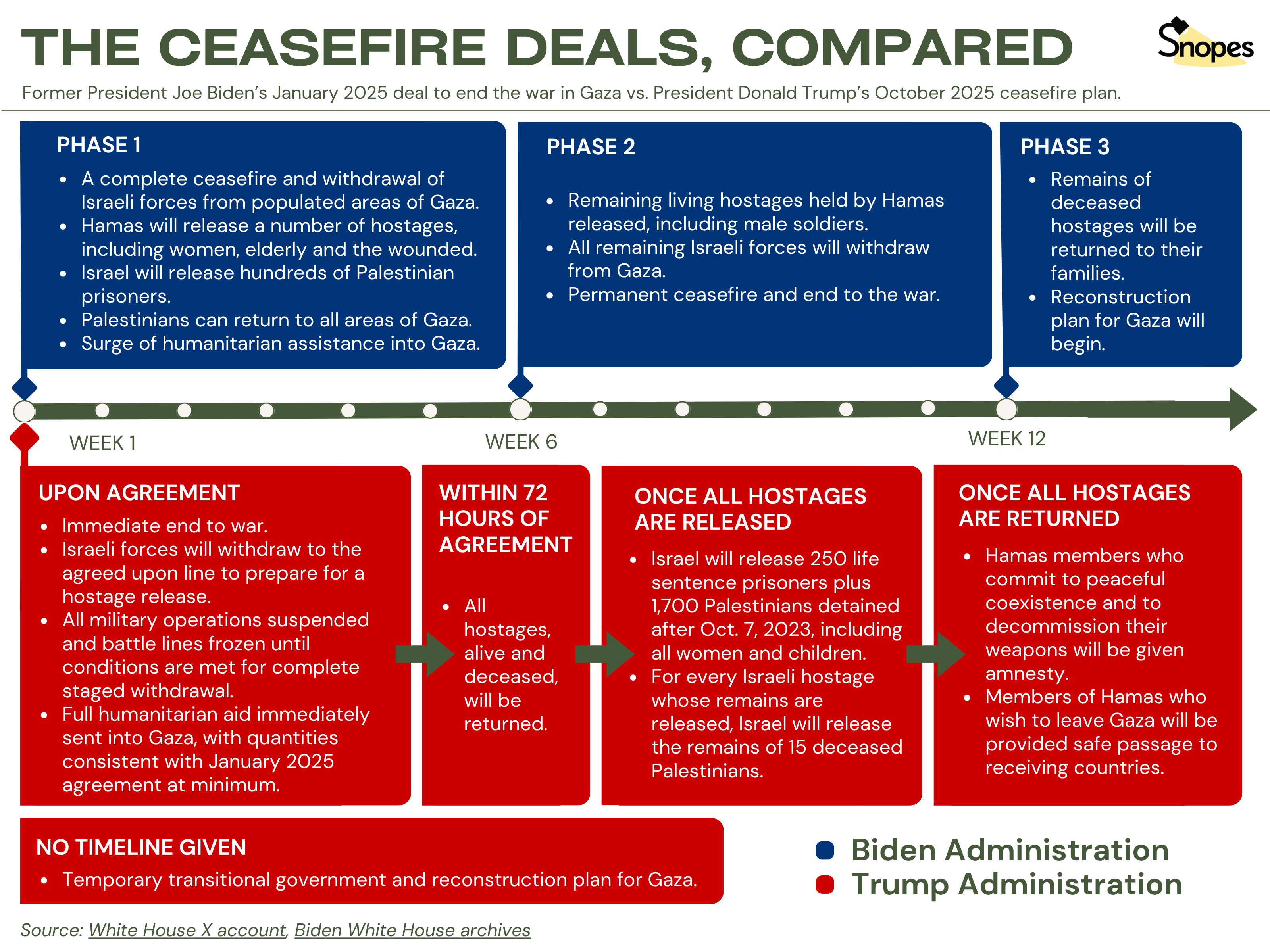
- While Biden and Trump's deals shared similarities, they differed in how quickly Hamas and Israel had to swap captives. Under Trump's plan, Hamas released all remaining Israeli hostages within a week, in exchange for 1,700 Palestinians imprisoned by Israel without charge and 250 convicted prisoners. Biden's plan, in contrast, involved releasing captives in stages.
- Other differences included Trump's proposal that Hamas would not have any role in Gaza's governance, nor the region's approach to redevelopment. Similarities included guidance on Israel's withdrawal and the directive that the country must immediately allow humanitarian aid into Gaza.
- Even if Trump had used Biden's "exact deal," implying that Trump replicated Biden's plan ignores an ever-evolving political landscape affecting the ceasefire.
- As of this writing, Hamas and Israel have agreed only to the first phase of Trump's deal, and negotiations over terms to end the war continue. It is not clear just how much the final version of Trump's framework might differ from Biden's or will be similar to it.
On Oct. 8, 2025, Israel and Hamas agreed to the first phase of U.S. President Donald Trump's ceasefire deal to end the war in Gaza.
The agreement came two years after Hamas' Oct. 7, 2023, attack on Israel, in which the militant group killed 1,200 people and captured 251 hostages. Israel's ensuing offensive killed more than 67,000 Palestinians and displaced an estimated 90% of Gaza's population in what a United Nations commission declared a
Following the ceasefire announcement, a rumor spread online that Trump used a deal brokered by former President Joe Biden to try to stop the fighting. Some claims referenced a May 2024 proposal by Biden, while others claimed Trump's plan matched a ceasefire agreement that Israel and Hamas signed in January 2025 under Biden's presidency. Keith Edwards, a Democratic strategist, made the claim on X, writing:
Joe Biden had a peace deal in place, and then Netanyahu and Trump met in Mar-a-Lago and decided that keeping the war going would benefit them both.
Ten months later, they're signing the exact deal Biden brokered.
Other posts on X, Facebook,
While Trump's plan had similarities with Biden's ceasefire plans, they were not the same. Namely, Biden and Trump's plans differed in how quickly the hostages would be released. Furthermore, the implication that Trump stole Biden's proposal fails to consider how circumstances, both on the ground in Gaza and politically across the globe, have changed over months.
As such, we have rated this claim false.
Furthermore,
Timeline of events
Biden first announced a ceasefire proposal in May 2024. He characterized it as an offer from Israel, but neither Hamas nor Israel publicly agreed to it at that time. Critics and journalists said the proposal was essentially the same as one suggested by Egypt and Qatar in April and endorsed by Hamas.
Then, on Jan. 16, 2025 — after Trump won the presidency but before Biden left office — Biden announced that Israel and Hamas had agreed to a ceasefire and hostage-exchange deal.
"This — this is the ceasefire agreement I introduced last spring," Biden said in his announcement, referencing his initial May 2024 proposal. "Today, Hamas and Israel have agreed to that ceasefire agreement and the whole — ending the war."
The peace lasted until March, when Israel broke the ceasefire agreement through surprise airstrikes that, according to the Gaza Health Ministry, killed more than 400 Palestinians.
At the time, families of hostages,
Netanyahu's office claimed the March strikes happened because Hamas refused Israel's demand to release half of the remaining hostages as a precondition for continuing
Over the spring and summer, Israel continued to bombard Gaza, killing more than 15,000 Palestinians, according to U.N. reports compiling Gaza Ministry of Health data.
On Oct. 8, Trump announced Israel and Hamas had "signed off" on the first phase of his deal.
A major difference between Trump's and Biden's deals
In short, the biggest difference between Biden's and Trump's ceasefire deals was the timeline for swapping captives.
Under Trump's
Hamas freed the last group of living hostages on Oct. 13, less than a week after Trump's ceasefire deal announcement.
In contrast, Biden's plan called for the captives' release over a longer span of time. He said in January that his proposal included "the release of a number of hostages held by Hamas, including women and elderly and the wounded" in a first phase lasting six weeks. In exchange, Israel would "release hundreds of Palestinian prisoners."
Biden never publicly released the full text of his May 2024 proposal, nor the framework that he described as a ceasefire deal in January 2025. However, The Times of Israel reportedly obtained copies of both plans. A Congressional Research Service information page by Middle East specialists called the Times of Israel's report a "reputed text." Furthermore, the United Nations Security Council passed a resolution endorsing Biden's May 2024 proposal, and the information in that endorsement aligned with the reported copies of the former president's deal.
Biden said his January 2025 proposal was "the exact framework" as the May 2024 plan, and that the previous plan "laid out the precise contours" of the later one.
As such, using the May 2024 text (archived), Biden's plan reportedly involved a detailed step-by-step release of captives. For example, the deal directed Hamas to release three Israeli female civilian hostages on Day 1, four additional female hostages on Day 7 and then three more detainees every seven days.
In other words, unlike Trump's deal, Hamas did not have to release all hostages immediately under Biden's plan. The former president's plan called for releasing remaining hostages during its second phase and the remains of hostages who had died in the third.
How similar were the deals overall?
Following Trump's announcement of a ceasefire deal in October 2025, former secretary of state
(Snopes illustration)
Notably, the proposals diverted in their approach to timing Israel's withdrawal from Gaza. Trump's plan also addressed specifics regarding Hamas' future in the region, the transition of governance and the United States' role in redeveloping the enclave.
For example, both plans necessitated
Both plans called for immediate, unobstructed aid into Gaza and cooperation with the U.N. and other agencies. Trump's deal directly referred to Biden's
The third phase of Biden's proposal required a "reconstruction" period of three to five years, calling for the building of homes, civilian facilities and other infrastructure. Trump's plan focused on the "redevelopment" of Gaza that, according to the proposal, would consider "many thoughtful investment proposals and exciting development ideas."
Regarding governance, Trump's framework required "Hamas and other factions" to relinquish any direct or indirect role in governing Gaza and decommission all weapons using an
Biden's plan did not include any details regarding the future governance of Gaza, only that a number of countries and organizations including Egypt, Qatar and the U.N. would supervise reconstruction.
How did the political climate change since Biden's plan?
Even if Trump had used Biden's "exact deal," suggesting that Trump repurposed or stole Biden's blueprint for himself ignores an evolving global political landscape in the backdrop of negotiations.
In July, the Integrated Food Security Phase Classification, the foremost authority on global food security, declared the "worst case scenario" of famine was unfolding in Gaza.
Human-rights groups such as Amnesty International concluded that Israel was committing genocide in Gaza before
Global protest over the Isreali military's actions in Gaza escalated; the world watched as Israel arrested hundreds of civilians from more than 44 nations on a Gaza-bound flotilla, including climate activist Greta Thunberg.
In September 2025, m
In the United States, public views toward Israel's military actions in Gaza steadily shifted toward disapproval, according to a Pew Research survey. The poll found 39% of Americans felt in September 2025 that Israel "is going too far in its military operation against Hamas," up from 31% in September 2024.
Furthermore, analysts suggested that Trump, with strong support from his base at home and high popularity in Israel, may have had more flexibility in his dealmaking than Biden. Experts also pointed to Trump's history of business with the Middle East and close ties to Gulf leaders as reasons he might have secured his deal in October 2025.
What's next?
As previously stated, Israel violated Biden's ceasefire deal before its second phase.
Hamas and Israel have agreed only to the first phase of Trump's plan. As of this writing, it was impossible to say whether the ceasefire would hold.
Just days after Israel and Hamas signed Trump's agreement, Israel accused Hamas of violating the ceasefire by failing to return the hostages' bodies. Hamas accused Israel of breaking the ceasefire by killing 24 people and Israel has reportedly limited aid into Gaza.
In sum, the major difference between the two plans was the pace of releasing captives. And while both plans touched on redevelopment options and a transitional government for the region, Biden's proposal included less details.
That said, Trump's plan might change as negotiations continue, making it difficult to conclude, exactly, how much the plans overlap.