
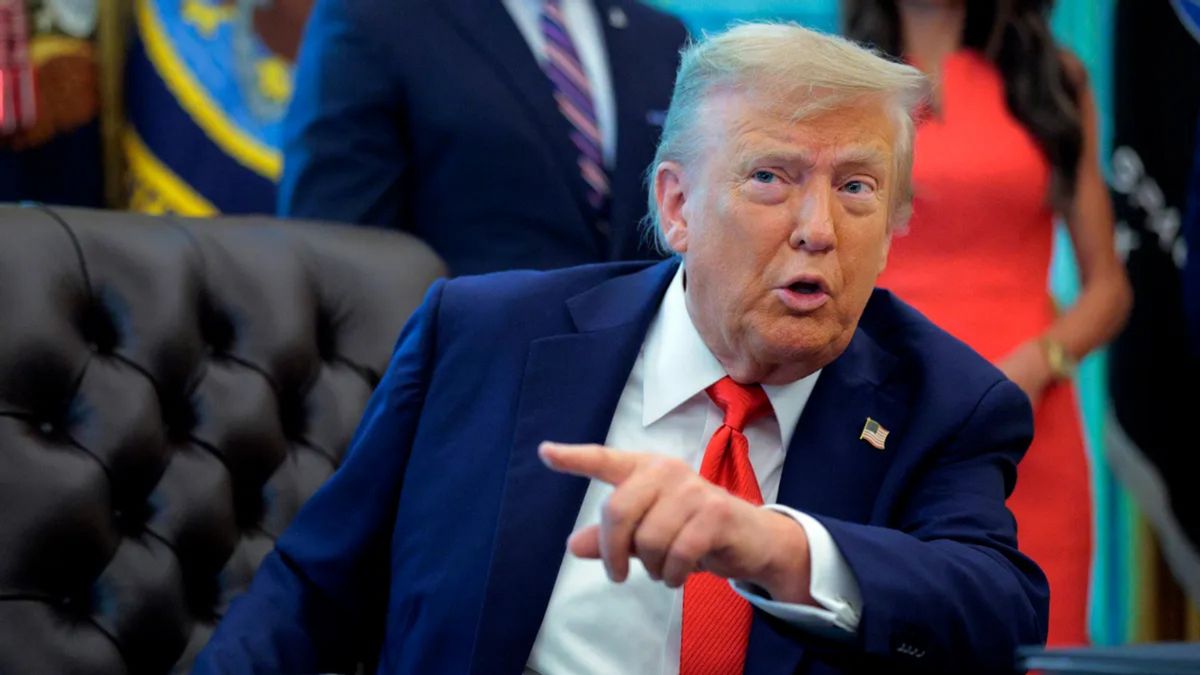
On Aug. 24, 2025, a series of posts claimed U.S. President Donald Trump once said the Japanese attacked Pearl Harbor during World War II by coming through the Panama Canal. Since he was elected to his second presidential term, Trump has called for the return of the Panama Canal to United States' control.
The same meme spread across Instagram and Facebook, and claimed the 1941 Japanese attack was Trump's reason for taking "back" the Panama Canal.

(Screenshot via Facebook)
We found no evidence of Trump making the above statement. Had Trump actually said this in public, it would have been widely covered by mainstream news outlets. As such, we rate this claim as an incorrect attribution.
We looked for examples of Trump making the above claim in the news, and searched for variations of statements alleging that Japan attacked Pearl Harbor through the Panama Canal. The only available sources were social media posts displaying the same meme in question and news stories that matched the same keywords but were unrelated to the claim.
In December 1941, during World War II, Japan launched a surprise attack on Pearl Harbor, a U.S. naval base near Honolulu, Hawaii. Around 2,400 people, including civilians, were killed in the attack, resulting in the U.S. declaring war on Japan and entering the wider conflict.
Per the National World War II Museum, the Japanese Navy dispatched fleet carriers across 3,000 miles of open ocean from Japan to the Hawaiian islands. Japanese aircraft then launched from these carriers a few hundred miles north of the islands. The Panama Canal is located in the southern part of Central America and was controlled by the U.S. in 1941. Any assertion that the Japanese would have used it to get to Hawaii is outlandish at best.
The Panama Canal's construction was completed by the U.S. in 1914, revolutionizing global navigation by cutting ships' travel around South America from a few months to a few hours. In 1977, then-U.S. President Jimmy Carter agreed to gradually hand over control of the canal to the Panamanian government, which took over completely by 1999.
While Trump did not claim that Japan had used the canal during World War II, he has made a number of other unsubstantiated claims about the canal while repeatedly calling for returning it to U.S. control. In his second presidential inauguration speech in January 2025, Trump said the U.S. lost 38,000 people in the construction of the canal and it was now being operated by China:
President McKinley made our country very rich through tariffs and through talent — he was a natural businessman — and gave Teddy Roosevelt the money for many of the great things he did, including the Panama Canal, which has foolishly been given to the country of Panama after the United Spates — the United States — I mean, think of this — spent more money than ever spent on a project before and lost 38,000 lives in the building of the Panama Canal.
We have been treated very badly from this foolish gift that should have never been made, and Panama's promise to us has been broken.
The purpose of our deal and the spirit of our treaty has been totally violated. American ships are being severely overcharged and not treated fairly in any way, shape, or form. And that includes the United States Navy.
And above all, China is operating the Panama Canal. And we didn't give it to China. We gave it to Panama, and we're taking it back.
As we have reported previously, China does not control the canal, and there is no Chinese military presence there, although U.S. experts have raised concerns about ports being run by a Hong Kong-based company, as well as Panama's cooperation with Beijing. The official death toll for workers during construction of the canal was estimated at 5,600 (not 38,000 as Trump claimed), and the majority of those workers
Trump has been accused before of being ignorant around the events and history of Pearl Harbor. According to a 2020 book "A Very Stable Genius" written by two reporters from The Washington Post, Trump appeared to have little understanding of the significance of Pearl Harbor:
The first couple was set to take a private tour of the USS Arizona Memorial, which sits just off the coast of Honolulu and straddles the hull of the battleship that sank into the Pacific during the Japanese surprise bombing attack in 1941. As a passenger boat ferried the Trumps to the stark white memorial, the president pulled Kelly aside for a quiet consult.
"Hey, John, what's this all about? What's this a tour of?" Trump asked his chief of staff.
Kelly was momentarily stunned. Trump had heard the phrase "Pearl Harbor" and appeared to understand that he was visiting the scene of a historic battle, but he did not seem to know much else. Kelly explained to him that the stealth Japanese attack here had devastated the U.S. Pacific Fleet and prompted the country's entrance into World War II, eventually leading the United States to drop atom bombs on Japan. If Trump had learned about "a date which will live in infamy" in school, it hadn't really pierced his consciousness or stuck with him.
"He was at times dangerously uninformed," said one senior former adviser.
The book itself relied on hundreds of interviews with mostly unnamed sources. The authors said their scenes were based on firsthand accounts. Kelly thus appears to be one of the few named sources for the above interaction. Trump in turn called the book "Fake" and the reporters "third rate." The reporters were part of a 2018 Pulitzer Prize-winning team for their reporting on Trump and Russia.
In 2017, Trump and first lady Melania Trump misquoted President Franklin Delano Roosevelt and misstated the date of the attack on social media, respectively. For example, Trump posted on what was then Twitter: "National Pearl Harbor Remembrance Day – 'A day that will live in infamy!' December 7, 1941." The real quote from Roosevelt was: "A day which will live in infamy."
We have previously covered Trump's past statements about the canal as well as the history of U.S. ownership.