
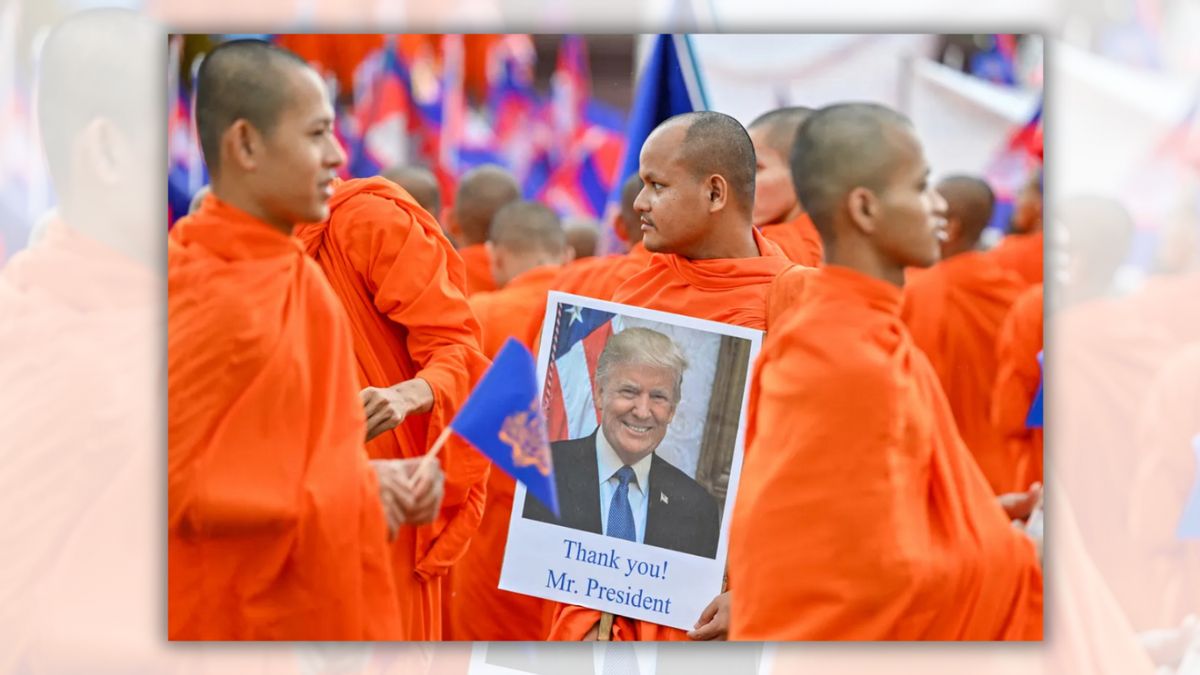
In August 2025, a claim spread online that a group of Cambodian monks had thanked U.S. President Donald Trump for ending a war between their country and Thailand
The rumor spread on X, Facebook and Instagram. One post spreading the claim, from former Speaker of the House Newt Gingrich, received over 45,000 likes on X as of this writing.
These posts need context. It is true that a group of Cambodian monks thanked Trump for his peacemaking efforts. However, they expressed gratitude to the U.S. president for his role in helping broker a temporary pause in fighting, also known as a ceasefire, between Cambodia and Thailand — not for permanently ending any war between the two countries.
As a result of the July 28, 2025, ceasefire agreement, Cambodia and Thailand paused fighting in a five-day armed conflict at the neighboring countries' border. While the territorial dispute resulted in the deadliest escalation of violence between Cambodia and Thailand since 2011, neither side officially declared war — and journalists and diplomats, as of this writing, have largely not described it as such.
Thus, we rate this claim a mixture of truth and falsehood.
Monks thanked Trump
On Aug. 10, 2025, a group of Cambodian Buddhist monks participated in a march for peace in Phnom Penh, Cambodia, amid reports that the two neighboring countries accused the other of violating the ceasefire.
Some of these monks carried signs with a picture of Trump that said: "Thank you! Mr. Preside
Images of the march and these signs were available through Getty Images, a reputable image bank. Several
According to Reuters, the march "stopped briefly at the US embassy to show gratitude to Trump for initiating the ceasefire
Why the monks thanked Trump
On July 26, 2025, Trump said in a Truth Social post that he spoke to the leaders of both countries to "request a Ceasefire, and END to the War, which is currently raging."
In his post, he added that he told both countries he would not negotiate any trade deal with either side until the fighting stopped. Two days later, Thailand and Cambodia came to a ceasefire agreement.
At the time of Trump's threat, both countries faced a potential 36% U.S. tariff that would have begun on Aug. 1. Three days after the ceasefire announcement, the White House announced a reduction in the tariff rate for both countries to 19%.
In a July 31 exclusive, Reuters reported that Trump's call "prompted Thailand to join ceasefire talks."
Snopes cannot independently verify Reuters' report. However, according to multiple reputable outlets, after Thailand's acting prime minister, Phumtham Wechayachai, and Cambodia's prime minister, Hun Manet, agreed on the ceasefire, both thanked Trump. (They also thanked Malaysian Prime Minister Anwar Ibrahim, who hosted the peace talks, and China, whose diplomats participated in the meeting.)
On Aug. 7,
Thus, reputable reports and statements from Cambodia and Thailand's leaders indicated Trump had a legitimate and significant role in the ceasefire agreement. With this context, it is clear that the monks' thank you signs referenced Trump's efforts to broker a ceasefire.
Trump helped pause a conflict, not 'end a war'
While Trump referred to the conflict between Cambodia and Thailand as a "war" in his Truth Social post, neither Cambodia nor Thailand have officially declared war against each other over the border conflict as of this writing, based on a search for news articles about a war declaration.
The New York Times reported that Wechayachai warned on July 25 that the border dispute "could develop into war," suggesting that Thailand's leader, at least, did not consider the conflict a "war."
On occasion, journalists and experts will refer to a conflict as a war even if the countries have not officially proclaimed it as such. In fact, the Merriam-Webster definition of war includes any "open and declared armed hostile conflict between states and nations," a criteria that Cambodia and Thailand's July 2025 border conflict technically met, despite the lack of official declaration.
According to the United Nations, the conflict displaced more than 131,000 people in Thailand and over 4,000 in Cambodia. The Associated Press reported on July 26 that at least 32 people had died.
Still, the AP, the United Nations and the U.S. State Department have not, as of this writing, referred to the Thailand-Cambodia border conflict as a war. The AP, long considered the standard for journalistic language, "considers the number of casualties, the intensity of fighting, the involvement of each party, and what each country was calling the conflict" to determine whether it describes a conflict as "war" to avoid diminishing the word's importance.
As such, the claim that Cambodian monks thanked Trump for "ending a war," while somewhat accurate, may have misrepresented the scope or nature of the conflict as well as the subsequent peace talks.