
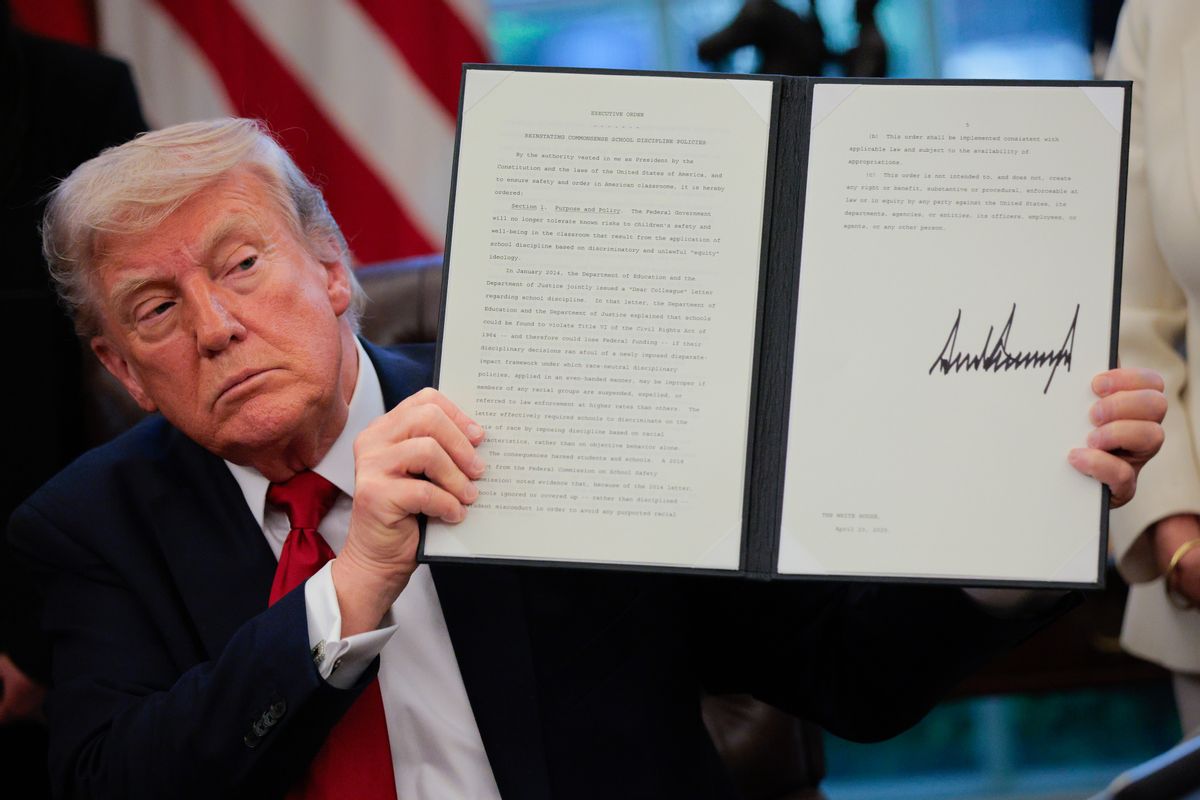
On April 23, 2025, U.S. President Donald Trump signed an executive order titled "Reinstating Common Sense School Discipline Policies."
In response, social media users began spreading a rumor that Trump's order permits teachers to discipline their students through physical force. One April 23 TikTok video, which several Snopes readers sent us a screenshot of, claimed, "Today Trump issued Executive Order allowing Teachers to physically 'discipline' students." The video has more than 70,000 likes as of this writing.

We rate this claim false. Trump's executive order does not explicitly address teachers using physical force to punish students, instead requesting new federal guidance revoking previous policies aimed at reducing racial disparities in school discipline. However, corporal punishment is still legal in many states, and it is not yet clear whether Trump's directive might accelerate that disparity.
It is also worth noting that Trump does not have the legal authority to permit corporal punishment in U.S. schools without an act of Congress. As we previously reported, an executive order is not a piece of legislation, but an official document shaping the federal government's operations. See our running list of Trump's executive orders here.
The White House did not immediately return a request to clarify Trump's stance on corporal punishment in K-12 schools.
The executive order
Trump's April 23 executive order on school discipline is available on the White House's website. The directive is focused on prohibiting racial equity policies in guidance issued by the federal government on school discipline, as stated in the second paragraph:
Section 1. Purpose and Policy. The Federal Government will no longer tolerate known risks to children's safety and well-being in the classroom that result from the application of school discipline based on discriminatory and unlawful "equity" ideology.
The order
To be clear, the 2014 letter is not law itself, but guidance on how the federal government interprets the law. Title VI of the Civil Rights Act of 1964 already prohibits racial discrimination in public schools.
The first Trump administration revoked the Obama-era guidance, but Biden's administration released updated advice echoing the 2014 letter, although education advocates said it didn't go as far.
Overwhelming evidence finds that Black students are disciplined at higher rates than white students, facing harsher disciplinary actions for even minor infractions, such as dress code violations.
"As a consequence of these policies, teachers and students are suffering increased levels of classroom disorder and school violence," Trump's executive order claimed, before instructing officials to issue new guidance on school discipline and "their obligations not to engage in racial discrimination."
(Evidence supporting Trump's claim is scant; studies indicate strict zero-tolerance policies do more harm than good, particularly for marginalized students. While research on nonpunitive alternatives is still emerging — some showing clear benefits, others showing no improvements in outcomes — these alternatives, such as nonjudgmental conflict resolution, do appear to improve the school environment.)
Trump's order also directs officials to submit a report to the president "regarding the status of
As such, nothing in the order explicitly provides direction on physical force in school discipline.
Corporal punishment and Trump's administration
However, it is possible that new guidance created by the Trump administration could promote or turn a blind eye to corporal punishment — or, at least, the inequitable use of it, according to advocates against physical discipline in schools.
"It's harmful for the entire school community to move away from research-based approaches to discipline, and it's particularly harmful for those students who are going to experience suspensions, expulsions, corporal punishment at higher rates from their peers," said Morgan Craven, policy director at the Intercultural Development Research Association, a Texas-based education advocacy group against corporal punishment. Meanwhile, Adaku Onyeka-Crawford, education advocate at civil rights group Advancement Project, said the order targets "the successes of parents and students who have fought to get rid of overly harsh discipline policy such as corporal punishment."
As of
It is worth noting that states that ban corporal punishment do not necessarily ban physical force — many of these states still allow physically restraining students to "maintain order or discipline in the classroom," according to Craven.
The 2014 letter targeted by Trump's executive order listed "corporal punishment policies that allow schools to paddle, spank, or otherwise physically punish students" as a disciplinary action that can raise equity concerns. The guidance later issued by Biden's education officials does not explicitly mention the use of physical force in school discipline, but it does cite Department of Education demographic data on corporal punishment as an example of the "significant disparities by race" in "the application of student discipline in schools"
The executive order also mentions promoting school discipline with "traditional virtues" (emphasis ours):
(iv) model school discipline policies that promote common sense, protect the safety and educational environment of students, do not promote unlawful discrimination, and are rooted in American values and traditional virtues.
Corporal punishment may be considered a traditional value by many of those who practice it — but the Trump administration does not appear to have a concrete stance on physical discipline in schools, making it mere speculation to suggest that "traditional virtues" equals "promoting corporal punishment."
"Violence against children is consistent with how a lot of children have been treated in schools and communities in America because it was sanctioned by the government, like Indian boarding schools," Craven said. "If what we're looking at is tradition and values, there's a really ugly tradition of treating children poorly to try to get them to conform."
But both Onyeka-Crawford and Craven pointed out that the language used in the executive order is vague, so we don't yet know exactly what the guidance in the report ordered by the directive will say.
"It all depends on the actual words of the guidance, which haven't been created," Onyeka-Crawford said.
Thus, while the Trump administration did not permit physical discipline of students, it's still legal in many states — and the executive order Trump signed may exacerbate already existing racial disparities in corporal punishment.