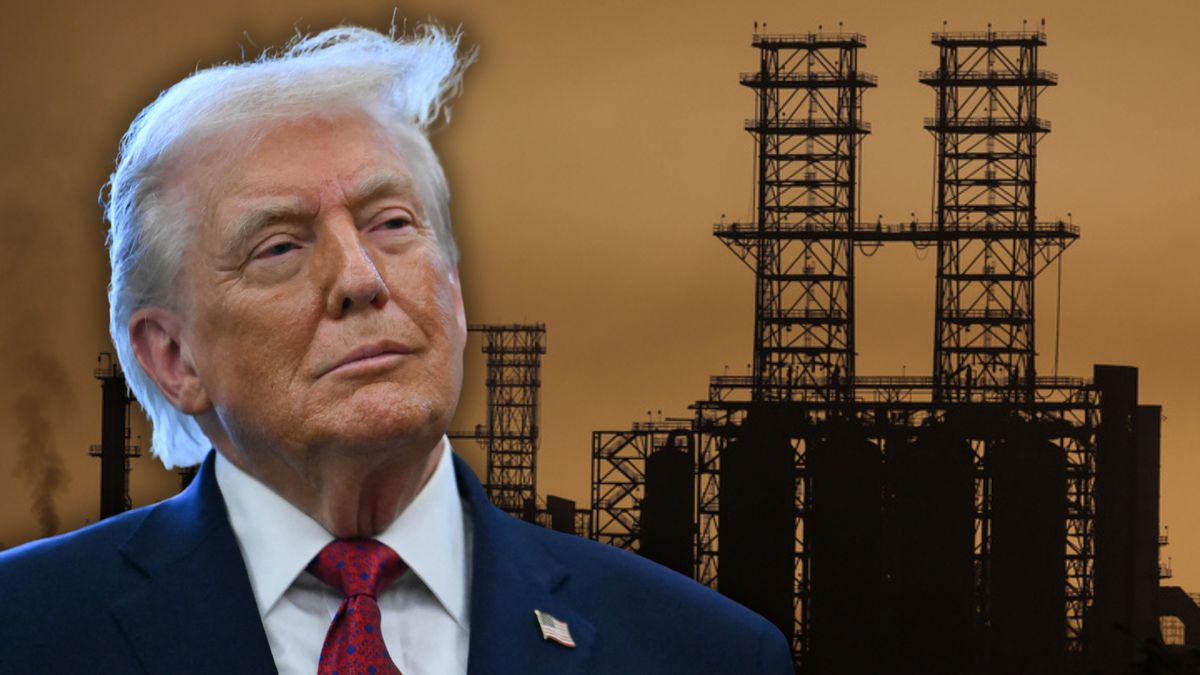
On Dec. 17, 2025, U.S. President Donald Trump claimed Venezuela "illegally took" U.S. oil.
Here's what he said, in response to a reporter asking about his blockade of "sanctioned oil tankers" into Venezuela:
REPORTER: Is the goal of the blockade with Venezuela — is it regime change?
TRUMP: Just a blockade. We're not gonna let anybody going through that shouldn't be going through. You remember, they took all of our energy rights, they took all of our oil, from not that long ago. And we want it back. But they took it, they illegally took it.
[…]
REPORTER: You mentioned getting land back from Venezuela — what land?
TRUMP: Getting land, oil rights, whatever we had. They took it away because we had a president that maybe wasn't watching, but they're not gonna do that. We want it back. They took our oil rights. We had a lot of oil there, as you know they threw our companies out, and we want it back.
A clip of the president's allegation spread on X, Facebook and TikTok.
His comments followed a Dec. 16 Truth Social post we previously covered, in which he demanded Venezuela "return to the United States all of the Oil, Land and other Assets that they previously stole from us."
Trump's comments
Venezuela's oil reserves belong, unequivocally, to Venezuela, due to the country's constitution and international law on the sovereign rights of a country over its own natural resources. Thus, Trump was wrong when he claimed Venezuela stole or "illegally took" U.S. oil. (It's unclear whether Venezuela seized literal barrels of oil, which could have theoretically been owned by the companies once taken out of the reserves, but the president's comments appeared to refer to the oil reserves, given his reference to "oil rights.")
As such, we have rated this claim mostly false. The White House did not respond to an inquiry that asked what law Trump believed Venezuela violated.
It is worth noting the question of whether Venezuela stole U.S. land and assets — as Trump claimed on Truth Social — has a less-clear answer. Experts we spoke to disagreed on whether Venezuela's seizure of land and assets was illegal. An international tribunal court has ruled in favor of at least one company's demands for compensation.
As of this writing, Venezuela has yet to pay, but U.S. law and sanctions make it impossible for the nation to do so, said Francisco Rodríguez, a Venezuelan economist at the University of Denver.
Trump has reportedly refused to rule out war with Venezuela amid his administration's claims the South American country is using oil revenue to fund "drug terrorism." (Experts agreed, without hesitation, that any use of force by Trump to recover U.S. oil industry-related assets would violate international law.)
Venezuelan oil belongs to Venezuela
It is a fundamental principle of international law: Countries have total ownership and control (in academic terms, "permanent sovereignty") over their own natural resources. That includes oil, said both Rodríguez and Milena Sterio, an expert in international law at Cleveland State University.
The rule is outlined in a 1962 United Nations resolution, "Permanent sovereignty over natural resources," which recognized the "inalienable right of all States freely to dispose of their natural wealth and resources in accordance with their national interests."
International law also recognizes that people and entities are subject to the laws of a nation they are physically located in. Venezuela's constitution, as active at the time, stated that the country owns its natural resources (translated via the Constitute Project, a database of global constitutions):
Article 12
Mineral and hydrocarbon deposits of any nature that exist within the territory of the nation, beneath the territorial sea bed, within the exclusive economic zone and on the continental shelf, are the property of the Republic, are of public domain, and therefore inalienable and not transferable. The seacoasts are public domain property.
Article 13
The territory shall never be assigned, transferred, leased or in any manner whatsoever conveyed, even temporarily or partially, to foreign States or other international law subjects.
What about the legal battles?
When Venezuela seized U.S. oil company assets, it offered compensation to the affected companies. Chevron agreed to strike a deal with the Venezuelan government. ExxonMobil's and ConocoPhillips did not, so the government moved their operations and assets to state-owned oil company Petroleos de Venezuela SA.
Legal battles ensued.
However, none of these legal battles contested Venezuela's ownership over its oil reserves (see the ExxonMobil decision here and ConocoPhillips decision here). Rodríguez called the very idea of that "ridiculous."
"That claim would've been laughed out of court if it was about oil," said Rodríguez, who is also the founder of Oil for Venezuela, a think tank focused on using Venezuela's oil wealth to solve issues facing the country.
Rodríguez noted that while the companies were U.S.-owned, the contracts were technically negotiated with Netherlands-based subsidiaries of the U.S. companies.
"If anyone should be claiming that something was stolen from him, it's King Willem-Alexander of the Netherlands," he said.
Did Venezuela illegally take U.S. land and assets?
International law allows countries to seize assets on their own land — as long as it is for a public purpose, is not discriminatory and proper compensation is given to the affected parties, said Sterio, the Cleveland State University professor. While the tribunal has already determined Venezuela owes compensation to ConocoPhillips, experts disagreed on whether that makes what Venezuela did illegal.
Marko Milanovic, professor of public international law at the University of Reading, argued that the seizure breached international investment law, as proven by the court decisions (see Page 182 of the ConocoPhillips decision). But Sterio said the fact Venezuela has not paid yet does not necessarily make the seizure itself illegal.
"If Venezuela ultimately does not pay, this could be a violation of the arbitration sentence, and there could be additional arbitral proceedings against Venezuela," Sterio said.
Rodríguez argued that the United States has "rendered Venezuela incapable" of paying the debt, which thus made Milanovic's argument moot. That's because the United States does not formally recognize the current party in control of Venezuela as the country's government and has imposed sanctions that prevent Venezuela from being able to transfer money to a U.S. bank account.
"If I'm walking down the street and someone comes and beats me up and leaves me unconscious, can I be arrested for obstructing traffic?" Rodríguez said.
In sum …
It's simply false to claim that the United States has any right to Venezuela's oil reserves, according to both international law and Venezuela's constitution. However, an international tribunal did rule that Venezuela did not provide appropriate compensation to the U.S.-owned oil companies affected by the country's oil industry nationalization efforts in 2007. Experts disagree on whether that means Venezuela violated international law regarding seizure of land and assets.
Snopes reporter Anna Rascoüet-Paz contributed to this report.