
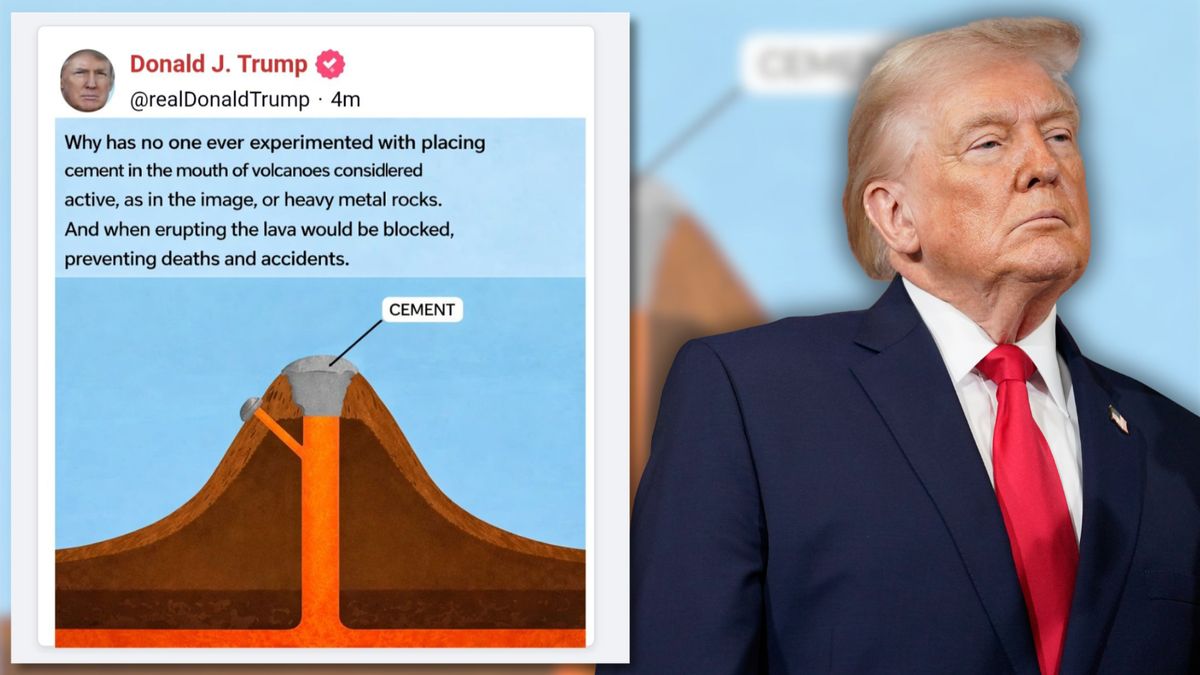
In February 2026, social media users shared an image claiming to show a Truth Social post from U.S. President Donald Trump, in which he allegedly wondered why no one had tried plugging volcanoes with cement to prevent eruptions.
Snopes readers asked whether Trump really shared the post.
A reverse image search found versions of the post circulating online since at least 2022, none of which were attributed to Trump. Someone altered the image circulating in 2026 to make it appear as though the president had posted it. As such, we've rated the image as fake.
For the record, filling a volcano with cement would not stop lava from escaping during an eruption.
Post appeared as early as 2022, not attributed to Trump
The text of the alleged post read:
Why has no one ever experimented with placing cement in the mouth of volcanoes considered active, as in the image, or heavy metal rocks. And when erupting the lava would be blocked, preventing deaths and accidents.
The attached image includes a mock diagram showing a cement plug over the top of a volcano and along a side chute.
The earliest version of the post attributed to Trump was shared on Feb. 11, 2026. However, no evidence of such a post exists on Trump's Truth Social account from that time.
Using Google's reverse image search tool, we found examples of the post dating as far back as June 2022. Those old images, however, did not credit the post to Trump. They were credited to a different user, whose name was blocked out.
Idea wouldn't work
While the idea of filling a volcano with cement might sound plausible at first, it's not scientifically sound. That's because most volcanoes already have a natural plug — it's just rock instead of cement.
When people think of a volcano, they often imagine a mountain with a fiery pit of lava at the top. While these lava lakes do exist on some volcanoes — Hawaii's Kilauea, for instance — they're quite rare. Most volcanic craters are filled with rocks and ash from previous eruptions. When a volcanic eruption happens, the magma is already breaking through a cap of rock.