
In mid-May 2026, a rumor spread online that the U.S. Transportation Security Administration had quietly decided to allow air travelers to carry medical marijuana in checked and carry-on bags.
The claim circulated on X, Facebook and Reddit. News outlets — including The Independent, the New York Post and Vice — also ran stories with headlines claiming that the TSA had updated its policies.
The TSA did update its webpage on medical marijuana in April 2026, prompting the online rumor. But the agency's "policy on medical marijuana has not changed," a TSA spokesperson confirmed to Snopes in a May 20 email.
The updates to the TSA's webpage didn't include any major changes to its medical marijuana rules, either. As of May 2026, it states that medical marijuana is allowed in checked and carry-on bags "with special instructions." That language is included on archived versions of the agency's webpage from as far back as 2019. The latest website update only removed some details regarding cannabis possession under federal law.
As such, we have rated this claim as mostly false.
Official TSA policy
As of this writing, it's still not legal to travel with most forms of cannabis, including almost all forms of medical marijuana. The TSA's webpage that says you can bring medical marijuana on a plane with "special instructions" includes one significant caveat:
TSA's screening procedures are focused on security and are designed to detect potential threats to aviation and passengers. Accordingly, TSA security officers do not search for illegal drugs, but if any illegal substance or evidence of criminal activity is discovered during security screening, TSA will refer the matter to a law enforcement officer.
In other words, TSA screening focuses on security threats rather than actively searching for drugs like marijuana. But as a federal agency, the TSA must abide by federal laws. If a TSA officer discovers illegal drugs during a screening, they may refer the matter to local law enforcement to determine any legal consequences.
The Washington Post spoke to lawyers in 2023 about what might happen if the TSA finds marijuana in your bag, which ranged from simply confiscating your stash to fines or criminal charges, depending on the amount you're carrying and whether medical marijuana is legal in your state.
"The final decision rests with the TSA officer on whether an item is allowed through the checkpoint," the TSA webpage reads.
Small change to TSA website prompts rumor
On April 27, 2026, the agency updated the medical marijuana page in its "What Can I Bring" section online by removing these two paragraphs about federal law:
Possession of marijuana and certain cannabis infused products, including some Cannabidiol (CBD) oil, remain illegal under federal law. TSA officers are required to report any suspected violations of law, including possession of marijuana and certain cannabis infused products.
Products/medications that contain hemp-derived CBD or are approved by the FDA are legal as long as it is produced within the regulations defined by the law under the Agriculture Improvement Act 2018.
The Agriculture Improvement Act, or 2018 farm bill, federally legalized hemp and hemp derivatives. Hemp, per its legal definition, is the part of a cannabis plant that contains less than 0.3% of delta-9 THC — the primary chemical compound in cannabis that gets people high.
Archived versions of the webpage on the Wayback Machine indicated that the TSA first updated its webpage sometime in mid-2019. Before then, the site said the agency prohibited carrying any medical marijuana products onto a plane.
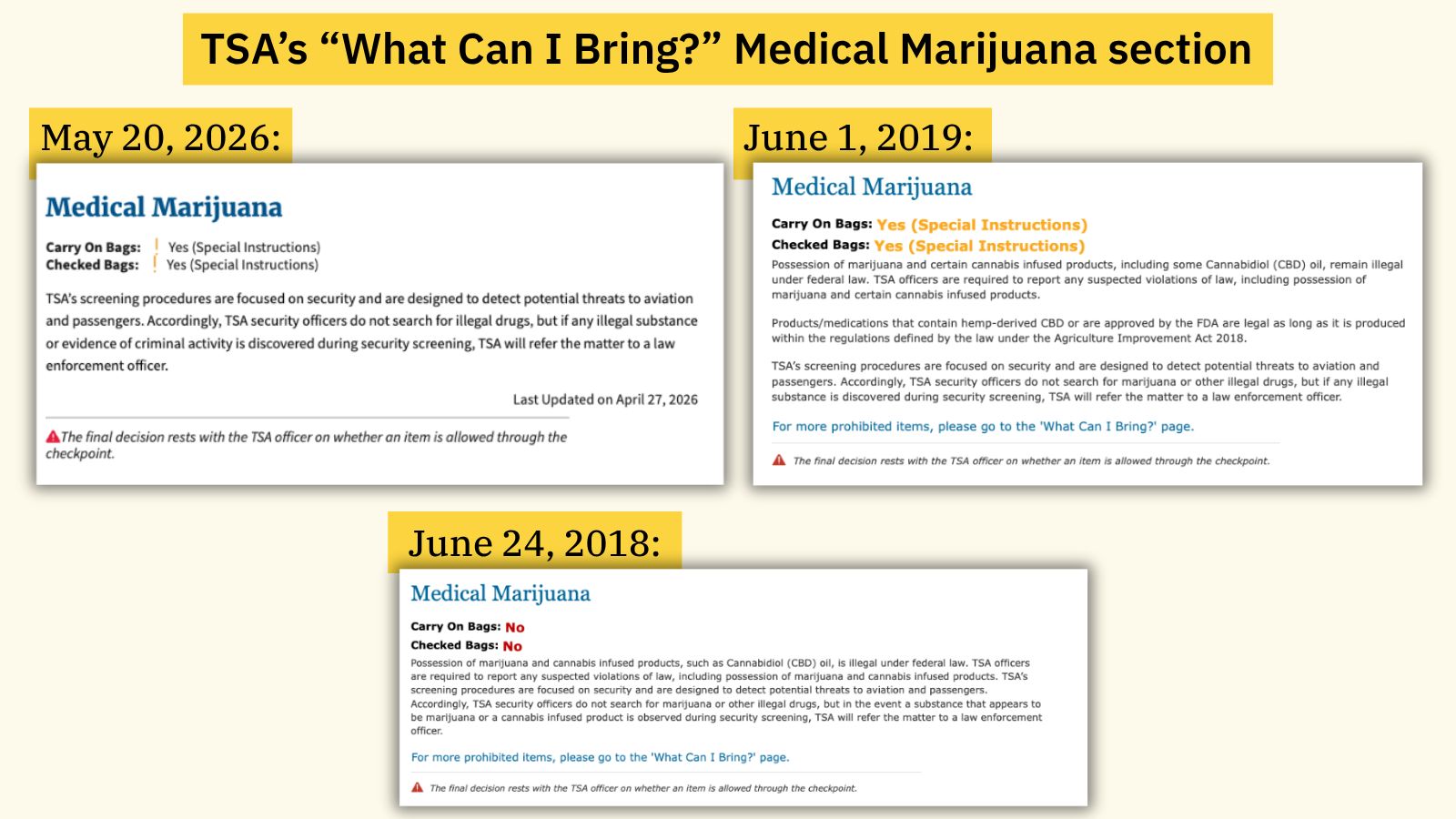
(TSA website accessed on Wayback Machine, illustrated by Snopes)
An NBC News story from May 2019 reported that the TSA made the change after learning about a drug approved by the Food and Drug Administration in June 2018 that contains CBD oil: epidiolex, which is used to treat seizures in children with epilepsy.
"To avoid confusion as to whether families can travel with this drug, TSA immediately updated TSA.gov once we became aware of the issue," NBC News reported the agency as saying.
The TSA said in its email to Snopes that it updates the website "for clarity and conciseness." However, the change comes on the heels of two major changes to federal cannabis policy.
The Department of Justice issued an order in April to reclassify state-licensed medical marijuana as a less-dangerous (but still illegal) drug. In December 2025, Congress also narrowed the definition of hemp in a law set to take effect in late 2026, affecting what products are federally legal.
In other words, federal marijuana policy is changing quickly, which may explain why the TSA does not want to list specific federal laws and regulations on its website.
The bottom line
So what does this mean for people trying to travel with medical marijuana? Essentially, nothing's changed at this point: If your medical marijuana is legal on the federal level — as in, it meets federal definitions of hemp, or it's FDA-approved — there's no issue. All other medical marijuana is not officially allowed.
While TSA officers aren't actively screening for marijuana, they may still report any illegal drugs they discover to law enforcement, leaving passengers subject to state and local laws.