
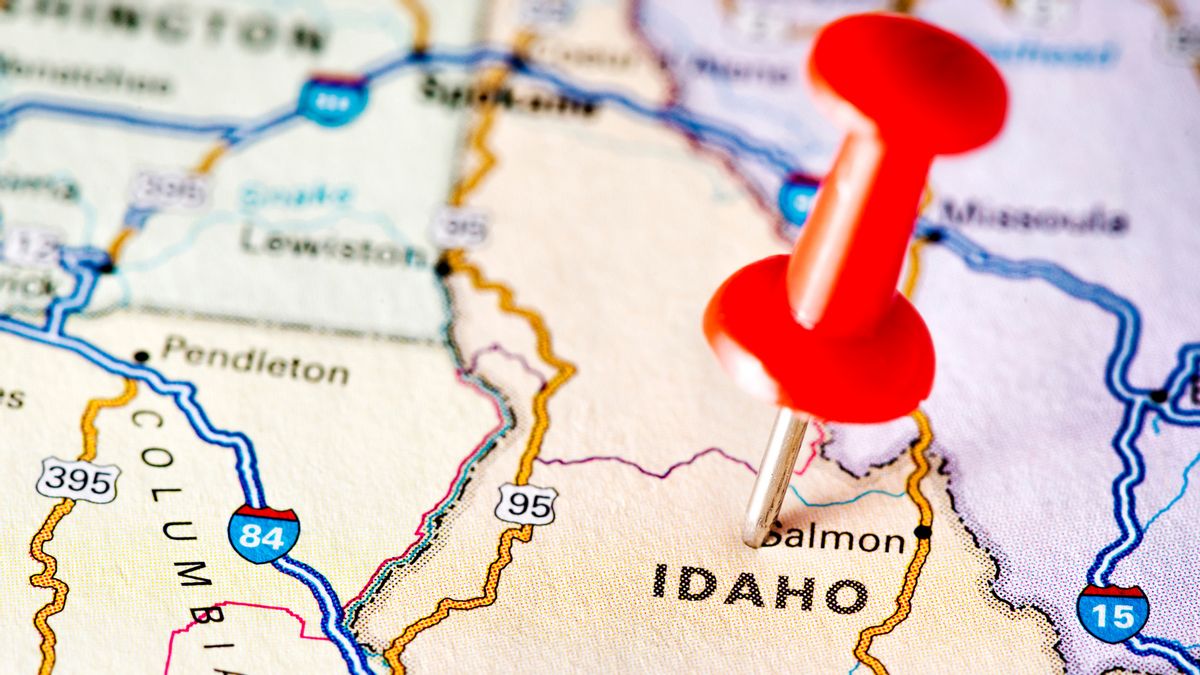
Social media posts have long claimed that cannibalism is legal in 49 U.S. states, often citing the absence of anti-cannibalism laws in every state except Idaho.

(BGatesIsaPsycho/X)
For example, on Feb. 8, 2025, an X account posted (archived) a video with the caption: "Hopefully we don't have to add bones to this. The number of States that legally permit cannibalism in America is insane." The video showed a map with the 49 U.S. states that allegedly allowed cannibalism colored in green and included a clip (archived) of Idaho state Rep. Heather Scott discussing a bill that would expand Idaho's ban on cannibalism
This post had more than 103,000 views as of this writing. Similar claims appeared elsewhere on TikTok (archived) and Facebook (archived).
While the claims included some accurate details, they oversimplified the issue and lacked necessary context. As a result, we've rated the claim that cannibalism is legal in 49 states a mixture of true and false information.
At the time of this writing, there was no federal law (archived) explicitly prohibiting cannibalism per se in the United States, and only one state, Idaho, specifically outlawed cannibalism. However, most (if not all) states have laws that make it effectively impossible to legally obtain and consume human body matter.
Cannibalism laws in Idaho
Idaho is the only U.S. state with a specific anti-cannibalism statute. Idaho Code Section 18-5003, which the legislature passed in 1990, was included in House Bill 817, a broader criminal law reform created in response to the November 1989 discovery in Minidoka County of "Baby X," a case allegedly connected to the ritualistic abuse of a child. The statute stated:
(1) Any person who wilfully ingests the flesh or blood of a human being is guilty of cannibalism.(2) It shall be an affirmative defense to a violation of the provisions of this section that the action was taken under extreme life-threatening conditions as the only apparent means of survival.(3) Cannibalism is punishable by imprisonment in the state prison not exceeding fourteen (14) years.
In 2024, Idaho lawmaker Rep. Heather Scott tried to expand the state's anti-cannibalism law to include prohibitions on giving someone human flesh without their knowledge or consent. During a Feb. 8, 2024, hearing at the House State Affairs Committee, she offered two reasons for the bill.
First, Scott cited concerns about human composting practices in neighboring states:
So a few years ago, back in 2019, I heard that Washington state was starting to do human composting and that disturbed me. So I wanted to address this because what I didn't want to see is bags of compost with human bone fragments.
While Washington state did become the first in the U.S. to legalize human composting in 2019, the process — also known as natural organic reduction — does not involve distributing human remains in a casual or unsafe manner. According to an article (archived) from Municipal Research and Services Center of Washington, human composting is a regulated method of turning human bodies into soil using controlled microbial activity. The process, overseen by licensed facilities, is intended as an environmentally friendly alternative to burial or cremation.
Scott also referenced a television program in which contestants were told they may have consumed human flesh, which she described as troubling:
I was on a plane this summer and I watched a video of some food show and the three contestants tasted the food and they had to guess what was in it. It was some kind of a sausage. And one of the options they told these people that was in the food was human flesh. And I thought this is going to be normalized at some point — the way our society's going and the direction we're going, this is going to be normalized.
The television program Scott referred to was an episode of "Fameless," a prank show created by comedian David Spade that aired on TruTV. In the episode, participants were misled into thinking they had unknowingly eaten human flesh as part of a cooking competition. The scenario was fictional and staged for comedic effect.
The bill passed the Idaho House but failed to progress in the Senate during the 2024 legislative session, effectively killing it.
Why cannibalism is effectively illegal elsewhere
Even without explicit anti-cannibalism laws, legal experts said the practice remains effectively impossible to engage in legally across all U.S. states due to overlapping criminal statutes.
"As a practical matter, there is no way for a cannibal to begin — or finish — his or her act without violating numerous laws, even though only Idaho has a law that explicitly outlaws cannibalism," said Robert M. Jarvis, a law professor at Nova Southeastern University who authored a comprehensive study of Idaho's anti-cannibalism statute.
Deborah W. Denno, a criminal law professor at Fordham Law School, explained that cannibalism cases are typically prosecuted under existing statutes. "In the vast majority of cannibalism cases, the person engaging in the cannibalism has been the one who's killed the victim, and so that's going to be covered under homicide," she said. "Desecration of a corpse,
The legal barriers fall into several categories:
Corpse desecration statutes address the handling of human remains. Most states have laws prohibiting the abuse, mutilation or improper handling of dead bodies. For example, Oklahoma's Title 21, Section 1161.1 makes it a felony to desecrate a corpse, while New Jersey's Title 2C, Section 22‑1 classifies unlawfully disturbing human remains as a second-degree crime.
Grave-robbing laws criminalize the unauthorized removal of bodies from burial sites, as seen in Louisiana Revised Statute 8, Section 653, p
Organ donation laws also prohibit legal cannibalistic consumption. Under the Uniform Anatomical Gift Act, which all states have adopted in some form, organ donations are restricted to specific purposes such as transplantation, research or education. When asked whether someone could donate an organ specifically for another person to consume, Jarvis said such a donation would be illegal because it has "not been authorized by the government. The UAGA is very specific as to who, and for what reason, a person can gift their remains."
Consent provides no legal protection. Jarvis explained that the law operates under "the irrefutable assumption that no sane person would agree to be eaten," making any claimed consent legally invalid
Religious exemptions do not apply to cannibalistic practices. When asked about potential spiritual justifications, Jarvis noted that while the First Amendment protects religious beliefs, "it does not protect religious acts that are illegal." He added that "no recognized religion currently includes a practice of eating the dead," making religious defenses unlikely to succeed in court.
The legal framework has been tested in
More recently, actor Armie Hammer faced public scrutiny (archived) over allegations involving cannibalistic fantasies, though no criminal charges were filed. The case demonstrated how cannibalism remains a significant cultural taboo regardless of legal technicalities.
In sum …
While the technical claim that 49 states lack explicit cannibalism laws was accurate, the broader implication that cannibalism is "legal" in those states was false and misleading. The absence of specific anti-cannibalism statutes does not mean the practice is legal, as other laws make it effectively impossible to legally engage in cannibalism anywhere in the United States.
Snopes has previously investigated other claims related to cannibalism, including rumors that Homeland Security Secretary Kristi Noem said a cannibal tried to eat himself on a deportation flight, that former President Joe Biden said his uncle was eaten by cannibals and that Tokyo opened the first human meat restaurant.