
On June 7, 2025, U.S. Vice President JD Vance claimed that for every dollar the U.S. government spent on humanitarian aid, only 12 cents reached people in need.
"Marco Rubio, who's secretary of state — he's a very good friend — what he told me is that his best estimate after he had his team look at it is that 88 cents of every dollar was actually being collected by middlemen," Vance said on "This Past Weekend w/ Theo Von," a podcast with the American comedian (at 28:57). "So every dollar we were spending on humanitarian assistance, 12 cents was actually making it to people who needed it."
Rubio, as Vance said, has repeatedly cited a similar data point. For example, he said in a Feb. 4, 2025, news conference, that in "some cases with USAID, 10, 12, 13%, maybe less, of the money was actually reaching the recipient, and the rest was going into the overhead and the bureaucracy" (see 23:18). On May 20, 2025, Rubio claimed in a Senate committee hearing that "at USAID, 12 cents of every dollar was reaching the recipient" (see 5:09).
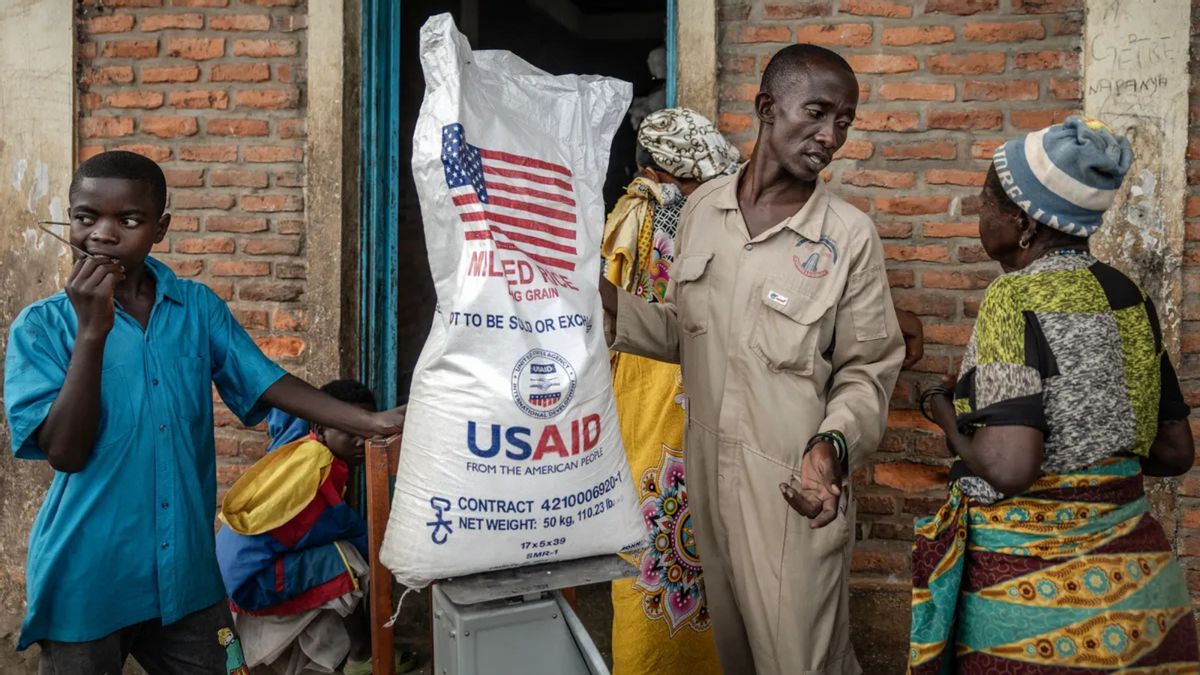
Rubio was referring to the U.S. Agency for International Development, which distributes humanitarian aid around the world. U.S. President Donald Trump's administration attempted to dismantle USAID in the first few months of his second term; globally, former beneficiaries continue to feel the effects of the White House's cuts to USAID, per reporting from reputable outlets. Similar claims, with numbers ranging from less than 10% to 30%, have spread online for months, including via tech billionaire Elon Musk and Republican lawmakers.
Snopes reached out to Rubio and Vance to confirm that their source is the January 2024 report and await responses.
It is also worth noting that USAID did not oversee all of the United States' foreign aid; according to the government's foreign assistance database,
How USAID money gets spent
According to a 2024 analysis by the nonpartisan Congressional Research Service, most USAID money was funneled through what are called "implementing partners" — third parties that include "private contractors, nonprofit organizations, foreign governments, international organizations, and other U.S. government agencies."
That included groups like the United Nations Children's Fund, the Red Cross and the Catholic Relief Services; in other words, USAID often works with organizations not based in the locality the project may be based in and therefore not part of the 12.1% statistic. A good chunk of the money — more than $1 billion in fiscal year 2024 — also went to American small businesses who deliver resources and services to foreign countries.
"A key reason USAID relies on American and multilateral intermediaries is to protect against fraud and corruption. The agency demands that its partners provide a detailed paper trail to account for every dollar spent—creating administrative hurdles that few local organizations can clear," wrote Rachel Bonnifield and Justin Sandefur of the Center for Global Development, a think-tank based in Washington, D.C., focused on international economic research.
The 2024 CRS analysis determined that from fiscal year 2013 to 2022, only 7.7% of USAID's funds were spent on "administrative costs," defined as the salaries and benefits of USAID direct hires and "all costs not related to a specific project," including costs that are "inherently governmental or part of the cost of doing business." But that percentage, per the analysis, does not include the administrative costs of USAID's partners (see "Administrative Costs").
It is difficult to determine how much money these intermediaries spend on administrative and operating costs, compared to direct assistance. However, it is possible to look at case studies to definitively show that at least for some of USAID's largest partners, the bulk of spending made its way to people in need.
For example, in fiscal year 2023, at
In turn, as first reported on by Bonnifield and Sandefur, Gavi and The Global Fund both spent less than 10% of their overall funding on operating and overhead expenses in 2023, meaning more than 90% went directly to delivering supplies and health services. (See Page 14 of Gavi's
To summarize, claims made by prominent lawmakers like Vance and Rubio that suggest approximately 12% of USAID spending reached the intended recipient are simply not true and based on a misrepresentation of data collected by USAID on the percentage of local groups it sends funding to. USAID may have channeled much of its money through intermediaries, but that does not mean the majority of USAID's money was spent on overhead and operating costs.